
AP Computer Science Unit 1 – Test Review Practice Questions
$69.00
- Buy to unlock unlimited access to all Quiz questions.
- After purchase you can print a PDF of the whole quiz at any point. The PDF will contain the questions and the correct answers.
About this Exam
The AP Computer Science A course introduces students to the foundational concepts of computer science using the Java programming language. Unit 1, focusing on Primitive Types, is the crucial starting point. This initial unit and its corresponding test are designed for high school students new to object-oriented programming. It provides the essential building blocks for understanding how computers store and manipulate data, setting the stage for all future units. Excelling on this unit test demonstrates a solid grasp of fundamental programming concepts and builds confidence for the remainder of the AP course.
Ready to test your knowledge?
Buy Now to Access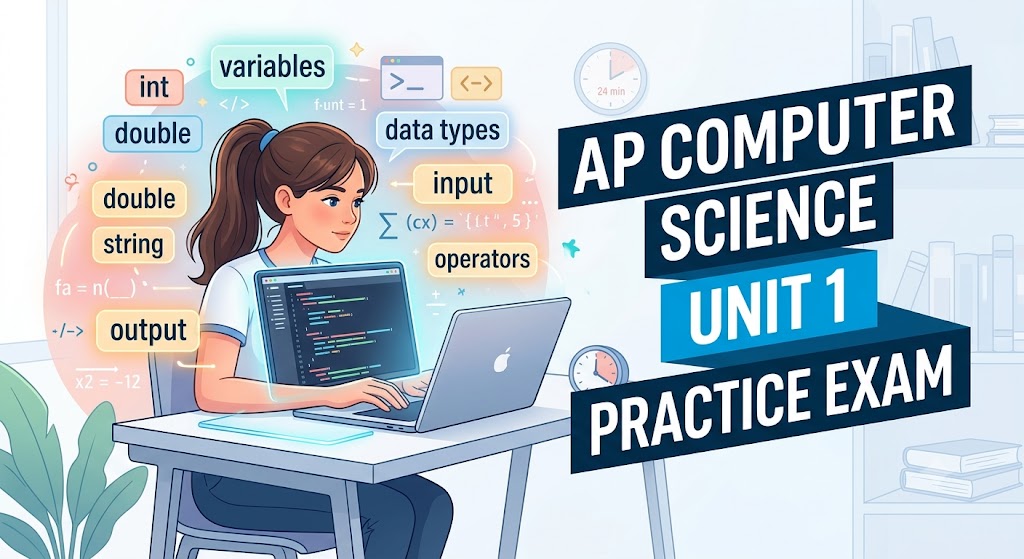
Additional Information
What the Course Entails and Exam Details
Unit 1 lays the bedrock of programming in Java. A thorough review for the unit test involves mastering several core topics:
Understanding Data Types: Distinguishing between different primitive types and their uses.
Variables and Identifiers: Learning how to declare, initialize, and manage variables using meaningful names.
The 'final' Keyword: Grasping the concept of constants and their application.
Arithmetic Operators: Mastering basic mathematical operations and their precedence in code.
Casting and Overflow: Understanding how Java handles type conversions and data limits.
Input and Output: Practical knowledge of using the Scanner class for user input and System.out.print for displaying results.
This unit test typically encompasses these primary learning objectives and skills, forming the essential toolkit for any Java programmer.
What to Expect in the Final Exam
While the full AP Computer Science A exam is a comprehensive assessment, individual unit tests, like the Unit 1 Test, are more focused in scope. This test usually mirrors the official AP exam format, combining multiple-choice questions with potential short free-response coding exercises.
Format: You can anticipate a section of multiple-choice questions testing conceptual understanding, code tracing, and error identification. There may also be a free-response section requiring you to write small snippets of valid Java code to solve simple problems.
Time Limit: Unit tests are generally timed to fit within a single class period, typically 45-60 minutes, mirroring the time pressure of the actual AP exam sections.
Passing Score: Success is typically measured by a high percentage score, with scores of 80% or above indicating a strong understanding.
Specific Rules: Similar to the AP exam, the use of calculators or outside resources is generally prohibited. Your primary tools will be your knowledge of Java syntax and logical problem-solving abilities.
How to Study and Exam Centers
Effective preparation for the AP Computer Science Unit 1 test requires a mix of conceptual review and practical coding practice:
Work Through Practice Questions: Dedicated practice is key. Seek out comprehensive AP Computer Science Unit 1 practice exams and review questions to test your knowledge and identify areas needing improvement.
Trace Code Manually: Actively "trace" code snippets on paper, determining the value of variables at each step. This strengthens logical thinking and error detection skills.
Write Code: Don't just read about programming; actually write Java code. Practice declaring variables, performing calculations, and handling input/output in a simple IDE or online compiler.
Review Class Notes and Textbook: Solidify your understanding of key terms, syntax rules, and primitive type limitations from your course materials.
Utilize AP Classroom: Use the resources and progress checks provided by your teacher through the College Board's AP Classroom portal.
As this is a unit test, it will typically be administered directly in your high school classroom by your AP Computer Science teacher. The full AP Computer Science A Exam in May is administered at authorized schools and test centers worldwide; this practice exam prepares you specifically for the foundational content.
Job Opportunities from the Course
Mastering the fundamentals in AP Computer Science A, starting with Unit 1, unlocks a vast array of high-demand and rewarding career paths in technology. This course provides the prerequisite skills for roles such as:
Software Engineer
Web Developer
Mobile Application Developer
Data Scientist
Game Developer
Systems Analyst
Cloud Engineer
AI/Machine Learning Engineer
Computer Science Educator
Frequently Asked Questions
Reviews
5.0
Based on 0 reviews
Leave a Review
No reviews yet. Be the first to review!