
AP Computer Science Practice Exam
$69.00
- Buy to unlock unlimited access to all Quiz questions.
- After purchase you can print a PDF of the whole quiz at any point. The PDF will contain the questions and the correct answers.
About this Exam
The Advanced Placement (AP) Computer Science A exam is a pivotal assessment designed for high school students who wish to earn college credit or advanced placement in a university-level computer science course. This rigorous exam evaluates proficiency in fundamental computer science concepts using the Java programming language. It is ideal for students with a strong interest in logical reasoning, problem-solving, and the foundational aspects of software development and algorithm design. Achieving a high score on this practice exam—and subsequently the final AP exam—demonstrates a commitment to technological literacy and provides a head start in computer science and engineering degree programs.
Ready to test your knowledge?
Buy Now to Access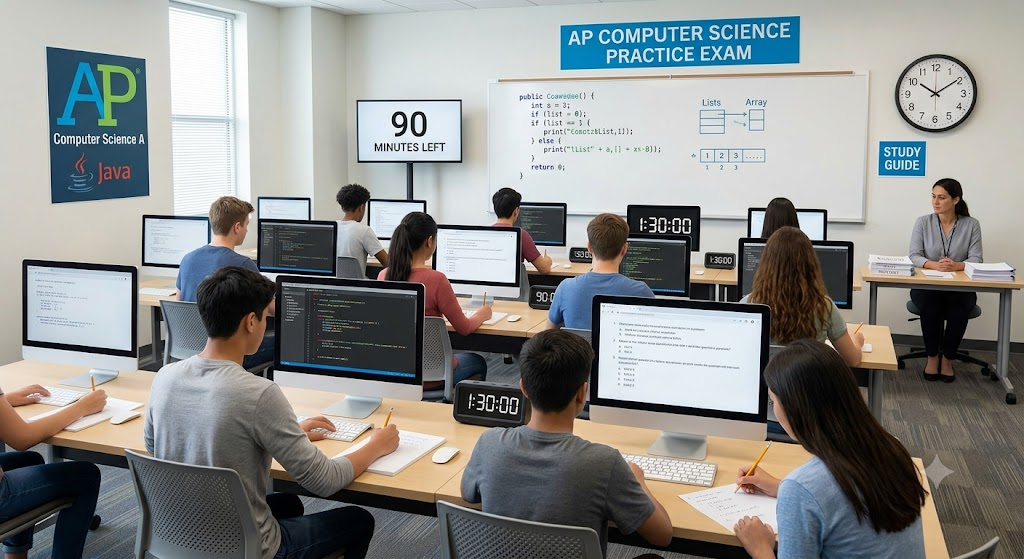
Additional Information
What the Course Entails and Exam Details
The course curriculum focuses heavily on the development and analysis of algorithms, the standard data structures, and object-oriented programming methodologies. Key areas covered include Java syntax, program design, code implementation, and testing. Students learn to read, write, and analyze code that involves basic data structures like arrays, lists, and two-dimensional arrays, as well as recursion and standard algorithms for searching and sorting.
The practice exam mirrors this breadth, assessing a student's ability to interpret and manipulate code in these critical areas. Understanding object-oriented design is paramount, as students will be expected to create, debug, and trace Java classes that solve specific problems. Ethical computing practices and responsible use of technology are also integrated into the overall learning objectives.
What to Expect in the Final Exam
The actual AP Computer Science A exam is divided into two sections, each contributing 50% to the final score:
Section I: Multiple-Choice Questions (MCQs): This section contains 40 multiple-choice questions that evaluate your ability to understand and analyze Java code. You will have 1 hour and 30 minutes to complete this section. Questions assess fundamental topics like variable types, arithmetic expressions, method implementation, control structures, inheritance, and recursion. It is designed to test depth of knowledge across the entire AP curriculum.
Section II: Free-Response Questions (FRQs): The free-response section consists of four mandatory, open-ended questions which must be solved in 1 hour and 30 minutes. Students are required to write entire Java methods or classes from scratch to solve specific, complex problems. The topics for the FRQs are often predictable, covering specific curricular requirements such as ArrayLists, two-dimensional arrays, class creation, and data manipulation, which demands strong syntactical precision and structured problem-solving skills.
The final AP score is reported on a 1-5 scale, where a score of 3 or higher is typically considered passing for college credit by many institutions. A strong performance on practice exams is an excellent indicator of readiness for this challenging format.
How to Study and Exam Centers
Preparation for the AP Computer Science Practice Exam requires a consistent, hands-on approach. Here are actionable study strategies:
Master Java Fundamentals: Ensure you have a crystal-clear understanding of Java variables, data types, loops, arrays, and standard ArrayList manipulation methods. Practice coding these daily.
Utilize Official Resources: Leverage AP Classroom materials provided by the College Board, including official progress checks and past free-response questions. Analyze the scoring guidelines meticulously for past FRQs to understand what scorers are looking for.
Take Timed Practice Tests: Use comprehensive AP Computer Science practice exams to simulate the exact conditions of the test. Practice both the 90-minute multiple-choice section and the 90-minute free-response section in separate sessions to build stamina and time management skills.
Focus on Object-Oriented Design: Create and debug multiple Java classes involving inheritance and polymorphism. This is a crucial, high-yield topic for both sections of the exam.
Identify Weak Points: Review incorrect answers on practice questions rigorously. Dedicate extra time to challenging concepts like recursion, nested loops, or array traversing until you can explain the solution clearly.
The final AP Computer Science A exam is administered globally in registered schools and approved testing centers on specific dates, usually in early May. Students taking the exam must coordinate with their high school AP Coordinator or local test center for registration and logistics. Official practice materials and practice tests are often accessed via the College Board's online student portal, AP Classroom.
Job Opportunities from the Course
A strong score on the AP Computer Science exam is a foundational step, but it is not a direct job certification. However, mastering these foundational skills unlocks numerous advanced academic pathways and subsequent career opportunities in technology:
Computer Science Student (University Degree)
Junior Software Developer
Junior Web Developer
Mobile Application Developer (Junior)
QA Analyst or Software Tester
Data Analyst (Entry-Level)
Front-End Developer (Junior)
Back-End Developer (Junior)
Technical Support Specialist (IT)
Research Assistant in Computing
Achieving high performance on this practice exam validates your potential for success in these exciting fields.
Frequently Asked Questions
Reviews
5.0
Based on 0 reviews
Leave a Review
No reviews yet. Be the first to review!