
AP Chemistry Unit 4 Practice Test 2026 (Chemical Reactions)
$69.00
- Buy to unlock unlimited access to all Quiz questions.
- After purchase you can print a PDF of the whole quiz at any point. The PDF will contain the questions and the correct answers.
About this Exam
The Advanced Placement (AP) Chemistry examination is a rigorous assessment administered by the College Board, designed to measure high school students' college-level understanding of fundamental chemical principles and their application. Unit 4, focusing specifically on Chemical Reactions, is a cornerstone of this course, exploring the transformations and interactions that define chemical behavior. This AP Chemistry Unit 4 Practice Test 2026 is an indispensable tool for students seeking to gauge their comprehension and readiness for the actual AP exam.
It provides a representative sampling of question types and content depth, allowing learners to identify areas of strength and those requiring further study before facing the high-stakes final assessment. This practice test is tailor-made for dedicated AP Chemistry students across the country who are striving for excellence and aiming to achieve a score of 4 or 5, thereby earning college credit and advanced placement in science-related fields. Prepare effectively and boost your confidence with this comprehensive review of chemical reactions.
Ready to test your knowledge?
Buy Now to Access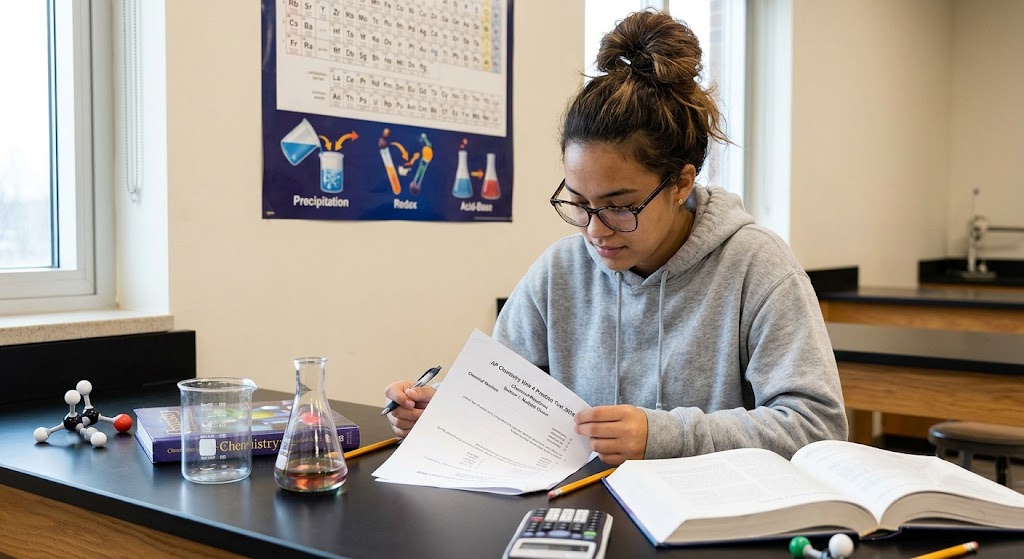
Additional Information
What the Course Entails and Exam Details
Unit 4: Chemical Reactions covers essential topics critical for mastering the principles of chemistry. Students will dive deep into analyzing and categorizing diverse chemical processes. They will learn to write balanced chemical equations and net ionic equations, which accurately represent the changes occurring at the molecular and ionic levels. Understanding Stoichiometry, including mole-to-mole and mass-to-mass calculations, is a key component, enabling students to predict reactant usage and product formation with precision.
The course covers various types of chemical reactions, such as precipitation reactions, acid-base neutralizations, and oxidation-reduction (redox) reactions, exploring the underlying electron transfer and dynamic nature of these transformations. Furthermore, students will engage with laboratory scenarios and real-world applications related to chemical reactions, reinforcing the practical relevance of these concepts. Mastery of these fundamental topics is essential for success in later units and throughout the entire AP Chemistry curriculum, laying the foundation for a strong scientific education.
What to Expect in the Final Exam
The actual AP Chemistry Exam is a multi-part, comprehensive assessment that takes place in May each year. It is divided into two main sections: Multiple Choice and Free Response. The entire examination lasts 3 hours and 15 minutes. The Multiple Choice section, consisting of 60 questions, contributes to 50% of the overall score. Students are typically given 90 minutes to complete this section.
The Free Response section, also accounting for 50% of the score, contains 7 questions: 3 long questions and 4 short questions. This section is 105 minutes long. A graphic calculator is allowed for both sections of the exam, facilitating complex calculations related to stoichiometry, thermodynamics, and equilibria. The final score is reported on a scale of 1 to 5, with scores of 3 or higher generally considered qualifying for college credit and advanced placement at many institutions worldwide. Students can expect challenging questions that test their analytical thinking, conceptual understanding, and ability to apply chemical principles to solve novel problems.
How to Study and Exam Centers
Effective preparation is key to conquering the AP Chemistry Exam. We recommend developing a structured study plan early. Review class notes consistently, complete all textbook assignments diligently, and solve numerous practice problems in every topic area. Utilize official College Board resources, including past exam questions, AP Classroom materials, and sample syllabi to familiarize yourself with the exam format and expectations. Form study groups to discuss complex topics with peers. Actively practice writing balanced equations and performing calculations for limiting reactants, theoretical yield, and titration stoichiometry.
Engage in hands-on laboratory experiences whenever possible to deepen your conceptual understanding and experimental skills. Create flashcards for reaction types, definitions, and key formulas. Regarding exam logistics, students should coordinate with their school's designated AP Coordinator for registration information, key dates, and location details. The actual AP exams are administered at the student’s high school or at a nearby high school authorized by the College Board. For comprehensive guidelines, access the official AP student website or speak with your AP Chemistry teacher for personalized support and guidance throughout your journey.
Job Opportunities from the Course
A strong foundation in chemistry, demonstrated through excellent performance in AP Chemistry, unlocks a wide array of fascinating and rewarding career possibilities in numerous fields. The analytical, problem-solving, and laboratory skills developed through this course are highly valued by employers across diverse industries, from healthcare and research to environmental protection and technological innovation. Pursuing studies and careers in chemistry-related disciplines offers a path to fulfilling professional lives and significant societal contributions. Here are just a few job titles that stem from a chemistry education:
Chemical Engineer: Designs and develops chemical processes and products, applying principles of chemistry, physics, mathematics, and economics.
Biochemist: Studies the chemical principles of living organisms and biological processes, with applications in medicine, agriculture, and biotechnology.
Pharmacist: Prepares and dispenses medications, ensuring safe and effective use, and providing patient education.
Forensic Scientist: Applies scientific principles, including chemistry, to analyze physical evidence in criminal investigations.
Research Scientist: Conducts experiments and analyzes data in various fields, contributing to scientific knowledge and innovation.
Environmental Scientist: Studies the environment, addresses environmental challenges, and promotes sustainable solutions using scientific principles.
Chemistry Teacher/Professor: Educates and inspires students about the principles and wonders of chemistry at the high school or collegiate level.
Doctor/Physician: Utilizes chemistry knowledge, particularly in areas like pharmacology and biochemistry, to diagnose and treat illnesses.
Laboratory Technician: Performs tests and procedures in a laboratory setting, ensuring accuracy and efficiency under scientific supervision.
Quality Control Analyst: Monitors and maintains the quality of chemical products and processes through testing and analysis.
Frequently Asked Questions
Reviews
5.0
Based on 0 reviews
Leave a Review
No reviews yet. Be the first to review!