
AP Chemistry Unit 3 Practice Test 2026 Properties of Substances and Mixtures
$69.00
- Buy to unlock unlimited access to all Quiz questions.
- After purchase you can print a PDF of the whole quiz at any point. The PDF will contain the questions and the correct answers.
About this Exam
Welcome to your comprehensive guide and preparation resource for the AP Chemistry Unit 3 Properties of Substances and Mixtures Practice Exam for 2026. This practice test is specifically designed for high school students enrolled in Advanced Placement (AP) Chemistry who are looking to solidify their understanding of the fundamental concepts within Unit 3. Whether you're aiming for a top score on the final College Board exam or simply seeking to master this challenging material, this simulated test will provide invaluable practice and build your confidence. Our goal is to equip you with the essential knowledge and skills needed to navigate properties of matter and mixtures effectively. This course and exam are essential for students pursuing future studies in science, technology, engineering, and mathematics (STEM) fields, providing a rigorous introduction to college-level chemistry principles.
Ready to test your knowledge?
Buy Now to Access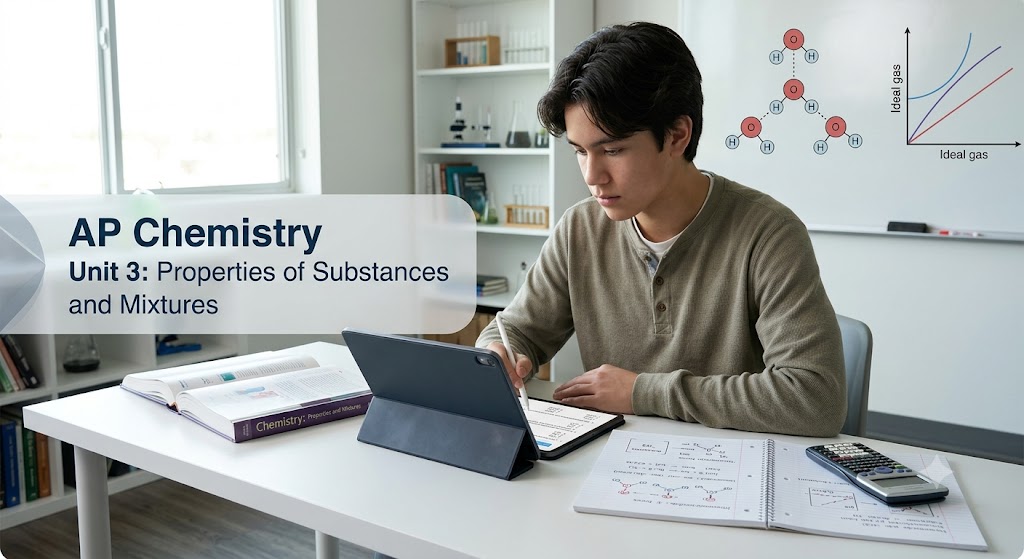
Additional Information
What the Course Entails and Exam Details
Unit 3 of AP Chemistry digs deep into the relationships between molecular structure and the physical properties of substances, as well as the behavior of mixtures. Students will explore a wide array of topics, including intermolecular forces (IMFs) such as dipole-dipole interactions, London dispersion forces, and hydrogen bonding. You will learn to predict properties like boiling points, vapor pressures, and solubility based on these interactions. The course covers different types of solids (ionic, metallic, covalent network, molecular) and their characteristic properties. Additionally, the gaseous state is thoroughly examined, with a focus on the ideal gas law, kinetic molecular theory, and real gas behavior. Finally, the properties of mixtures, including solutions and their concentrations (like molarity), are studied, emphasizing concepts of solubility and intermolecular interactions. Understanding these topics is key for interpreting phenomena in labs and real-world chemical applications.
What to Expect in the Final Exam
While this practice test simulates the format and difficulty of Unit 3 questions, it's crucial to understand how this content relates to the final AP Chemistry exam. The actual College Board final exam is divided into two main sections: Section I (Multiple Choice) and Section II (Free Response). Content from Unit 3, specifically on Intermolecular Forces and Properties, often appears in both sections. Section I contains 60 multiple-choice questions with a total time of 90 minutes. Section II consists of 7 free-response questions, including 3 long questions and 4 short questions, with a total time of 105 minutes. A calculator is allowed only on the free-response section. The final scaled score (ranging from 1 to 5) determines potential college credit. Unit 3 material forms a substantial portion of the knowledge base tested across both sections, making mastery of these topics imperative for success.
How to Study and Exam Centers
Effective studying for the AP Chemistry Unit 3 properties test requires a multifaceted approach. We highly recommend reviewing your class notes, textbook chapters, and all lab experiments related to intermolecular forces, states of matter, and solutions. Utilize online resources like Khan Academy, and consider investment in reputable AP review books (e.g., Barron’s, Princeton Review). Practice is absolutely critical; solve many practice problems, both multiple-choice and free-response, focusing on understanding the "why" behind correct answers. Review past AP FRQs from the College Board website and study their scoring guidelines. Form study groups to discuss challenging concepts and test each other. As for exam centers, please note that this specific practice test does not take place in a certified testing center. However, the official AP Chemistry final exam is administered by authorized schools and test centers worldwide, and registration is typically facilitated through your high school's AP coordinator.
Job Opportunities from the Course
A strong understanding of AP Chemistry principles, starting with foundational units like Properties of Substances and Mixtures, opens doors to numerous rewarding career paths in STEM. Below are specific job titles and career avenues that this course content begins to unlock:
Chemical Engineer
Biomedical Engineer
Pharmacist
Medical Doctor (requires extensive pre-med study)
Toxicologist
Materials Scientist
Forensic Scientist
Environmental Scientist
Clinical Biochemist
Analytical Chemist
Food Scientist
Quality Control Inspector
Science Writer
Chemistry Teacher (Secondary)
Industrial Hygienist
Frequently Asked Questions
Reviews
5.0
Based on 0 reviews
Leave a Review
No reviews yet. Be the first to review!