
AP Chemistry Unit 2 Practice Test 2026 (Compound Structure and Properties)
$69.00
- Buy to unlock unlimited access to all Quiz questions.
- After purchase you can print a PDF of the whole quiz at any point. The PDF will contain the questions and the correct answers.
About this Exam
The AP Chemistry course is a rigorous, college-level introduction to the fundamental principles of chemistry. It is designed for highly motivated high school students who wish to pursue careers in science, technology, engineering, or mathematics (STEM) fields. Success in this course can earn students college credit, advanced placement, or both. Unit 2 specifically focuses on Compound Structure and Properties, exploring the atomic-level forces that define the physical and chemical behavior of substances. This practice test is an essential diagnostic tool for students targeting a 5 on the final AP Exam.
Ready to test your knowledge?
Buy Now to Access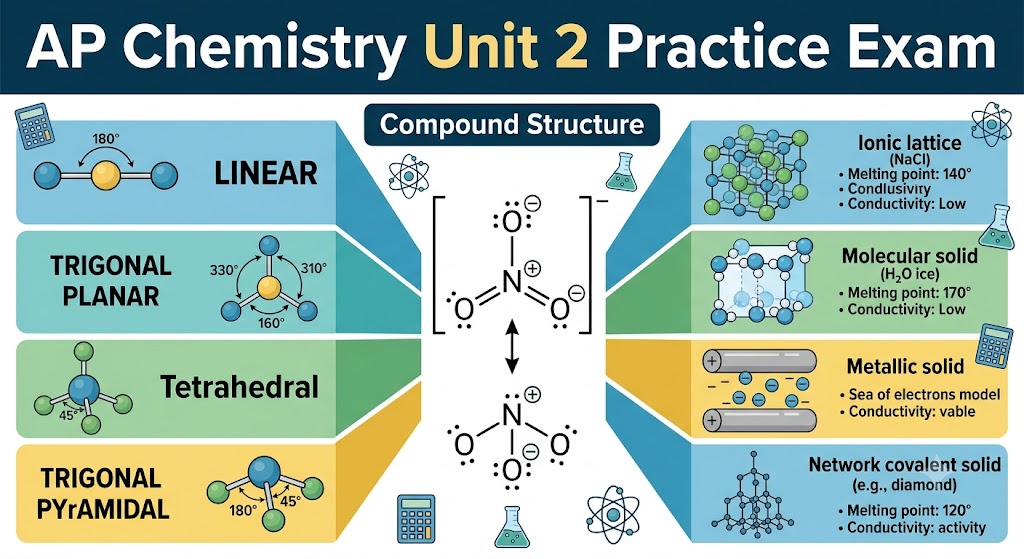
Additional Information
What the Course Entails and Exam Details
Unit 2 represents approximately 18–22% of the final exam score. This comprehensive practice test covers all crucial topics within the Compound Structure and Properties syllabus:
Types of Chemical Bonds: Distinguishing between ionic, covalent (polar and nonpolar), and metallic bonding based on electronegativity.
Structure of Solids: Understanding the properties of ionic solids, metallic solids, covalent network solids, and molecular solids.
Lewis Structures & Formal Charge: Master the art of drawing Lewis diagrams, calculating formal charges, and identifying the most plausible structures.
Resonance and Hybridization: Recognizing resonance structures and understanding the concept of orbital hybridization (sp, sp², sp³) in molecular geometry.
VSEPR Theory: Predicting the three-dimensional shapes, bond angles, and polarity of molecules using the Valence Shell Electron Pair Repulsion model.
What to Expect in the Final Exam
While this practice test focuses on Unit 2, the final AP Chemistry Exam administered by the College Board is a comprehensive, three-and-a-quarter-hour assessment. It consists of two sections:
Section I: Multiple Choice Questions (MCQ): You will have 90 minutes to answer 60 questions. This section accounts for 50% of your total score and tests your ability to recall facts, interpret data, and solve problems across all course units.
Section II: Free Response Questions (FRQ): You will have 1 hour and 45 minutes to answer 7 questions (3 long-answer and 4 short-answer). This section also accounts for 50% of your score and requires you to explain phenomena, design experiments, and perform calculations.
A score of 3 is generally considered passing, while many competitive universities require a score of 4 or 5 to award college credit.
How to Study and Exam Centers
The most effective way to study is through active practice. Use this Unit 2 practice test to identify your weak points. We highly recommend creating summary sheets for complex theories like VSEPR shapes, formal charge rules, and solid types. Don’t just memorize definitions; focus on why structure determines properties (e.g., why ionic solids have high melting points). Consistent revision and practice of past AP Free Response questions are vital for success.
The final AP Chemistry Exam is not taken online or at third-party testing centers. It is administered directly at your high school or an authorized nearby school. Speak with your school’s AP Coordinator to register and ensure you are aware of the exact date, location, and required materials for your exam.
Job Opportunities from the Course
A strong performance in AP Chemistry lays the foundation for numerous high-demand, prestigious career paths. It is the first step towards specialization in fields such as:
Analytical Chemist
Biotechnologist
Chemical Engineer
Environmental Scientist
Food Scientist
Forensic Scientist
Medicinal Chemist
Pharmacologist
Research Scientist
Science Educator
By mastering the principles in Unit 2, you are unlocking the microscopic world that governs the creation of new medicines, the development of sustainable energy, and the understanding of materials that shape our future. Good luck!
Frequently Asked Questions
Reviews
5.0
Based on 0 reviews
Leave a Review
No reviews yet. Be the first to review!