
AP Chemistry Exam Unit 7 Practice Test 2026 (Equilibrium)
$69.00
- Buy to unlock unlimited access to all Quiz questions.
- After purchase you can print a PDF of the whole quiz at any point. The PDF will contain the questions and the correct answers.
About this Exam
The AP Chemistry Unit 7 Practice Test is an essential study resource designed specifically for high school students preparing for the AP Chemistry Exam. This comprehensive practice test focuses entirely on Chemical Equilibrium, a cornerstone topic that requires both conceptual understanding and quantitative problem-solving skills. By using this resource, students can evaluate their mastery of equilibrium constants, Le Chatelier’s principle, and solubility equilibria, ensuring they are fully prepared for the challenging questions they will face on the final exam.
Ready to test your knowledge?
Buy Now to Access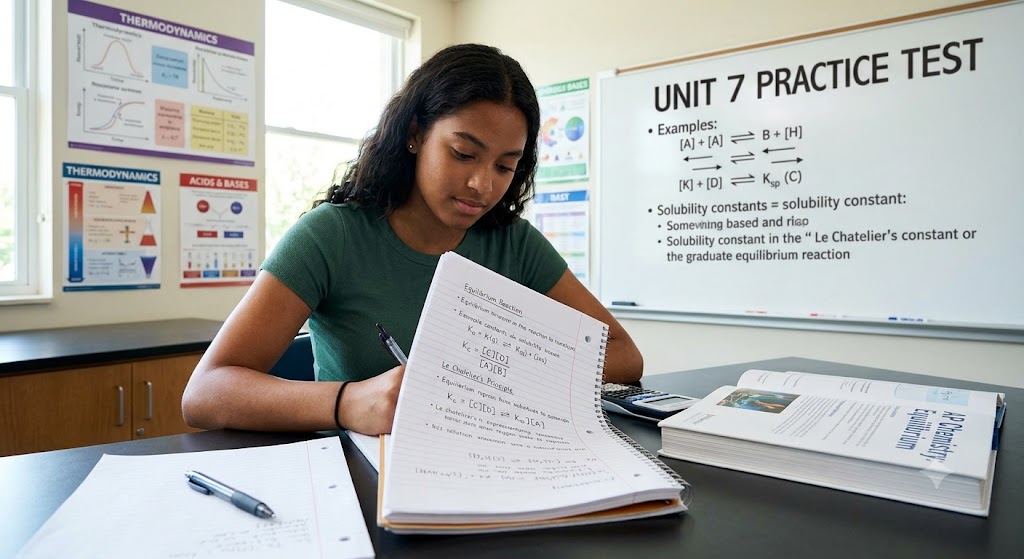
Additional Information
What the Course Entails and Exam Details
The AP Chemistry course and final exam curriculum for Unit 7 cover several critical areas of Chemical Equilibrium. Students must demonstrate proficiency in understanding the nature of equilibrium, calculating equilibrium constants (Kc and Kp), and interpreting the significance of the magnitude of K. The course also entails mastering Le Chatelier's principle to predict shifts in equilibrium resulting from changes in concentration, pressure, volume, and temperature. Furthermore, students must be skilled in performing calculations related to the solubility product constant (Ksp) and understanding the common ion effect and its impact on solubility.
What to Expect in the Final Exam
The official AP Chemistry Exam, which takes place in May, is a rigorous assessment divided into two main sections. The first section consists of 60 multiple-choice questions that assess conceptual knowledge and require quick calculations across all units, with Unit 7 equilibrium concepts typically representing about 7–9% of the questions. The second section includes 7 free-response questions (3 long-response and 4 short-response), where students must provide detailed, written solutions and justifications. Students should expect at least one free-response question to focus heavily on equilibrium, often requiring the setup of an ICE (Initial, Change, Equilibrium) table to solve for unknown concentrations or constants. The total exam time is 3 hours and 15 minutes.
How to Study and Exam Centers
To study effectively for this unit, students should utilize a combination of this practice test, their class notes, and textbook readings. It is highly recommended to practice solving a wide variety of equilibrium problems, focusing on identifying the correct formulas and checking units throughout calculations. Actively reviewing past AP Exam free-response questions provided by the College Board can also offer valuable insights into the types of problems expected and how they are scored. Mastering the ability to explain conceptual shifts using Le Chatelier’s principle is equally important as the math. AP Exams are administered at authorized schools and test centers; your high school AP Coordinator will provide specific details on the testing location and schedule.
Job Opportunities from the Course
A strong performance in AP Chemistry can lead to college credit and placement, opening doors to diverse career paths in science, technology, engineering, and math (STEM). While not a job-qualifying certification on its own, it is a crucial prerequisite for pursuing degrees that lead to careers such as:
Chemical Engineer
Pharmacist
Biochemist
Environmental Scientist
Forensic Scientist
Materials Scientist
Medical Doctor or Veterinarian
Frequently Asked Questions
Reviews
5.0
Based on 0 reviews
Leave a Review
No reviews yet. Be the first to review!