
AP Chemistry Exam Unit 1 Practice Test 2026
$69.00
- Buy to unlock unlimited access to all Quiz questions.
- After purchase you can print a PDF of the whole quiz at any point. The PDF will contain the questions and the correct answers.
About this Exam
The Advanced Placement (AP) Chemistry course is a college-level, introductory chemistry curriculum offered in high schools, culminating in a standardized final exam. This specific practice resource is focused solely on Unit 1: Atomic Structure and Properties. It is designed for students currently enrolled in AP Chemistry who want to ensure they have a deep, foundational grasp of the material before moving onto more complex units. By mimicking the style and difficulty of the actual exam, this practice test provides invaluable feedback on your strengths and weaknesses, helping you to direct your study efforts effectively and achieve a high score.
Ready to test your knowledge?
Buy Now to Access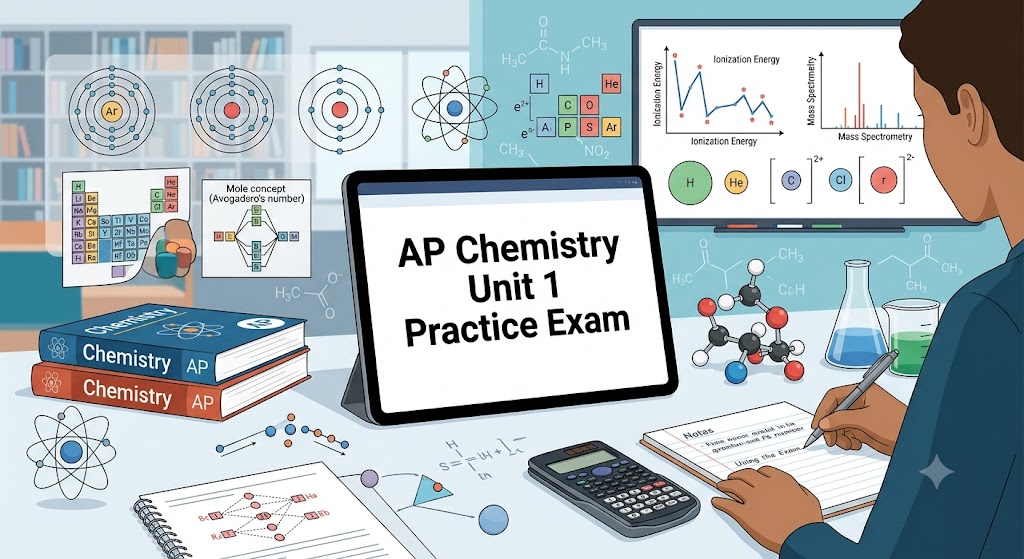
Additional Information
What the Course Entails and Exam Details
This practice test focuses on the concepts and skills covered in Unit 1 of the AP Chemistry Curriculum, as outlined by the College Board. This fundamental unit lays the groundwork for understanding matter at the particulate level, which is crucial for subsequent topics like chemical bonding, reactions, and thermodynamics. The core topics and syllabus areas include:
Moles and Molar Mass: Understanding and using the mole concept, Avogadro's number, and molar mass to perform stoichiometric calculations.
Atomic Structure and Electron Configuration: Describing the subatomic particles (protons, neutrons, electrons), isotopes, and how electrons are arranged in atoms, including quantum mechanics, electron configurations, and periodic trends.
Modern Atomic Theory: Reviewing the historical development of atomic models, from early theories to the Bohr model and the quantum-mechanical model, and how they explain atomic properties and behaviors.
Periodic Trends: Analyzing how properties such as atomic radius, ionization energy, electronegativity, and ionic radius vary across periods and down groups in the periodic table.
Mass Spectrometry: Understanding the principles of mass spectrometry and using it to identify elements, isotopes, and determine isotopic composition and relative atomic mass.
Elemental Composition of Pure Substances: Calculating empirical and molecular formulas based on mass composition data.
Composition of Mixtures: Distinguishing between pure substances and mixtures, and analyzing the composition of heterogeneous and homogeneous mixtures.
Using Data: Practicing data analysis, including graphical interpretation and calculation-based problems using atomic and molecular data.
What to Expect in the Final Exam
The actual AP Chemistry exam is a comprehensive assessment covering all nine units of the course. While this practice resource is dedicated to Unit 1, understanding the overall structure of the final exam is critical for your preparation.
Exam Structure: The AP Chemistry exam consists of two main sections:
Section I: Multiple Choice Questions (MCQs): 60 questions, worth 50% of your total score.
Section II: Free Response Questions (FRQs): 7 questions, worth 50% of your total score. The FRQs include three long questions and four short questions.
Unit 1 Weighting: Although Unit 1 (Atomic Structure and Properties) typically accounts for approximately 7-9% of the total multiple-choice questions on the complete exam, the foundational knowledge you build here is essential for correctly answering questions throughout the entire assessment, particularly the free-response section.
Time Limit: You will have 90 minutes for Section I (MCQs) and 105 minutes for Section II (FRQs). Managing your time is key to completing all questions.
Calculators: A graphing calculator is allowed and highly recommended for the entire exam, especially for numerical problems and data interpretation.
Scoring: AP exams are scored on a scale of 1 to 5. A score of 3 is generally considered passing, while scores of 4 or 5 are often eligible for college credit at many institutions. Your final score is a composite of your results from both the multiple-choice and free-response sections.
How to Study and Exam Centers
Effective preparation for the AP Chemistry Unit 1 exam involves a mix of conceptual understanding and practical application. Here are some actionable study strategies:
Review Your Notes and Textbook: Revisit your class notes, textbook chapters, and any supplemental materials covering atomic structure, periodic trends, and mole calculations. Focus on understanding the why behind the chemical principles.
Practice, Practice, Practice: Use this practice test and search for additional AP Chemistry Unit 1 specific questions. The more problems you solve, the more comfortable you will become with the question style and the faster you can identify the underlying concepts.
Understand Periodic Trends: Create or study summary diagrams for key trends like atomic radius, ionization energy, and electronegativity. Be sure you can explain the reasons for these trends based on effective nuclear charge and electron shielding.
Work Through Calculations: Practice converting between mass, moles, and particles. Master empirical and molecular formula calculations, and ensure you can perform stoichiometry with confidence.
Analyze Data: Spend time interpreting graphs, diagrams, and data sets, such as mass spectra or data on atomic properties. This is a crucial skill for both multiple-choice and free-response questions.
Check and Understand Your Answers: After taking the practice test, carefully review not only the questions you got wrong but also the ones you got right. Understanding the reasoning for the correct answer will reinforce your knowledge and help you identify areas for further study.
Where to Take the Exam
The official AP Chemistry exam is administered in May by the College Board.
Physical Testing Centers: Most students take the AP exam at their high school. Schools that offer AP courses act as authorized test centers. Your AP coordinator will handle the registration and logistics.
Authorized Schools: If your high school does not offer AP exams, you can contact the College Board or neighboring schools that do. The AP coordinator at an authorized school may be able to register you to take the exam as an external student.
Important Note: Registration and testing for the actual exam must be done through your high school's AP coordinator. Practice tests like this one are for your personal preparation only and do not constitute an official exam sitting.
Job Opportunities from the Course
Succeeding in AP Chemistry and pursuing further studies in the field opens doors to diverse and rewarding career paths. Here is a list of some job opportunities that this foundation unlocks:
Chemist: Conducts research in laboratories to develop new products, analyze chemical components, or improve industrial processes in sectors such as pharmaceuticals, consumer products, and environmental science.
Chemical Engineer: Designs and develops chemical manufacturing processes, creates new materials, and applies chemical principles to solve problems in fields like energy, food production, and electronics.
Pharmacist: Dispenses medications, provides healthcare advice, and acts as a key link between patients and physicians, ensuring the safe and effective use of drugs.
Medical Doctor / Physician: Diagnoses and treats illnesses, promotes wellness, and conducts medical research. A strong understanding of biochemistry and chemical principles is vital.
Biochemist / Biophysicist: Studies the chemical and physical principles of living things and biological processes, with applications in medicine, agriculture, and environmental science.
Environmental Scientist: Analyzes environmental data to protect human health and the natural environment, often focusing on areas like pollution control and hazardous waste management.
Forensic Scientist: Applies chemical and biological analyses to legal investigations, including examining evidence from crime scenes.
Material Scientist: Research and develops materials with specific properties for use in technology, construction, aerospace, and energy, with a strong focus on atomic structure and properties.
Food Scientist: Develops new food products, ensures food safety, and studies the chemical composition of foods.
Chemistry Teacher / Professor: Educates future scientists and professionals in high schools and colleges.
Frequently Asked Questions
Reviews
5.0
Based on 0 reviews
Leave a Review
No reviews yet. Be the first to review!