
Antimicrobial Recall Practice Test
$69.00
- Buy to unlock unlimited access to all Quiz questions.
- After purchase you can print a PDF of the whole quiz at any point. The PDF will contain the questions and the correct answers.
About this Exam
The "Antimicrobial Recall" is not a specific, single national certification, but rather a targeted practice tool widely used by educational institutions, healthcare systems, and professional training programs. It is designed to evaluate and strengthen an individual's ability to rapidly and accurately recall essential information about antimicrobial agents. The test is a critical preparatory step for students facing larger standardized licensing and board examinations, such as the USMLE, NAPLEX, NCLEX, and various specialized certification tests (e.g., in infection control or clinical microbiology). By focusing specifically on recall, it builds a foundation of quick knowledge retrieval, which is vital in clinical decision-making and patient safety.
Ready to test your knowledge?
Buy Now to Access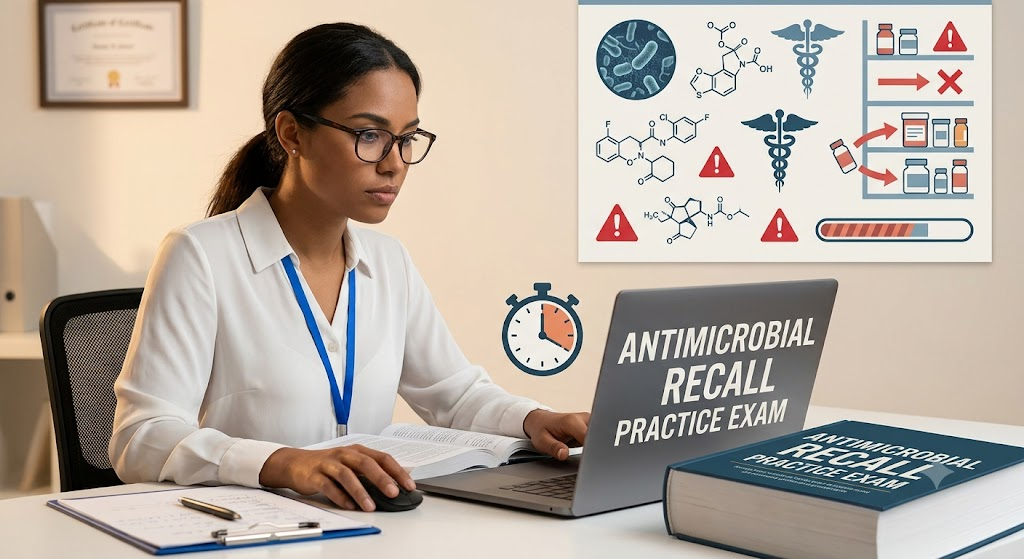
Additional Information
What the Course Entails and Exam Details
A course or study program for the Antimicrobial Recall focuses on deep learning and immediate knowledge accessibility. It is structured to cover the full spectrum of antimicrobial therapy. The core curriculum typically includes detailed modules on:
Classification of Antimicrobials: Understanding the primary categories (e.g., Penicillins, Cephalosporins, Macrolides, Fluoroquinolones, Aminoglycosides, Antifungals, Antivirals) and their common members.
Mechanisms of Action: Master how each drug class works at a molecular level (e.g., inhibition of cell wall synthesis, protein synthesis, nucleic acid replication, cell membrane disruption).
Spectrum of Activity: Identify which antimicrobials are effective against specific types of pathogens (e.g., gram-positive, gram-negative, anaerobes, atypicals).
Mechanisms of Resistance: Learn how microorganisms develop defenses against antimicrobials (e.g., efflux pumps, enzymatic degradation, target modification).
Pharmacology: Understand key principles like pharmacokinetics (how the body processes the drug) and pharmacodynamics (how the drug affects the microorganism).
Common Clinical Uses and Guidelines: Study first-line treatments for common infections and current clinical guidelines.
Side Effects, Contraindications, and Drug Interactions: Recall critical safety information to prevent adverse outcomes.
What to Expect in the Final Exam
As a preparatory test, the format of an Antimicrobial Recall exam is optimized for evaluating rapid information retrieval. It is almost exclusively a simulated, computer-based experience. While not leading to a separate, physical certification, the "final exam" within this framework is designed to mimic high-stakes conditions. You can generally expect:
Format: 100% multiple-choice questions (MCQs), often featuring true/false, matching, and "select all that apply" variations to test depth of knowledge. Case study questions that require applying recall to a clinical scenario are also common.
Simulated Time Limit: Unlike full board exams, these practice tests are often heavily timed. Expect a demanding schedule, perhaps 60-90 minutes for 100 questions, to simulate and build the rapid-fire thinking required.
Score Requirements: There is typically no universal passing score for a practice test, as its purpose is self-assessment and improvement. However, individual programs or institutions may set benchmarks (e.g., 75-80%) to indicate readiness for the major certification exam it supports.
Rules: The test must be taken in a quiet, independent setting without access to outside resources (textbooks, notes, Internet). This simulates the conditions of a secure testing facility.
How to Study and Exam Centers
Preparation for antimicrobial recall must focus on active learning and building mental pathways for quick retrieval. Traditional passive reading is insufficient. Effective strategies include:
Create and Use Comprehensive Flashcards: Tools like Anki or digital flashcard apps are your best assets. Build cards that connect a drug class to its mechanism, spectrum, common side effects, and key examples.
Employ Spaced Repetition: Consistently review your flashcards over increasing time intervals. This technique leverages the psychological spacing effect for better long-term memory.
Practice with Question Banks (Qbanks): Utilize Qbanks from various educational platforms (e.g., UWorld, Kaplan, BoardVitals) that specialize in medical and pharmacy test preparation. Focus on the antimicrobial sections.
Utilize Active Recall with Case Studies: Don't just read case studies; actively try to answer the "What is the most appropriate next step?" question before looking at the explanation.
Form Study Groups: Explaining concepts to peers is a powerful way to solidify your own understanding and uncover knowledge gaps.
Draw and Analyze Diagrams: Visually representing pathways, such as cell wall synthesis and resistance mechanisms, can create strong memory anchors.
Taking the Exam: Since this is a practice and self-assessment tool, you do not take a finalized "Antimicrobial Recall" exam at a physical testing center like Pearson VUE. Instead, you access simulated tests through online educational portals, learning management systems, or authorized medical and pharmacy school internal networks. Access is typically granted as part of a course or upon purchasing a test preparation package from a recognized provider.
Job Opportunities from the Course
A strong foundation in antimicrobial knowledge is a cornerstone for numerous high-impact careers in healthcare and life sciences. The mastery demonstrated by excelling in knowledge recall opens doors to diverse professional roles, including:
Physician (MD, DO) across all specialties
Pharmacist (PharmD)
Physician Assistant (PA)
Nurse Practitioner (NP)
Infection Control Preventionist
Clinical Microbiologist
Public Health Epidemiologist
Pharmaceutical Sales Representative (Specializing in Antimicrobials)
Medical Science Liaison
Clinical Research Coordinator
Regulatory Affairs Specialist in Pharmaceuticals
A dedicated effort to master antimicrobial information through rigorous practice and recall is an invaluable investment in any of these career paths.
Frequently Asked Questions
Reviews
5.0
Based on 0 reviews
Leave a Review
No reviews yet. Be the first to review!