
Antianginal Agents Practice Test
$69.00
- Buy to unlock unlimited access to all Quiz questions.
- After purchase you can print a PDF of the whole quiz at any point. The PDF will contain the questions and the correct answers.
About this Exam
The Antianginal Agents Practice Test is a comprehensive assessment designed for nursing students, pharmacy students, and other healthcare professionals-in-training. This exam evaluates a candidate's understanding of the medications used to manage angina pectoris (chest pain resulting from reduced blood flow to the heart). Mastering this topic is crucial for ensuring patient safety and providing effective cardiovascular care in clinical settings.
Ready to test your knowledge?
Buy Now to Access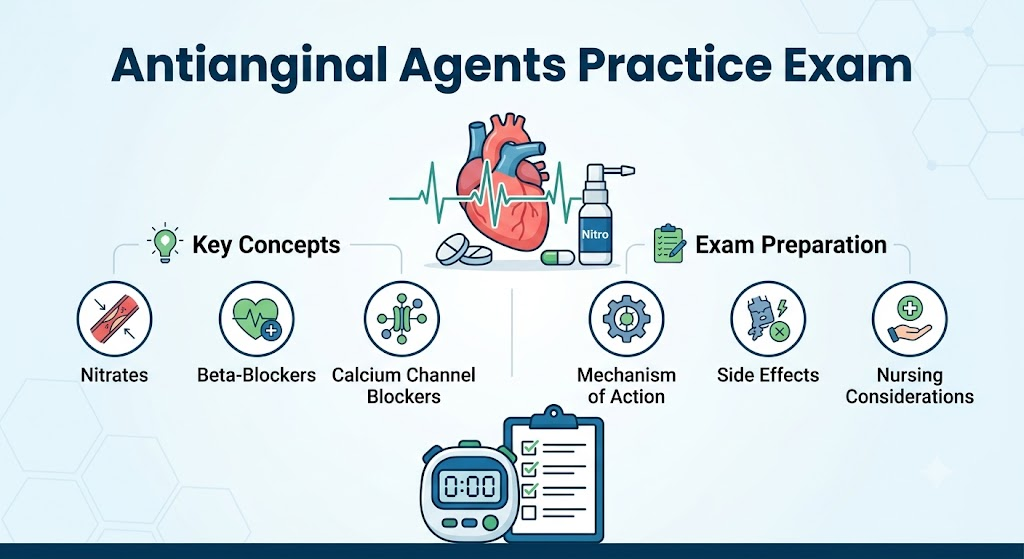
Additional Information
What the Course Entails and Exam Details
This pharmacology topic covers the crucial knowledge required to manage ischemic heart disease. The practice exam assesses your understanding of the three main classes of antianginal drugs: Nitrates (like nitroglycerin), Beta-Blockers (such as atenolol), and Calcium Channel Blockers (such as diltiazem).
You will need to demonstrate knowledge of:
The mechanisms of action for each drug class (how they improve the oxygen supply/demand balance).
Specific indications for acute angina relief versus long-term prophylaxis.
Major side effects and adverse reactions (e.g., hypotension, headache, reflex tachycardia).
Critical drug interactions, particularly the contraindication of nitrates with erectile dysfunction medications.
Essential nursing considerations, including patient education on administration (e.g., sublingual nitrate storage) and monitoring parameters (e.g., blood pressure and heart rate).
What to Expect in the Final Exam
This is typically a multiple-choice exam, focusing heavily on clinical application scenarios. The format includes standalone knowledge questions and case-based questions where you must determine the appropriate drug therapy or priority nursing intervention.
While specific requirements vary by institution, practice tests usually mirror certification standards. Candidates often have around 60 seconds per question, and a passing score is typically 75-80%. It is vital to read each scenario carefully, as questions often test your ability to differentiate between the nuances of each drug class in different patient situations (e.g., managing stable angina versus variant angina).
How to Study and Exam Centers
Effective preparation requires a mix of rote memorization and clinical reasoning. Focus on creating comparison charts for the three drug classes to quickly differentiate their mechanisms and side effects. Utilize pharmacology flashcards for quick recall of generic drug names and their classifications. Practice case studies are highly effective for mastering nursing considerations and priority assessments.
This practice test is usually administered online through educational portals (e.g., ATI, HESI, or university learning management systems). The final pharmacology certifications are often taken at authorized testing centers, such as Pearson VUE, or proctored within specific nursing and medical schools.
Job Opportunities from the Course
Mastery of this pharmacology content is a vital component of licensure for several healthcare career paths. Understanding these agents is essential for the following roles:
Registered Nurse (RN)
Licensed Practical Nurse (LPN) / Licensed Vocational Nurse (LVN)
Pharmacist (PharmD)
Pharmacy Technician
Medical Assistant
Frequently Asked Questions
Reviews
5.0
Based on 0 reviews
Leave a Review
No reviews yet. Be the first to review!