
Anti-Hypertensive Agents Practice Test
$69.00
- Buy to unlock unlimited access to all Quiz questions.
- After purchase you can print a PDF of the whole quiz at any point. The PDF will contain the questions and the correct answers.
About this Exam
The Anti-Hypertensive Agents Practice Test is a crucial learning and assessment tool designed for nursing students, pharmacy technicians, and healthcare professionals who are preparing for licensure exams or seeking to solidify their knowledge of cardiovascular pharmacology. This practice exam offers a concentrated review of the various classes of drugs used to manage hypertension, a critical skill for anyone involved in patient medication management. By engaging with this practice test, candidates can evaluate their understanding of drug mechanisms, therapeutic uses, critical side effects, and essential nursing implications, ensuring they are well-prepared for real-world clinical scenarios and formal certification assessments.
Ready to test your knowledge?
Buy Now to Access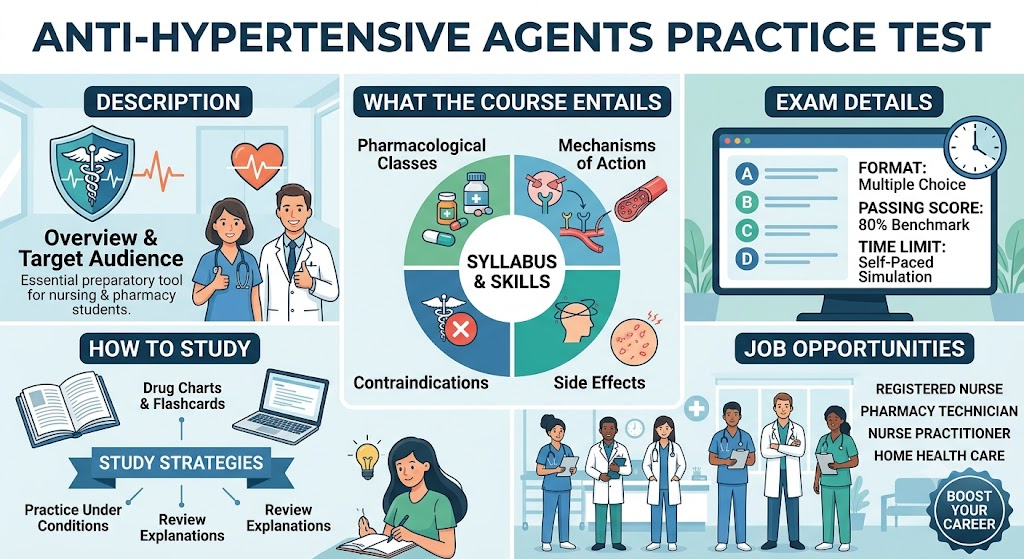
Additional Information
What the Course Entails and Exam Details
This comprehensive practice exam covers the essential curriculum related to hypertensive management. The content is structured to test proficiency in several key areas, including:
Pharmacological Classes: Mastery of major drug categories such as Diuretics (thiazides, loop, potassium-sparing), Beta-Blockers, ACE Inhibitors, Angiotensin II Receptor Blockers (ARBs), Calcium Channel Blockers, and Centrally Acting Alpha-2 Agonists.
Mechanisms of Action: Detailed understanding of how each drug class physiologically lowers blood pressure (e.g., reducing blood volume, decreasing cardiac output, or systemic vascular resistance).
Therapeutic Indications and Contraindications: Knowing which agents are preferred for specific patient populations (e.g., those with diabetes, heart failure, or chronic kidney disease) and which are contraindicated (e.g., ACE inhibitors in pregnancy).
Adverse Effects and Interactions: Recognition of common and severe side effects (like angioedema, hyperkalemia, or orthostatic hypotension) and critical drug-drug or drug-food interactions.
Nursing Implications and Patient Education: Focus on the practical application of this knowledge, such as necessary vital sign monitoring, laboratory value assessment, and essential teaching points for patients taking these medications.
What to Expect in the Final Exam
This practice test is designed to simulate the format and rigor of formal healthcare licensure exams, such as the NCLEX-RN or pharmacy technician certification exams.
The exam consists exclusively of multiple-choice questions (MCQs), which are the standard format for these types of assessments. Candidates should expect questions that range from recall of basic drug facts to complex application scenarios, requiring clinical prioritization and judgment.
To receive a passing score and achieve proficiency, candidates are generally expected to achieve a minimum score of 80%. This benchmark ensures a thorough understanding of the material rather than just a superficial familiarity.
There is no strict time limit for this practice test, allowing users to review the rationale for each answer. However, when using it for simulation, candidates are encouraged to pace themselves to approximately 60-90 seconds per question to mimic the time constraints of a real proctored exam.
How to Study and Exam Centers
Effective preparation for the Anti-Hypertensive Agents Practice Test requires a multi-faceted study strategy:
Utilize Active Learning: Do not simply read textbooks. Create concept maps, drug charts, and flashcards focusing on the "Most Important to Know" facts for each class, specifically mechanisms, side effects, and nursing interventions.
Simulate Test Conditions: Take the practice test in a quiet, distraction-free environment. Use the timer function to build test-taking stamina and improve pacing.
Review Rationales thoroughly: The most valuable part of any practice test is the explanation provided for correct and incorrect answers. Analyze why the correct answer is right and, equally importantly, why the other options are wrong.
Identify Knowledge Gaps: Use your practice test results as a diagnostic tool. If you consistently miss questions on ACE Inhibitors, dedicate focused study time to that specific topic before retaking the test.
Because this is a practice exam, it is typically accessible online through educational platforms, test preparation websites, and nursing or pharmacy tech school portals. It can be taken at the learner's convenience from any location with internet access. For the actual licensure exams (like the NCLEX), testing is conducted at authorized centers, such as Pearson VUE, which require secure, proctored environments.
Job Opportunities from the Course
A strong understanding of Anti-Hypertensive Agents, as demonstrated by success on this practice test and subsequent licensure, is a foundational requirement for numerous essential roles in healthcare:
Registered Nurse (RN)
Licensed Practical Nurse (LPN) / Licensed Vocational Nurse (LVN)
Certified Pharmacy Technician (CPhT)
Pharmacist (PharmD)
Nurse Practitioner (NP)
Physician Assistant (PA)
Clinical Educator
Cardiology Specialized Nurse
Home Health Nurse
Medical Assistant
These roles all heavily involve medication reconciliation, administration, patient monitoring, and education, making cardiovascular pharmacology expertise non-negotiable for safe patient care.
Frequently Asked Questions
Reviews
5.0
Based on 0 reviews
Leave a Review
No reviews yet. Be the first to review!