
Animal Farm Practice Test
$69.00
- Buy to unlock unlimited access to all Quiz questions.
- After purchase you can print a PDF of the whole quiz at any point. The PDF will contain the questions and the correct answers.
About this Exam
This Animal Farm Practice Exam is a comprehensive study guide and simulation tool designed to help you prepare for a literature test on George Orwell's iconic allegorical novella, Animal Farm. Whether you are a high school student, a university scholar, or a dedicated reader aiming to deepen your understanding, this resource is a critical component of your preparation. It assesses your knowledge of the plot, characters, major themes, and the book's profound historical and political commentary. Unlike a professional certification, this test serves as a masterclass, solidifying your analysis and critical thinking before your official institution's assessment.
Ready to test your knowledge?
Buy Now to Access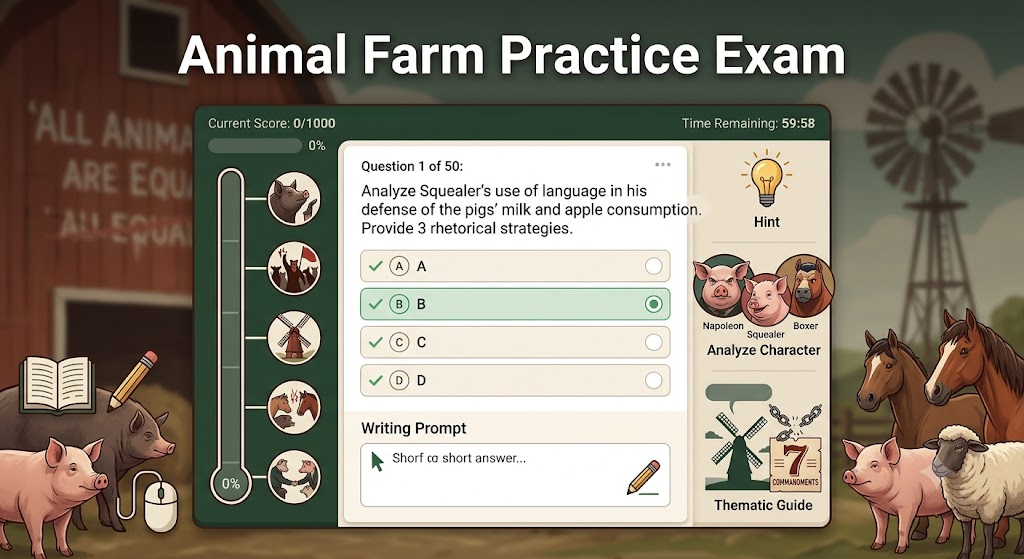
Additional Information
What the Course Entails and Exam Details
Your comprehensive study of Animal Farm, which this practice test mirrors, should cover the following core topics and concepts:
Detailed Plot Analysis: From the initial rebellion and the Seven Commandments to the ultimate dissolution of equality, you must master the sequential timeline of events.
Comprehensive Character Studies: Analyze the roles, motivations, and symbolic representations of key figures like Napoleon, Snowball, Squealer, Boxer, Clover, Old Major, and Benjamin.
Exploration of Key Themes: Focus on totalitarianism, the corrupting nature of power, class structure, the dangers of an uneducated working class, the use and abuse of language and propaganda, and the manipulation of history.
Allegorical and Historical Context: Decipher how the novel functions as an allegory for the 1917 Russian Revolution and the early years of Soviet Russia.
Literary Devices: Recognize the use of satire, fable, irony, symbolism (e.g., the windmill), and foreshadowing throughout the text.
Critical Vocabulary: Become fluent with terms relevant to the book, such as allegory, dictatorship, oppression, and rebellion.
What to Expect in the Final Exam
While the exact structure will depend on your specific institution (school, college, or course provider), your final literature exam on Animal Farm will likely include several distinct parts. You should be prepared for the following:
Multiple-Choice and Objective Questions: This section tests your factual recall of the plot, characters, settings, and the specific historical figures and events they represent.
Identification and Matching: You may be asked to match character names with their descriptions or to identify who said or did a particular action.
Short Answer and Textual Connection: These questions require you to explain a concept in a few sentences, define a term, or make a direct connection between an event in the book and the historical event it satirizes.
Essay and Analytical Writing: A significant portion of your grade will come from your ability to construct coherent arguments. These prompts might ask you to analyze the development of a theme, compare and contrast characters, or discuss the ending's significance in depth.
While there is no universally fixed time limit, literature tests typically provide between 60 and 120 minutes. The passing score varies dramatically, set by your teacher or professor, ranging from a typical 60% or 70% to be considered passing within an academic context.
How to Study and Accessing Your Test
How to Study Effectively
Mastering Animal Farm is about more than just remembering facts; it is about critical analysis. Follow this actionable study plan:
Reread with Active Note-Taking: Don't just read; summarize each chapter immediately after finishing it. Note down pivotal moments, character shifts, and any thematic evolution.
Create Detailed Charts: Make dedicated charts for characters, listing their name, animal, what they represent, their key actions, and major character traits.
Track Key Themes and Quotes: Use different highlighters or lists to track the text's evidence for each major theme (like the corruption of power). Find 3-5 powerful quotes that support each point and create flashcards.
Practice Essay Outlines: Do not just read essay prompts; practice outlining your response, including a thesis, body paragraphs with evidence, and a strong conclusion.
Utilize Practice Tests: Use resources like this one repeatedly. Treat the simulation as a learning tool, noting not only your correct answers but also reviewing why you got specific questions wrong.
Accessing Your Test
It is essential to understand that an Animal Farm literature test is typically an in-course requirement, not a standardized test administered at a professional center like Pearson VUE. Students will access and take their final test in several ways:
Physical Classrooms: Many assessments are traditional paper-based or digital tests administered directly by your instructor during scheduled class time.
Online Learning Platforms: Many institutions utilize Learning Management Systems (LMS) such as Canvas, Blackboard, or Google Classroom, where your test will be posted for you to take within a specific time window.
Authorized School Testing Centers: On larger campuses, tests may be proctored in a dedicated school or university testing center rather than the classroom.
For a comprehensive practice experience, ensure the tool you are using simulates a clean, timed digital or paper-based test environment.
Job Opportunities from the Course
While taking a literature test does not provide a career-building certification, it is a crucial step in a rich academic path. The skills developed through the rigorous analysis and critical thinking required to excel on an Animal Farm Practice Exam are highly valued across many professional fields. Mastering literature cultivates strong communication, analytical reasoning, and cultural literacy, which are valuable in numerous careers, such as:
Content Writer: Crafting compelling, well-reasoned written material for businesses and websites.
Editor: Refining and improving text, ensuring clarity, logical flow, and persuasive power.
Journalist: Using sharp investigation, research, and analysis to report on complex issues.
Political Analyst: Utilizing the skills to deconstruct propaganda, analyze power structures, and write insightful political commentary.
English Teacher (or Literature Instructor): Inspiring the next generation to engage critically with texts and the world.
Researcher: Employing deep analysis, critical thought, and attention to detail to gather and interpret data.
Communications Specialist: Designing and implementing effective strategic communication plans.
Public Relations Professional: Crafting narratives and managing media relations with strong, clear messaging.
Frequently Asked Questions
Reviews
5.0
Based on 0 reviews
Leave a Review
No reviews yet. Be the first to review!