
Anglo-Saxon and Norman England Practice Test
$69.00
- Buy to unlock unlimited access to all Quiz questions.
- After purchase you can print a PDF of the whole quiz at any point. The PDF will contain the questions and the correct answers.
About this Exam
The Anglo-Saxon and Norman England Practice Exam is a comprehensive preparatory tool for students studying the fascinating and critical period of English history from the 5th to the 12th century. This practice test is specifically designed for learners studying history at the GCSE, A-Level, or equivalent secondary education standard, as well as independent history enthusiasts aiming to master this transformative era. It serves as an essential resource for candidates preparing for final qualifications that include a dedicated module on the developments between the end of Roman rule and the peak of Norman control.
Ready to test your knowledge?
Buy Now to Access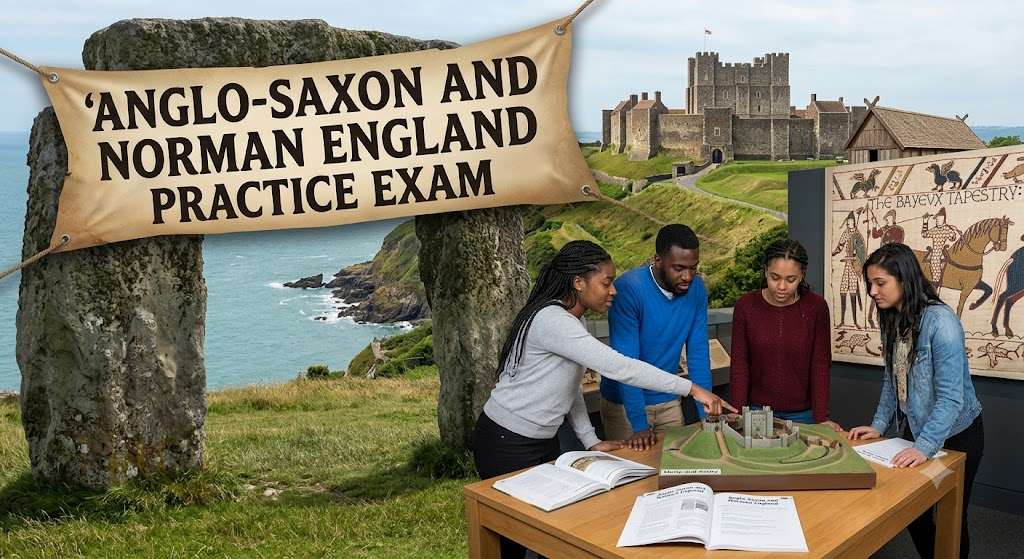
Additional Information
What the Course Entails and Exam Details
The material covered in this practice test delves deep into the dynamic political, social, and cultural transformations of England during this period. The course content generally includes several core themes and detailed knowledge areas:
Anglo-Saxon Society: Analyzing the structure of Saxon life, including the influence of kings, nobles, peasants, the church, and legal codes.
The Struggle for Power: Exploring the Viking invasions, the reign of Alfred the Great, the formation of the unified Kingdom of England, and the succession crisis following Edward the Confessor.
The Norman Conquest: A detailed study of the 1066 campaigns, the Battle of Hastings, and the tactics employed by Harold Godwinson, Harald Hardrada, and William of Normandy.
Norman Control and Settlement: How William I and his successors established authority, including the building of castles (motte-and-bailey, stone keep), implementation of the Feudal System, the survey of the Domesday Book, and religious reforms.
Changes in England: Evaluating the social, economic, and political shifts resulting from the transition from Anglo-Saxon to Norman rule, including land ownership, governance, and the English identity.
What to Expect in the Final Exam
The design of the final exam simulates the rigors and structure of official qualifications like the UK’s GCSE history. It is typically a written assessment lasting a set duration, such as 1 hour and 45 minutes for an entire paper (of which this topic forms a significant portion). The format generally blends different assessment methods:
Short Answer Questions: Testing recall of key facts, dates, events, and individuals.
Source Based Questions: Evaluating skills in interpreting, analyzing, and questioning primary sources (like the Bayeux Tapestry or early chronicles).
Extended Writing and Essay Questions: Requiring well-structured arguments, historical explanations, and analysis of major themes (e.g., “Analyze the causes of the Norman Conquest”).
Grading: Students are assessed on their factual knowledge, understanding of historical periods, and critical thinking skills, usually resulting in a numerical or letter grade relevant to the qualification (e.g., 9-1 in current GCSE).
How to Study and Exam Centers
A proactive and structured study plan is crucial for success on this challenging material.
Comprehensive Notes: Create detailed timelines and revision cards for key figures (like Alfred the Great, King Cnut, Edward the Confessor, Harold Godwinson, William I), battles, and societal changes.
Practice Past Papers: Regularly attempt previous exam papers and use official mark schemes to understand what examiners are looking for in top band answers.
Source Analysis Practice: Dedicate specific study sessions to evaluating primary and secondary sources, asking who, when, where, why, and how a source was produced.
Essay Structure: Plan and practice writing extended answers, ensuring you can formulate clear arguments supported by specific evidence and analytical depth.
Exam Centers: This practice test helps prepare students for qualifications that are generally taken within registered educational institutions, such as schools and colleges. These institutions act as official exam centers (e.g., Pearson VUE for computerized tests or specific boards like AQA, Edexcel, and OCR). If you are studying independently, you must register as a private candidate at an authorized center to sit the official examinations.
Job Opportunities from the Course
Gaining deep historical knowledge, analytical skills, and evidence based reasoning through this course provides a strong foundation for numerous professional pathways. The skills acquired are highly valued in fields requiring critical thinking and complex information processing. Potential career paths and job opportunities include:
History Teacher or Lecturer
Archivist or Records Manager
Museum Curator or Exhibition Officer
Historical Researcher for Media and Publishing
Archaeologist
Librarian
Lawyer or Legal Professional
Political Analyst or Policy Officer
Journalist
Public Relations Specialist
Academic Researcher
Frequently Asked Questions
Reviews
5.0
Based on 0 reviews
Leave a Review
No reviews yet. Be the first to review!