
Anesthesia Knowledge Test 24 (AKT-24) Practice
$69.00
- Buy to unlock unlimited access to all Quiz questions.
- After purchase you can print a PDF of the whole quiz at any point. The PDF will contain the questions and the correct answers.
About this Exam
The Anesthesia Knowledge Test 24 (AKT-24) is a critical, standardized examination designed for anesthesiology residents. This modular test, developed by the Inter-Hospital Study Group for Anesthesia Education (IHSGAE), is typically administered to residents around their 24th month of clinical anesthesia training, often during their Clinical Anesthesia Year 3 (CA-3). The primary purpose of the AKT-24 is to objectively assess a resident’s cumulative knowledge, evaluate their progress, and ensure they are on track to master the core competencies required for independent, advanced anesthesia practice. It provides vital feedback to both the resident and their program director, helping to identify strengths and areas that require further study before final board certification.
Ready to test your knowledge?
Buy Now to Access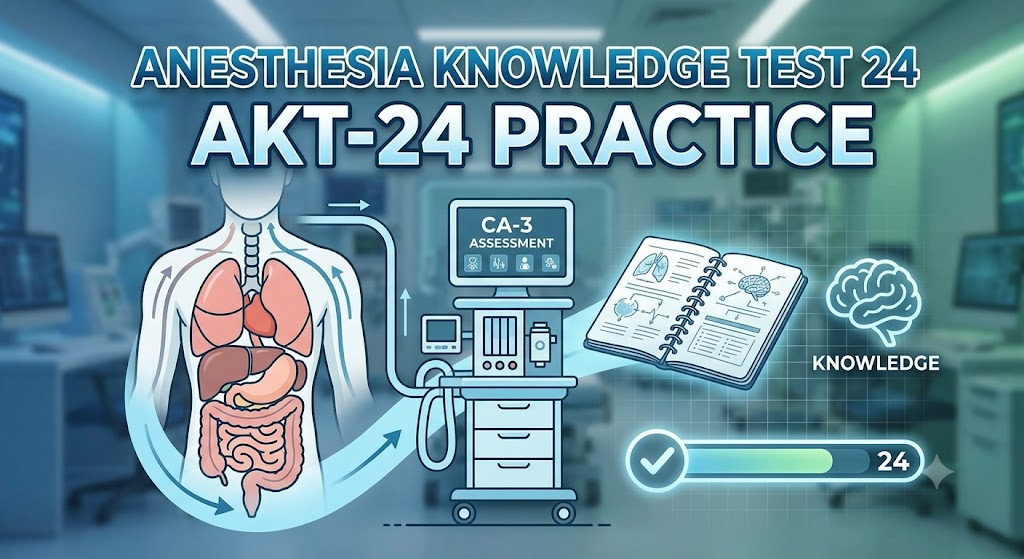
Additional Information
What the Course Entails and Exam Details
As an examination of advanced knowledge, the AKT-24 covers the comprehensive spectrum of anesthesiology. It entails a rigorous assessment of a resident's understanding and clinical application of fundamental concepts and specialized knowledge. The exam details a broad syllabus, including:
Basic Sciences: In-depth physics, pharmacology, and physiology as they relate to anesthesia and perioperative care.
Clinical Anesthesia: Advanced management techniques for diverse patient populations (e.g., pediatric, geriatric, obstetric) and surgical subspecialties (e.g., cardiac, neurosurgery, trauma).
Patient Safety and Monitoring: Best practices in patient safety, monitoring technologies, and the interpretation of intraoperative data.
Regional Anesthesia and Acute Pain Management: Techniques for peripheral nerve blocks, neuraxial anesthesia, and multimodal pain control.
Critical Care and Emergencies: Management of critically ill patients, resuscitation, and anesthesia-related crises.
What to Expect in the Final Exam
The final AKT-24 exam is a comprehensive computer-based test, typically consisting of approximately 200 multiple-choice questions (MCQs). Candidates should be prepared for a wide variety of question types, from recall of foundational facts to complex, case-based clinical scenarios. While specific passing scores can vary by year and institution, the exam is designed with illustrative pass marks and mean scores that gauge performance against a national cohort of peers. For illustrative purposes, a recent exam might have a pass mark around 140-145. The time limit is substantial, generally spanning several hours, designed to reflect the thoroughness required for an exam at this advanced training stage. The test is administered in a controlled, proctored environment.
How to Study and Exam Centers
Preparation for the AKT-24 requires a dedicated and systematic approach. To study effectively, create a structured plan and utilize high-yield resources:
Utilize Advanced Study Materials: Focus on standard textbooks like Miller's Anesthesia, and "Basics of Anesthesia," supplemented by highly relevant review articles from publications such as BJA Education (formerly CEACCP).
Practice with Multiple-Choice Questions: Take advantage of existing AKT-style question banks and previous practice exams to become familiar with the format and improve test-taking speed and accuracy.
Form Study Groups: Collaborating with fellow residents can provide different perspectives on complex topics and help in covering the extensive syllabus.
Identify Weaker Areas: Use the results of practice tests to focus study time on subjects where your knowledge is less robust.
AKT-24 exam centers are typically authorized educational institutions or medical schools where the residency program is based. The exam is administered through dedicated secure testing portals, such as the ones provided by PSI/AMP, ensuring standard and fair testing conditions. Candidates should check with their program coordinator for specific dates and testing locations.
Job Opportunities from the Course
Passing the AKT-24 is a significant achievement and a necessary milestone on the journey to becoming a fully credentialed Anesthesiologist. While the test itself is an academic requirement rather than a job license, success on the AKT-24 directly unlocks advanced career phases and ultimate employment opportunities:
Advanced Anesthesiology Resident (CA-3): Passing marks the successful progression to the final year of residency.
Chief Resident: Demonstrated knowledge can make a candidate a strong contender for leadership roles within their program.
Fellowship Opportunities: A high score on AKT-24 can be an important factor for gaining acceptance into competitive fellowship programs in subspecialties like Pediatric Anesthesia, Obstetric Anesthesia, Cardiothoracic Anesthesia, Neuroanesthesia, or Critical Care Medicine.
Attending Anesthesiologist: Ultimately, the knowledge validated by the AKT-24 is foundational for passing the final written and oral board examinations to practice as a fully licensed physician anesthesiologist.
Academic Physician: Paves the way for a career in teaching and research within a university hospital.
Frequently Asked Questions
Reviews
5.0
Based on 0 reviews
Leave a Review
No reviews yet. Be the first to review!