
Anatomical Terminology Practice Test
$69.00
- Buy to unlock unlimited access to all Quiz questions.
- After purchase you can print a PDF of the whole quiz at any point. The PDF will contain the questions and the correct answers.
About this Exam
The Anatomical Terminology Practice Exam is a essential assessment tool designed for students, aspiring healthcare professionals, and anyone seeking to master the foundational language of medicine and life sciences. This exam evaluates a candidate's comprehensive understanding of the terms and systems used to describe the human body and its functions.
Whether you are preparing for a medical career, nursing school, physical therapy certification, or a biology degree, fluency in anatomical terminology is non-negotiable. This exam serves as a robust practice platform to test your knowledge, identify weaknesses, and build the confidence required for final course assessments and professional practice.
Ready to test your knowledge?
Buy Now to Access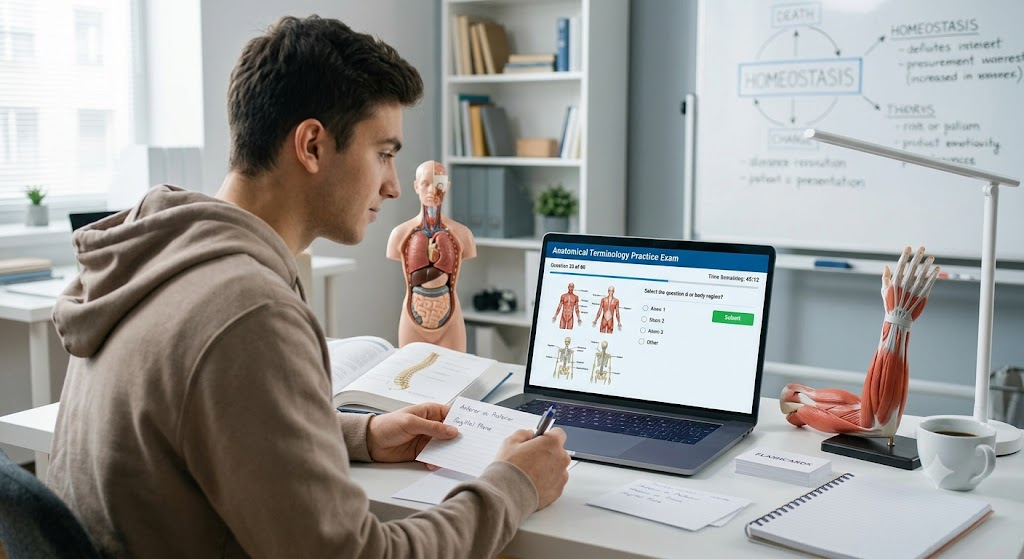
Additional Information
What the Course Entails and Exam Details
The content of the Anatomical Terminology course and its accompanying practice exam covers all major body systems and descriptive concepts. Candidates are tested on their ability to accurately define, spell, and apply a wide array of terms. Key areas of focus typically include:
Introduction to Anatomical Language: Principles of terminology, including the differences between anatomical and clinical terms.
Directional Terms and Body Planes: Mastery of spatial relationships (superior, inferior, anterior, posterior, medial, lateral, proximal, distal, superficial, deep) and the body planes (sagittal, frontal/coronal, transverse/axial).
Body Regions: Recognition of major divisions like the cephalic, cervical, trunk, and limb regions, as well as quadrants.
Systemic Terminology: Specific vocabulary for all organ systems, such as integumentary, skeletal, muscular, nervous, endocrine, cardiovascular, lymphatic, respiratory, digestive, urinary, and reproductive.
Roots, Prefixes, and Suffixes: Breaking down complex terms into their word parts for easier definition.
Plural and Singular Forms: Learning correct pluralization rules for anatomical terms.
The goal of this practice exam is to simulate the difficulty and subject matter scope of a comprehensive final assessment.
What to Expect in the Final Exam
A final exam on Anatomical Terminology is generally characterized by several common features across academic institutions and certification bodies. Students should be prepared for a rigorous format. Key expectations include:
Format: Multiple-choice questions (MCQs) are most common, often incorporating diagrams where students must identify labeled structures or terms. Some exams may include matching, short answers, or terminology application scenarios.
Time Limit: Typical exam times range from 60 to 90 minutes, depending on the number of questions.
Number of Questions: A final exam often consists of 50 to 100 questions.
Passing Score: The passing grade usually lies between 70% and 80%, depending on the program's specific requirements.
Practical Component: In many academic courses, a separate practical exam might accompany the theory paper, requiring the identification of anatomical structures on models or specimens.
Knowing what to expect is half the battle won, and the practice test is your best tool to prepare for these specific elements.
How to Study and Exam Centers
Developing a structured study plan is crucial. Here are effective strategies:
Use Active Study Methods: Employ flashcards (physical or digital like Anki) for consistent term recall. Draw and label anatomy diagrams from memory. Group terms by body region or system. Break down words into their parts.
Practice with Real Exams: Utilize practice exams extensively. They expose you to the question style, time management, and the breadth of topics you must cover. Analyze every answer, both right and wrong.
Study Groups: Collaborate with peers to explain concepts to each other. Teaching is one of the best ways to learn.
Take Care of Yourself: Adequate sleep, nutrition, and exercise are vital for cognitive function and memory retention.
Exam Centers and Testing Logistics:
The location where you take your final exam depends on your specific academic program or certification organization. Most common options include:
Institutional Testing Centers: For college and university courses, exams are typically held in computer labs or lecture halls on campus.
Authorized Testing Centers: Independent certification bodies may use established testing centers like Pearson VUE, which have locations worldwide.
Online Proctored Exams: An increasing number of programs offer exams online via proctoring services, allowing you to test from home with appropriate software and hardware setup.
Authorized Schools: If the course is associated with a specific vocational school or hospital, the test might be administered on-site at that facility.
Job Opportunities from the Course
Fluency in anatomical terminology is a fundamental skill that unlocks a diverse range of opportunities in the healthcare and life science sectors. This knowledge is not only beneficial but often required for entry into countless career paths.
Medical Assistant
Nursing Assistant (CNA)
Physical Therapist Aide
Occupational Therapist Assistant
Emergency Medical Technician (EMT)
Paramedic
Medical Transcriptionist
Surgical Technologist
Dental Assistant
Radiologic Technologist
Health Screener
Clinical Research Coordinator
Veterinary Assistant
Medical Biller and Coder
Health Information Manager
Personal Trainer
Exercise Physiologist
Massage Therapist
Mastering the language of the human body through rigorous preparation is an investment that will pay dividends throughout your career. Start with the right study guide and practice test.
Frequently Asked Questions
Reviews
5.0
Based on 0 reviews
Leave a Review
No reviews yet. Be the first to review!