
Analysis of Urine and Body Fluids (AUBF) Practice Test
$69.00
- Buy to unlock unlimited access to all Quiz questions.
- After purchase you can print a PDF of the whole quiz at any point. The PDF will contain the questions and the correct answers.
About this Exam
The Analysis of Urine and Body Fluids (AUBF) certification and its preparatory exams are designed for students and healthcare professionals aiming to prove their competency in clinical microscopy. This specialized field is fundamental to diagnostic medicine, focusing on the visual and chemical analysis of non-blood patient specimens. AUBF certification demonstrates to employers that you have the precise skills required to analyze urine, spinal fluid, and other body fluids to aid physicians in diagnosing and monitoring a wide range of diseases, from kidney function disorders to meningitis.
Ready to test your knowledge?
Buy Now to Access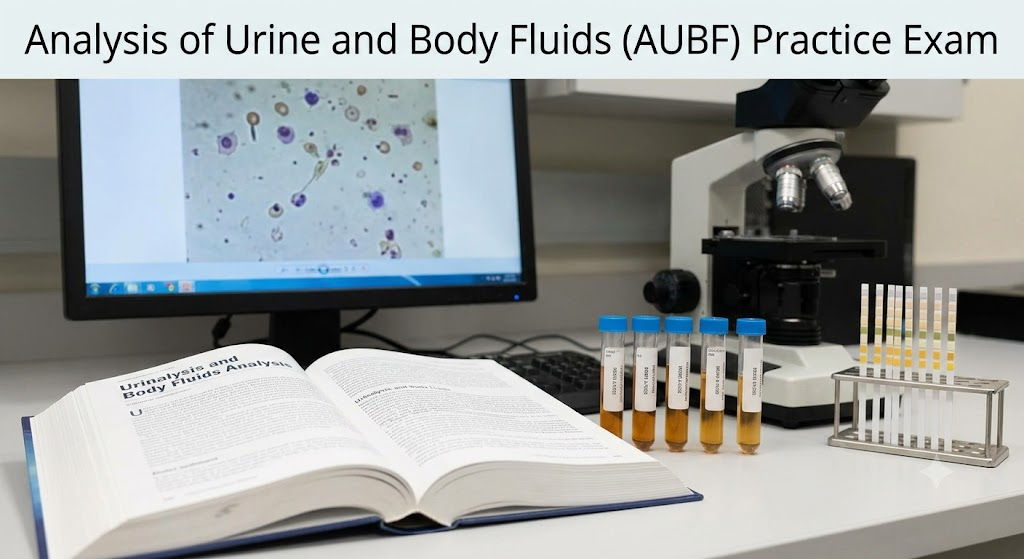
Additional Information
What the Course Entails and Exam Details
This practice test mirrors the comprehensive scope of a standard clinical microscopy course. It evaluates your practical and theoretical knowledge across several critical areas.
The primary focus is on urinalysis, which is covered in detail. You will encounter questions that test your understanding of renal function and physiology, as well as introduction to the laboratory safety and quality control essential to all tests. The specific topics include:
Physical Examination of Urine: Evaluating color, clarity, and specific gravity, and understanding the clinical significance of these observations.
Chemical Examination of Urine: Interpreting reagent strip (dipstick) reactions for glucose, bilirubin, ketones, blood, pH, protein, urobilinogen, nitrite, and leukocyte esterase. You must understand the chemical principles, interference, and clinical significance of each test.
Microscopic Examination of Urine: Identifying and correlating elements of urine sediment, including red blood cells, white blood cells, epithelial cells, casts, crystals, bacteria, yeast, and parasites.
Renal Disease Correlation: Using urinalysis results to recognize and differentiate various renal and metabolic disorders.
The practice test also extends your knowledge to other vital body fluids. You will be tested on the properties, proper collection, and analysis of fluids such as Cerebrospinal Fluid (CSF), Semen, Synovial Fluid, Serous Fluid (pleural, pericardial, peritoneal), and Amniotic Fluid. The evaluation covers when and how these fluids are analyzed, what the findings can indicate about a patient's health, and the key differences in their macroscopic and microscopic properties.
What to Expect in the Final Exam
While individual practice tests can vary, the final certification exams they prepare you for, such as those from the American Society for Clinical Pathology (ASCP), are rigorously structured. You should expect the official exam to consist entirely of multiple-choice questions (MCQs), typically delivered in a computer-based format.
These exams are timed. For instance, the ASCP Board of Certification exams often have a time limit of several hours to answer around 100 questions. The questions are adaptive, meaning they can adjust in difficulty based on your previous answers to accurately assess your competence. Passing score requirements are precisely defined by the certifying body and are usually based on a scaled score system. Your practice test experience should prepare you to manage your time and answer diverse MCQs efficiently.
How to Study and Exam Centers
Effective preparation is key. Leverage the structure of your practice test to organize your study:
Active Practice: Don't just read; take multiple AUBF practice tests. Analyze why you got answers wrong and review those specific concepts.
Visual Learning: A major part of the exam involves identifying microscopic elements. Use atlases and online image databases to quiz yourself on identifying different types of cells, casts, and crystals.
Create Comparison Charts: For chemical tests and body fluids, make your own summary charts detailing the principles, normal and abnormal values, and their clinical correlations.
Focus on Correlating Results: Practice linking a physical observation to a chemical finding and then to a microscopic element, and ultimately, to a potential clinical diagnosis.
Where to Take the Exam: The practice test itself is often offered through online portals from educational institutions, textbook publishers, or specialized test preparation companies. For the actual final certification exam, however, you must register with a national certifying body (like ASCP). Upon registration approval, you will schedule your appointment at a computer-based testing center, such as Pearson VUE. These physical centers are located worldwide, ensuring a secure and standardized testing environment.
Job Opportunities from the Course
Earning a certification that includes or is validated by an AUBF exam opens a well-defined career path in the high-demand field of medical diagnostics. Specific job titles you will be qualified for include:
Medical Laboratory Technician (MLT)
Medical Laboratory Scientist (MLS)
Clinical Microscopy Technician
Urinalysis Specialist
Clinical Chemistry Technician (specializing in fluid analysis)
Hospital Laboratory Technician
Beyond typical diagnostic labs, opportunities exist in specialized settings such as public health laboratories, research institutions, reference laboratories, and even medical equipment sales for companies focused on clinical microscopy technology.
Congratulations on taking the initiative to study for this critical exam. Good luck with your AUBF practice test—you are on your way to becoming a skilled professional in a field that makes a profound difference in patient care every single day.
Frequently Asked Questions
Reviews
5.0
Based on 0 reviews
Leave a Review
No reviews yet. Be the first to review!