
Analog Digital Practice Test
$69.00
- Buy to unlock unlimited access to all Quiz questions.
- After purchase you can print a PDF of the whole quiz at any point. The PDF will contain the questions and the correct answers.
About this Exam
Mastering the foundational principles of electronics is the first step toward a successful career in engineering and technology. The Analog Digital Electronics qualification is a vital certification designed for aspiring technicians, embedded systems developers, and engineering students who need to demonstrate a comprehensive understanding of core electronic principles. This credential validates your ability to analyze, troubleshoot, and design circuits that utilize both continuous (analog) and discrete (digital) signals, bridging the gap between theoretical knowledge and practical application. It serves as an essential stepping stone for anyone seeking a specialized career in robotics, telecommunications, or modern computer hardware design.
Ready to test your knowledge?
Buy Now to Access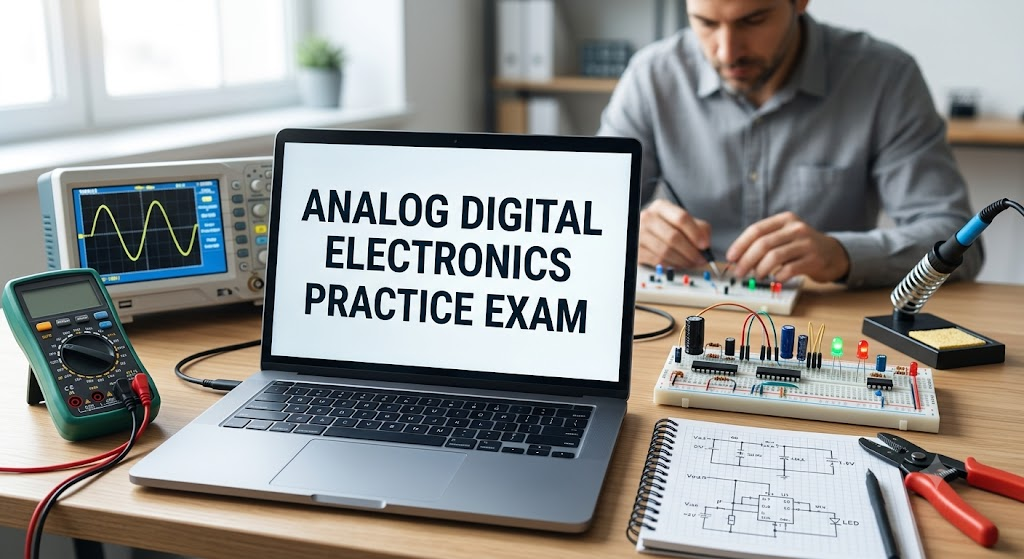
Additional Information
What the Course Entails and Exam Details
This examination covers a broad and essential syllabus that merges theoretical concepts with modern practical application. Successful candidates must demonstrate proficiency across the entire electronics spectrum, mastering subjects that are crucial for today’s integrated technological landscape. The core competency areas you will be tested on include:
Analog Electronics Fundamentals: Principles of AC and DC electricity; Ohm’s Law and Kirchhoff’s laws; analysis of passive components including resistors, capacitors, and inductors; operation of diodes, transistors (BJT and MOSFET), and operational amplifiers (Op-Amps) in amplifier and oscillator configurations.
Digital Electronics Fundamentals: Representation of data using binary and hexadecimal systems; Boolean algebra and logic simplification (Karnaugh Maps); operation of logic gates (AND, OR, NOT, NAND, NOR, etc.); combinational logic (encoders, decoders, multiplexers); and sequential logic circuits (flip-flops, counters, registers).
Mixed-Signal and Systems Engineering: Understanding how analog and digital worlds intersect, including Analog-to-Digital Converters (ADCs) and Digital-to-Analog Converters (DACs); signal conditioning techniques; and basic troubleshooting and measurement skills using tools like multimeters and oscilloscopes.
What to Expect in the Final Exam
Preparation is key, and understanding the exam environment will significantly reduce test anxiety. The final Analog Digital Electronics certification exam is designed to rigorously test both computational ability and conceptual understanding, usually offered in a proctored, standardized format. The specific parameters you should expect include:
Exam Format: The test typically consists of 60 to 90 objective-style questions, which may include multiple-choice, multiple-response, or matching items that require either theoretical analysis or direct calculation.
Passing Score: The passing benchmark is generally set between 70% and 75%, depending on the specific certifying body administering the examination, although some institutions may use a scaled scoring system.
Time Limit: You will be allocated approximately 90 to 120 minutes to complete the assessment, requiring a balanced approach of accuracy and speed.
Testing Environment: Most often, this is a closed-book examination. Prohibited items usually include reference materials, smartphones, and programmable calculators, though basic scientific calculators are frequently permitted.
How to Study and Exam Centers
Preparation requires a dedicated, dual-pronged strategy that emphasizes both understanding theoretical definitions and practicing computational problem-solving. This practice test itself is a critical tool for identifying knowledge gaps and simulating the time pressure of the actual exam. Combine the use of this practice test with a detailed review of standard electronics textbooks and video lectures to build a robust theoretical foundation. For the mathematical components (such as circuit analysis), practice solving problems from memory and then check your work. Leveraging circuit simulation software, such as SPICE-based programs, will also solidify your practical understanding of complex systems.
When you are ready to take the official certification exam, you will have several options for administration:
Authorized Testing Centers: Many examinations are administered globally through recognized testing networks like Pearson VUE or Prometric, which provide secure, physical testing sites.
Educational Institutions: If you are a student, your college or university may be an authorized testing site for this or related electronics certifications.
Online Proctored Exams: Increasingly, candidates may take the exam from home via an online platform, requiring a computer with a webcam, a stable internet connection, and strict adherence to remote proctoring guidelines.
Job Opportunities from the Course
A certification demonstrating proficiency in both analog and digital concepts is highly valued by employers, as it shows you possess the versatile skills necessary to work across diverse sectors of the technology industry. Earning this qualification unlocks numerous rewarding career paths, including, but not limited to, the following positions:
Electronics Technician
Hardware Engineering Assistant
Embedded Systems Technician
Automation and Robotics Technician
Test and Measurement Engineer
PCB Design and Assembly Technician
Telecommunications Equipment Installer
Consumer Electronics Repair Specialist
Frequently Asked Questions
Reviews
5.0
Based on 0 reviews
Leave a Review
No reviews yet. Be the first to review!