
AN/PRC-160 and AN/PRC-163 Radio Operations and Antenna Theory Practice Test
$69.00
- Buy to unlock unlimited access to all Quiz questions.
- After purchase you can print a PDF of the whole quiz at any point. The PDF will contain the questions and the correct answers.
About this Exam
The AN/PRC-160 and AN/PRC-163 Radio Operations and Antenna Theory Practice Test is a comprehensive assessment designed for military communications professionals, defense contractors, and advanced radio operators seeking to validate their proficiency.
This exam focuses on two of the most advanced tactical radio systems in use today: the L3Harris AN/PRC-160(V) Wideband HF/VHF Manpack Radio and the AN/PRC-163 Multi-channel Handheld Radio. Mastering these systems is crucial for ensuring reliable, secure, and resilient communications in challenging operational environments across the globe.
Ready to test your knowledge?
Buy Now to Access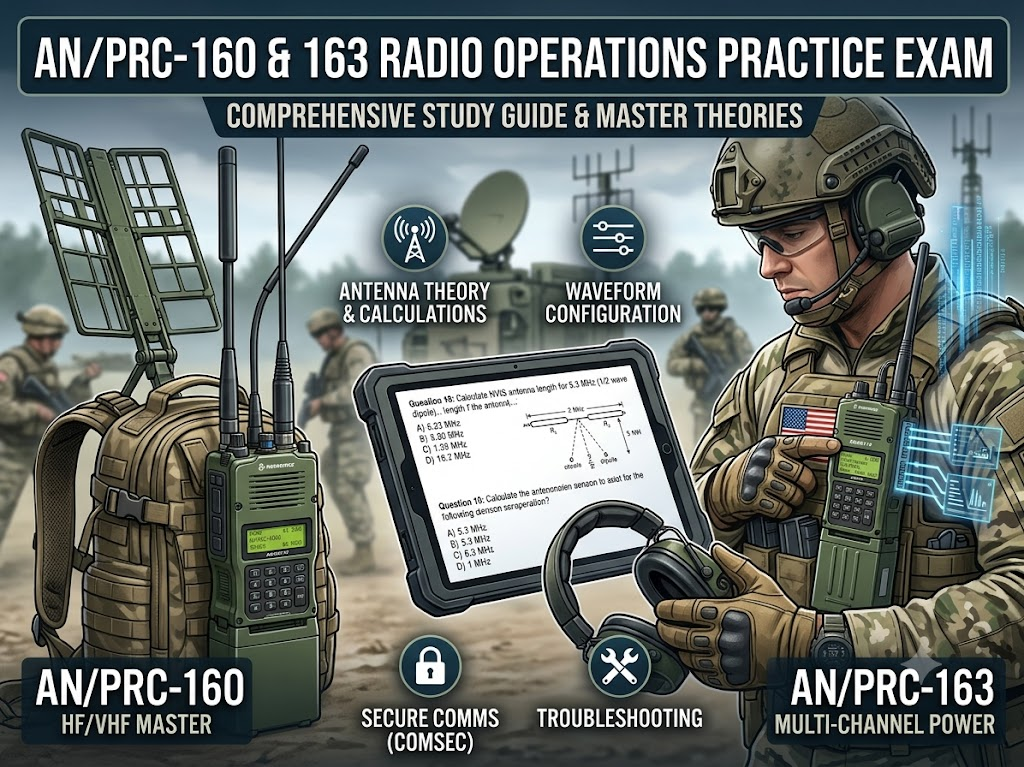
Additional Information
What the Course Entails and Exam Details
This practice test ensures mastery over a wide array of technical and operational domains. The material is organized into core modules that mirror the functionalities of the actual radios.
Radio Operations and Configuration:
Detailed initialization and programming procedures for both the AN/PRC-160 and AN/PRC-163.
Understanding and configuring waveforms, including HF, VHF, and UHF, for voice and data.
Setting up and managing communication networks, including point-to-point and networked modes.
Expertise in security procedures, COMSEC loading, and transmission security (TRANSEC).
Antenna Theory and Application:
Fundamental principles of radio frequency (RF) propagation, with a heavy emphasis on Near Vertical Incidence Skywave (NVIS) and ground wave.
Selection, calculation, and deployment of appropriate antennas for specific mission requirements (e.g., whip, dipole, long-wire).
Antenna matching and tuning techniques to maximize efficiency and range.
What to Expect in the Final Exam
The actual exam is designed to be a rigorous and comprehensive test of practical knowledge. While specific details can vary by authorized testing bodies, students should anticipate the following structure:
Format: A combination of multiple-choice questions, scenario-based problem solving, and detailed calculation problems regarding antenna theory and RF propagation.
Number of Questions: Typically between 60 and 100 questions, covering all modules.
Passing Score: Students generally require a score of 80% or higher to pass, reflecting the critical nature of these communications systems.
Time Limit: Expect a strict time limit, often around 90 to 120 minutes, simulating the time-sensitive pressure of field operations.
Prerequisites: Familiarity with basic radio principles is required. Many organizations recommend prior completion of an authorized 40-hour hands-on operator course before attempting the exam.
How to Study and Exam Centers
Preparation for this challenging exam requires a strategic approach. Students must balance theoretical knowledge with practical familiarity.
Actionable Study Strategies:
Utilize Official Manuals: The definitive resource is the technical manual (TM) for both the AN/PRC-160 and AN/PRC-163. Memorize key specifications and configuration sequences.
Practice with Real Equipment: Theoretical study is insufficient. Maximize "knob-turning" time on actual radios. Practice every operation until it is muscle memory.
Engage with Scenarios: Create and solve realistic communication failure scenarios. How would you establish links in a jungle, urban, or arctic environment?
Master the Calculations: Practice all required antenna length and frequency calculations until you can perform them accurately under time pressure.
Exam Centers:
The exam is not typically offered at general public centers. It is usually administered by specific entities.
Military Units: Authorized communications personnel within military units.
Authorized Schools: Specific defense and tactical training schools that offer certified L3Harris radio operator courses.
L3Harris Training facilities: Direct from the manufacturer at authorized training sites.
Online Portals: Some theoretical components may be offered through secure, proctored online portals for approved defense contractors and military personnel. Consult your unit or organization for approved locations.
Job Opportunities from the Course
Earning proficiency in these systems opens doors to specialized, high-demand roles. Validating your skills with this exam demonstrates elite capabilities in tactical communications.
Potential Career Paths and Job Titles:
Tactical Communications NCO/Specialist (Military)
Satellite and Wideband Communications Equipment Operator (MOS 25Q, 25U, or equivalent)
Radio Frequency (RF) Engineer/Technician
Field Service Representative (FSR) for Defense Contractors
Tactical Radio Instructor/Trainer
Disaster Response Communications Coordinator
System Integration and Test Engineer for Tactical Systems
Frequently Asked Questions
Reviews
5.0
Based on 0 reviews
Leave a Review
No reviews yet. Be the first to review!