
AMSCO Literary Terms and Allusions Practice Test
$69.00
- Buy to unlock unlimited access to all Quiz questions.
- After purchase you can print a PDF of the whole quiz at any point. The PDF will contain the questions and the correct answers.
About this Exam
The AMSCO Literary Terms & Allusions Practice Test is an essential diagnostic and preparation tool specifically designed for students enrolled in Advanced Placement (AP) English Literature and Composition courses. This comprehensive practice exam serves as a robust benchmark, allowing students to gauge their mastery of the intricate vocabulary and cultural references required to excel on the actual AP English Literature exam administered by the College Board. By simulating the rigors of AP-level questioning, this resource helps high school students identify critical knowledge gaps and build the analytical confidence necessary for academic success and college readiness.
Ready to test your knowledge?
Buy Now to Access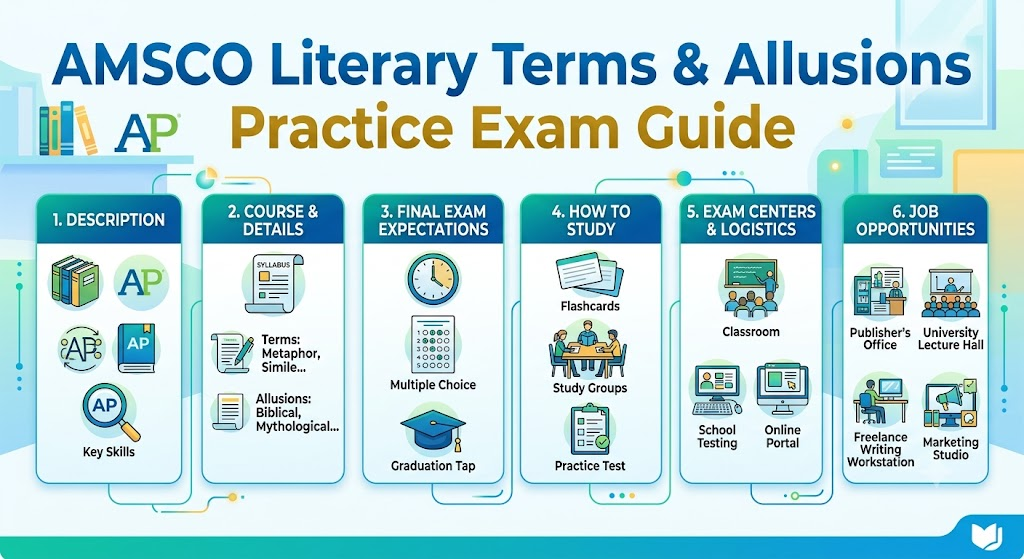
Additional Information
What the Course Entails and Exam Details
This practice exam meticulously covers the extensive scope of literary analysis required for AP credit. It evaluates a student’s ability to recognize, define, and interpret a wide array of literary terms, ranging from foundational concepts (like metaphor, simile, and personification) to advanced techniques (such as synecdoche, metonymy, and archaism). Furthermore, it heavily emphasizes the identification and interpretation of crucial literary allusions—biblical, mythological, historical, and Shakespearean—which are frequently woven into complex literary texts. Mastery of these elements is fundamental to the analytical writing and multiple-choice sections that define the final AP English Literature exam.
What to Expect in the Final Exam
While this is a practice test, it is structured to mirror the challenge and format of the official AP English Literature multiple-choice section. Students should expect a series of rigorous, passage-based and standalone questions that demand precise recall and nuanced application of knowledge. Unlike some certifications, this is not a licensed 'final exam' with a set passing score (like 70%); rather, its value is as a diagnostic tool where a 'good' score is reflective of a high probability of achieving a 4 or 5 on the actual AP exam. Students are generally advised to treat this practice with the same time pressure as the real exam, which allocates roughly one minute per question in the multiple-choice section.
How to Study and Exam Centers
Effective preparation requires a multi-faceted approach. First, leverage the AMSCO AP English Literature and Composition textbook, which typically includes extensive glossaries and diagnostic chapters. Utilize spaced repetition by creating flashcards (digital or physical) for every term and allusion. Engage in deep reading of complex texts, actively annotating for these devices. Finally, simulate the test environment by taking timing practice sessions. Regarding 'exam centers,' this practice test is typically administered within a classroom setting by an AP English teacher or accessed via online learning portals as part of a structured AP course. It is not an exam students register for independently at external testing facilities like Pearson VUE; it is an integrated component of an academic curriculum.
Job Opportunities from the Course
Excelling in AP English Literature and mastering the complex analysis supported by the AMSCO materials demonstrates an exceptional command of critical thinking, communication, and interpretation. While a single practice test does not unlock a specific job, achieving a high score on the final AP English Literature exam can earn college credit, providing a significant advantage in several fields. The skills validated by this academic rigor are foundational for success in various career paths:
Editor (Digital or Print)
Publisher's Reader/Assistant
Copywriter and Advertising Professional
Content Marketer and Strategist
Academic Tutor/High School English Teacher (Post-Licensure)
Freelance Writer/Journalist
Lawyer (The critical analysis skills are highly relevant to legal studies)
Communications Specialist
Literary Agent Assistant
These roles frequently require candidates who can analyze complex arguments, communicate with precision, and synthesize information—skills explicitly measured by rigorous preparation for AP English.
Frequently Asked Questions
Reviews
5.0
Based on 0 reviews
Leave a Review
No reviews yet. Be the first to review!