
AMSCO AP United States History Exam (APUSH) – Period 4 Practice Test
$69.00
- Buy to unlock unlimited access to all Quiz questions.
- After purchase you can print a PDF of the whole quiz at any point. The PDF will contain the questions and the correct answers.
About this Exam
The AMSCO AP United States History Exam (APUSH) – Period 4 Practice Test is an essential study tool designed for high school students preparing for the demanding College Board AP U.S. History Exam. This specific practice assessment focuses entirely on the critical historical era spanning 1800 to 1848, commonly known as the Period 4 in the APUSH curriculum. It is a targeted resource for students using the popular AMSCO Advanced Placement United States History review book and is meant to test knowledge and skills specific to this transformative time in American history. By simulating the exam experience for this key unit, it helps students gauge their understanding, identify areas for improvement, and build confidence before the comprehensive final exam.
Ready to test your knowledge?
Buy Now to Access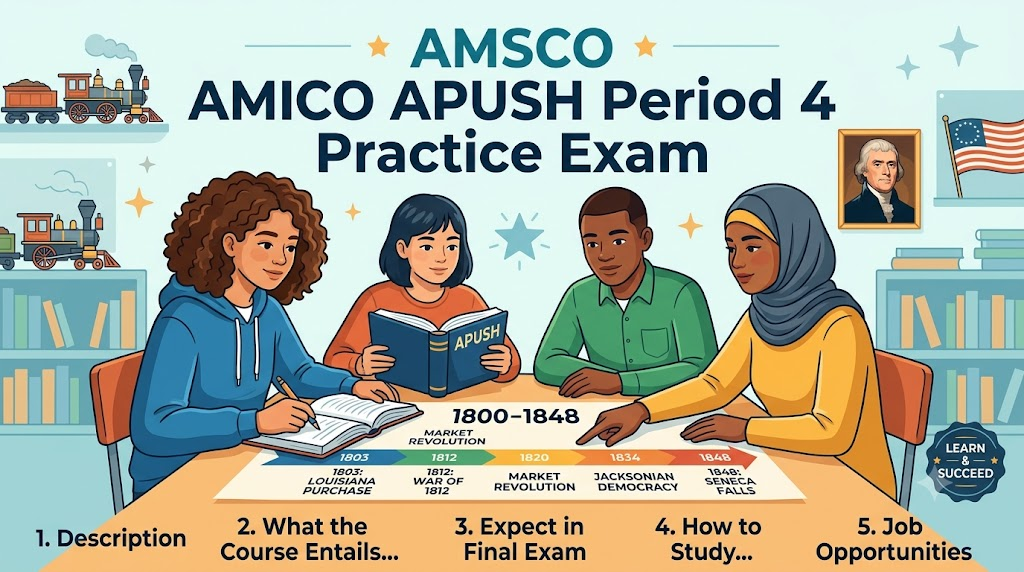
Additional Information
What the Course Entails and Exam Details
This "course" details the tumultuous and growth-filled decades in early American history (1800-1848). Key topics covered include the rise of political parties with a focus on the Jeffersonian Era and Jacksonian Democracy, massive territorial expansion like the Louisiana Purchase and the pursuit of Manifest Destiny, the influential Market Revolution and early industrialization, significant social reforms including the abolition movement and early women’s rights, and the deepening sectional tensions surrounding federal power and the expansion of slavery.
The practice exam itself typically mirrors the multiple-choice question format of the official APUSH exam but isolates questions specifically to these Period 4 concepts. It aims to evaluate a student's ability to analyze primary and secondary sources, understand cause and effect, recognize historical continuity and change, and compare different historical developments within this distinct era. Students can expect several multiple-choice question sets, often accompanied by historical stimuli like excerpts from documents, maps, or political cartoons.
What to Expect in the Final Exam
While the AMSCO Period 4 test is a practice assessment, it's a vital step towards succeeding on the final College Board AP United States History Exam. The official APUSH exam, taken globally each May, is a comprehensive evaluation covering nine historical periods from 1491 to the present. It consists of multiple sections and formats:
Section I, Part A: 55 multiple-choice questions (55 minutes, 40% of score)
Section I, Part B: 4 short-answer questions (40 minutes, 20% of score)
Section II, Part A: 1 document-based question (DBQ) (60 minutes, including 15-minute reading period, 25% of score)
Section II, Part B: 1 long essay question (40 minutes, 15% of score)
To pass and potentially earn college credit, students aim for a score between 3 and 5 on the 1-5 College Board scale. The requirements include both strong historical content knowledge and refined analytical and writing skills, which this practice test directly helps to develop for Period 4 content. The actual final exam is timed rigorously and demands both depth and breadth of historical understanding. Strong performance on focused period practices like this one is a strong predictor of overall success.
How to Study and Exam Centers
Preparation for the AMSCO APUSH Period 4 Practice Test – and the final exam – requires a combination of diligent study, active recall, and practiced application of skills. Students should:
Master the AMSCO Text: Dedicate time to thoroughly reading and reviewing the relevant Period 4 chapters in the AMSCO book, paying close attention to bolded terms, key dates, and historical arguments.
Create Timelines & Concept Maps: Visualizing the sequence of events and connection between themes (e.g., the Market Revolution, Jackson's presidency, and reform movements) is highly effective.
Use Active Recall: Quiz yourself with flashcards for key people, terms, cases (e.g., Marbury v. Madison, McCulloch v. Maryland), and legislation.
Practice Historical Thinking: When answering questions, focus not just on what happened, but why it happened, its impact, and how it connects to other periods. Analyze the purpose and perspective of any historical stimuli.
Simulate Test Conditions: Take the practice test in a quiet, timed environment to build stamina and familiarity with the pressure of the exam.
Regarding Exam Centers: This is a practice test often provided within study materials, an associated online portal for students using the book, or assigned by a classroom teacher. There is no central external testing center specifically for the practice test; it is generally self-administered or proctored within a school setting. For the official College Board AP United States History Exam, students take the test at their high school (if a participating AP school) or at designated, authorized external testing centers and approved schools. Information on registering and finding the nearest official AP exam center is provided through the College Board website.
Job Opportunities from the Course
A strong understanding of United States history and the analytical, critical thinking, and writing skills honed through APUSH study and assessments like this practice exam are highly valued in numerous professional fields. While no direct job title is unlocked solely by a practice test or even the course itself, success in APUSH is a substantial academic achievement that demonstrates qualities and skills beneficial in the following career paths:
Higher Education and Academia: Succeeding in APUSH can earn college credits and provides a foundational step for those pursuing history, political science, sociology, or law. This can eventually lead to roles such as professors, researchers, and university lecturers.
Law and Policy: The rigorous analysis of legal precedents (e.g., Marshall Court cases from Period 4), constitutional issues, and societal changes is excellent preparation for legal careers. Skills are highly transferable to positions as lawyers, legal analysts, and legislative aides.
Education: A strong historical background is essential for future history teachers and educators at all levels, enabling them to inspire future generations.
Government and Public Service: Historical perspective is crucial for roles in government administration, policy analysis, diplomacy, and urban planning. Key jobs include policy analysts, urban planners, and civil servants.
Journalism and Communication: The ability to digest complex information, understand societal context, and communicate clearly and persuasively is vital for journalists, writers, and communication professionals. Career paths include newspaper editors, investigative reporters, and public relations specialists.
Museums and Archives: Curators, archivists, and historical preservationists utilize deep historical knowledge to manage collections and interpret the past for the public.
Business and Leadership: Analytical thinking, complex problem solving, and understanding the historical context of markets and economic systems (relevant to the Market Revolution) are significant assets for roles in market analysis, management, and strategic planning.
By excelling in your APUSH studies and using focused tools like this Period 4 Practice Test, you are not just preparing for an exam but also building a robust skill set that will serve you well in college and your future career. Keep studying, stay curious, and approach this transformative period with diligence and historical curiosity!
Frequently Asked Questions
Reviews
5.0
Based on 0 reviews
Leave a Review
No reviews yet. Be the first to review!