
AMSCO AP United States History Exam (APUSH) – Period 3 Practice Test
$69.00
- Buy to unlock unlimited access to all Quiz questions.
- After purchase you can print a PDF of the whole quiz at any point. The PDF will contain the questions and the correct answers.
About this Exam
The AMSCO APUSH Period 3 Practice Test is a vital self-assessment tool designed for students preparing for the official AP United States History exam. This specific practice test focuses exclusively on Period 3 (1754–1800), which covers the crucial foundational years of the United States. It is designed for students seeking to master the context of the American Revolution, the formation of the young republic, and early challenges to the new government. It allows you to identify strengths and weaknesses in your historical reasoning skills, contextualization, and factual recall specific to this critical era.
Ready to test your knowledge?
Buy Now to Access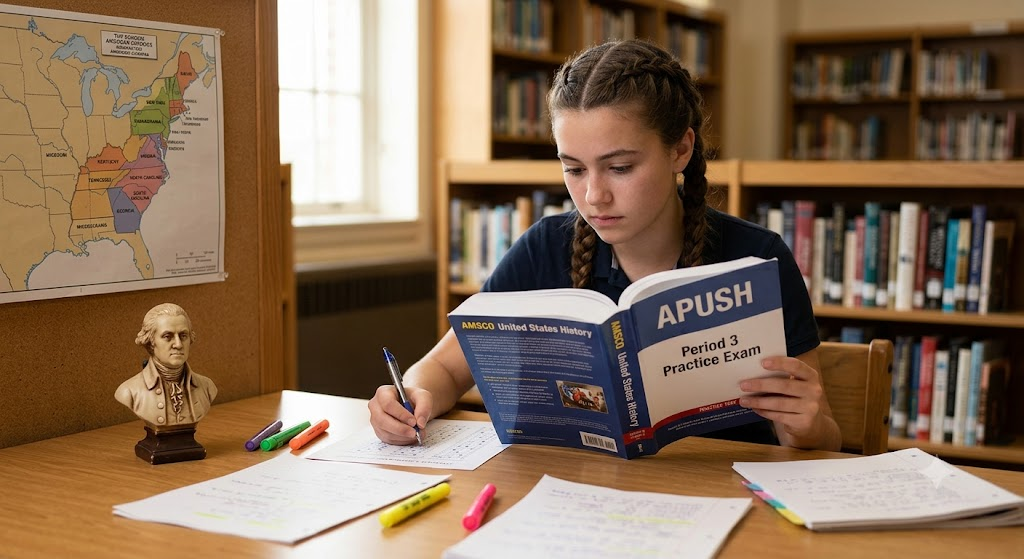
Additional Information
What the Course Entails and Exam Details
This practice test is derived from the concepts covered in Chapter 3 of the popular AMSCO Advanced Placement United States History publication. The material covered spans key themes that define the birth of the American nation:
The French and Indian War (1754–1763): Its impact on the relationship between Britain and its colonies, and the subsequent end of salutary neglect.
The Causes of the American Revolution: A detailed look at British acts (Stamp Act, Townshend Acts, etc.), colonial resistance, and the intellectual arguments for independence (Enlightenment, Thomas Paine’s Common Sense).
The War for Independence: Significant battles, the Declaration of Independence, and the factors contributing to the eventual American victory.
The Articles of Confederation: The weaknesses of the first national government and its failures to address economic and social challenges (e.g., Shays’ Rebellion).
The Constitutional Convention and the New Constitution: Debates over representation, the balance of power, the Bill of Rights, and the development of Federalism.
The Early Republic (1789–1800): The Presidencies of Washington and Adams, the rise of the first party system (Federalists vs. Democratic-Republicans), challenges to neutrality, and major domestic disputes like the Whiskey Rebellion.
The practice test aims to simulate the types of questions found on the actual APUSH exam but focused entirely on these historical concepts.
What to Expect in the Final Exam
The actual AP United States History exam, of which Period 3 is a significant portion, follows a strict format that you must be prepared for:
Format: The full APUSH exam includes:
Section I: Part A: Multiple Choice Questions (55 questions, 55 minutes)
Section I: Part B: Short-Answer Questions (3 questions, 40 minutes)
Section II: Part A: Document-Based Question (1 question, 60 minutes)
Section II: Part B: Long Essay Question (1 question, 40 minutes)
Focus: Period 3 (1754–1800) typically accounts for approximately 10-17% of the total content weighting on the full exam.
Scoring: The AP exam is scored on a 1-5 scale, with scores of 3 or higher generally considered "passing" and potentially eligible for college credit or advanced placement at many institutions.
Skills Tested: Beyond content recall, the exam heavily emphasizes historical thinking skills: Contextualization, Comparison, Causation, and Continuity and Change Over Time (CCOT).
The AMSCO Period 3 Practice Test is a simulation often featuring primarily Multiple Choice Questions (MCQs) and potentially an LEQ or Short Answer related to that specific period.
How to Study and Exam Centers
Study Strategies
To maximize your performance on the Period 3 practice test and the final AP exam, focus on these actionable strategies:
Master the AMSCO Text: The best resource for this specific practice test is the AMSCO APUSH publication itself. Read Chapter 3 meticulously, paying close attention to the thesis-based structure and key historical events.
Develop Context and Connection: Don’t just memorize dates. Understand why events happened (causation) and how they fit into the larger historical story. For instance, link the debt from the French and Indian War to the imposition of British taxes, which in turn fueled the argument for "no taxation without representation."
Focus on Primary Sources: Practice analyzing excerpts from documents like the Declaration of Independence, the Constitution, and Federalists/Anti-Federalist arguments. You must be able to identify the author’s point of view, audience, purpose, and historical context.
Simulate Exam Conditions: When taking the AMSCO practice test, do so in a quiet room, time yourself strictly, and avoid using notes. This helps you build pacing and mental stamina for the real exam.
Analyze Your Mistakes: After completing the test, don’t just look at the score. Thoroughly review every question you missed. Understand why the correct answer is right and why your chosen answer was incorrect.
Exam Centers
It is crucial to understand the difference between this practice test and the actual official AP Exam:
The Practice Test: The AMSCO APUSH Period 3 Practice Test is generally found within the AMSCO student workbook or provided through an instructor's resources. It is typically taken at home or in your high school classroom as part of your study plan. There are no external testing centers for this practice assessment.
The Official AP Exam: The official AP U.S. History Exam is administered by the College Board and only takes place during specified dates in May. These exams are always administered at authorized high schools or testing facilities, often organized by your school's AP Coordinator. You must register in advance through your school to take the final AP exam.
Job Opportunities from the Course
While taking a single practice test or even the full AP U.S. History course does not lead directly to professional certification, earning a high score (4 or 5) can open significant academic and career pathways:
Immediate Benefits: You can earn valuable college credit, which can save substantial tuition costs and allow you to enroll in advanced history or political science courses earlier in your college career. A strong APUSH score also significantly enhances your college application, demonstrating academic rigor to admissions officers.
Long-Term Career Paths: Students who excel in AP U.S. History and continue to study related fields in college are well-positioned for dynamic careers in:
Law and Legal Services
Politics and Government (Local, State, Federal)
Higher Education and Research (History Professors)
Public Policy and Advocacy
Journalism and Media
Archivists and Museum Curators
Prepare effectively by mastering the content of Period 3, refining your historical skills, and using this practice test as a critical tool for self-improvement!
Frequently Asked Questions
Reviews
5.0
Based on 0 reviews
Leave a Review
No reviews yet. Be the first to review!