
AMSCO AP United States History Exam (APUSH) – Period 2 Practice Test
$69.00
- Buy to unlock unlimited access to all Quiz questions.
- After purchase you can print a PDF of the whole quiz at any point. The PDF will contain the questions and the correct answers.
About this Exam
This article provides a comprehensive study guide for students preparing for the AMSCO Advanced Placement United States History (APUSH) Exam, specifically focusing on Period 2 (1607–1754). This critical era explores the development of early American colonies, the interaction between European powers, and the growth of transatlantic trade and labor systems. This guide and practice test are designed for high school students enrolled in an APUSH course or self-studying to earn college credit. Achieving a high score demonstrates a sophisticated understanding of early American history, preparing students for advanced academic work.
Ready to test your knowledge?
Buy Now to Access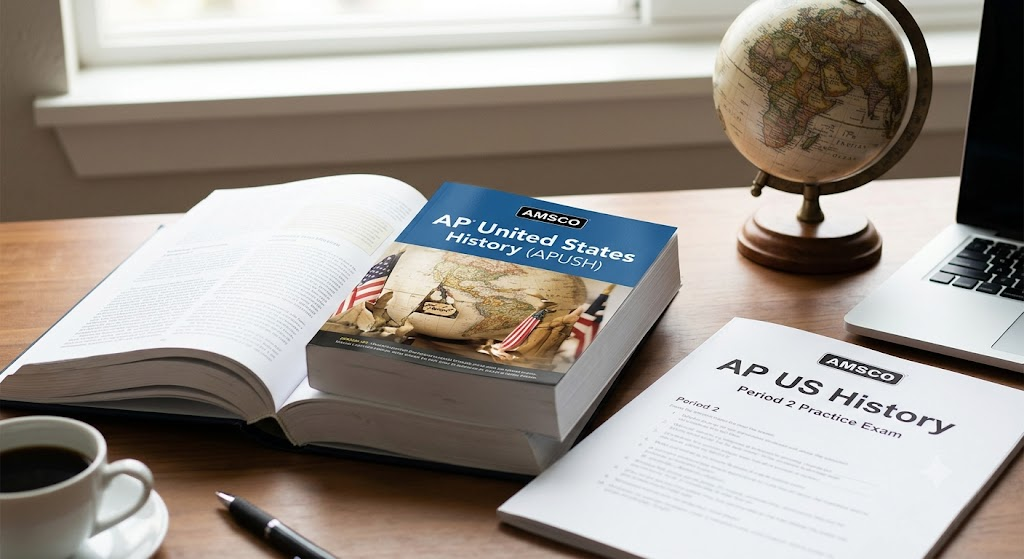
Additional Information
What the Course Entails and Exam Details
The AP U.S. History course is designed to provide students with the analytic skills and factual knowledge necessary to deal critically with the problems and materials in U.S. history. For Period 2 (1607–1754), students must develop a thorough understanding of:
Comparison of Colonization Models: Analyze the differing goals and cultures of the Spanish, French, Dutch, and British colonizers in North America.
The British Colonies: Examine the distinct regional development of the New England, Middle, and Southern colonies, including their social structures, economies, and political systems.
Transatlantic Trade: Understand the emergence of the "triangular trade" and mercantilism, and the pivotal role of the Middle Passage.
Labor Systems: Track the transition from indentured servitude to chattel slavery in the British colonies.
Key Conflicts and Shifts: Analyze major events such as Bacon's Rebellion, the Pueblo Revolt, the First Great Awakening, and the Enlightenment's early influence.
The exam details listed below apply to the full AP U.S. History Exam; a specific unit practice test would select from these question types to simulate the experience.
What to Expect in the Final Exam
The final AP U.S. History Exam is a rigorous test that evaluates both content knowledge and historical thinking skills. The format is split into two sections:
Section I (1 hour 35 minutes, 60% of total score):
Part A: Multiple Choice Questions (55 questions, 55 minutes). These are "stimulus-based," meaning they are grouped around a specific historical document, map, or image. (40% of score).
Part B: Short-Answer Questions (3 questions, 40 minutes). Students must analyze historical sources or themes. (20% of score).
Section II (1 hour 40 minutes, 40% of total score):
Part A: Document-Based Question (DBQ) (1 question, 60 minutes). Students must write an essay using seven provided documents as evidence. (25% of score).
Part B: Long Essay Question (LEQ) (1 question, 40 minutes). Students must choose one of three essay prompts and develop an argument using evidence from their knowledge base. (15% of score).
A passing score on the AP scale (1 to 5) is typically considered a 3 or higher, though many competitive colleges may only grant credit for a 4 or 5.
How to Study and Exam Centers
Preparation for the APUSH Period 2 test should be systematic and evidence-based. Here are actionable strategies for success:
Master Key Concepts: Do not just memorize dates; focus on thematic analysis. Can you compare the economic motivations of New England vs. Virginia? Can you explain the causes and consequences of the Stono Rebellion?
Use AMSCO Effectively: Utilize the specific "AMSCO Advanced Placement United States History" textbook, focusing on Chapters 2 and 3. Pay attention to the essential questions and the practice questions at the end of the unit.
Practice with Stimulus-Based MCQs: Review past AP tests and specifically practice identifying the author’s perspective and argument within the stimulus documents.
Develop Historical Skills: Actively practice writing SAQs that use the CER (Claim, Evidence, Reasoning) method. For DBQs, practice grouping documents and using evidence to support your thesis, rather than just summarizing them.
Simulate Test Conditions: Take the AMSCO Period 2 practice test under timed conditions to improve pacing.
Exam Centers: The final AP U.S. History Exam is administered on a single, nationwide date (typically in early May) at authorized AP test centers. These are almost always high schools. Students must register through their school’s AP Coordinator by the college board's designated deadline. For specific physical testing locations or to find an authorized school near you, consult the College Board AP Course Ledger.
Job Opportunities from the Course
While APUSH itself is an academic foundation rather than a vocational certification, achieving a high score demonstrates the refined analytical, research, and communication skills that are highly valued by employers in many prestigious fields. A degree in history or related areas (often accelerated by AP credit) can lead to the following career paths:
History Professor
Museum Curator
Archivist
Historian
Lawyer or Legal Analyst
Policy Advisor or Political Analyst
Intelligence Officer
Journalist or Author
Documentarian
Secondary Education Teacher
Nonprofit Director
Public Administrator
Frequently Asked Questions
Reviews
5.0
Based on 0 reviews
Leave a Review
No reviews yet. Be the first to review!