
AMSCO AP United States History Exam (APUSH) – Period 1 Practice Test
$69.00
- Buy to unlock unlimited access to all Quiz questions.
- After purchase you can print a PDF of the whole quiz at any point. The PDF will contain the questions and the correct answers.
About this Exam
The AMSCO AP United States History (APUSH) Period 1 Practice Test is an essential study tool designed for high school students preparing for the challenging AP United States History exam administered by the College Board. This practice test specifically targets Period 1, which covers the formative era of American history from 1491 to 1607.
It is designed for students enrolled in APUSH courses who want to master the content, chronological reasoning, and analytical skills required for success on the official exam. This practice resource helps students assess their understanding of the complex interactions, cultural developments, and early political structures that shaped the Americas before and during the initial phase of European colonization.
Ready to test your knowledge?
Buy Now to Access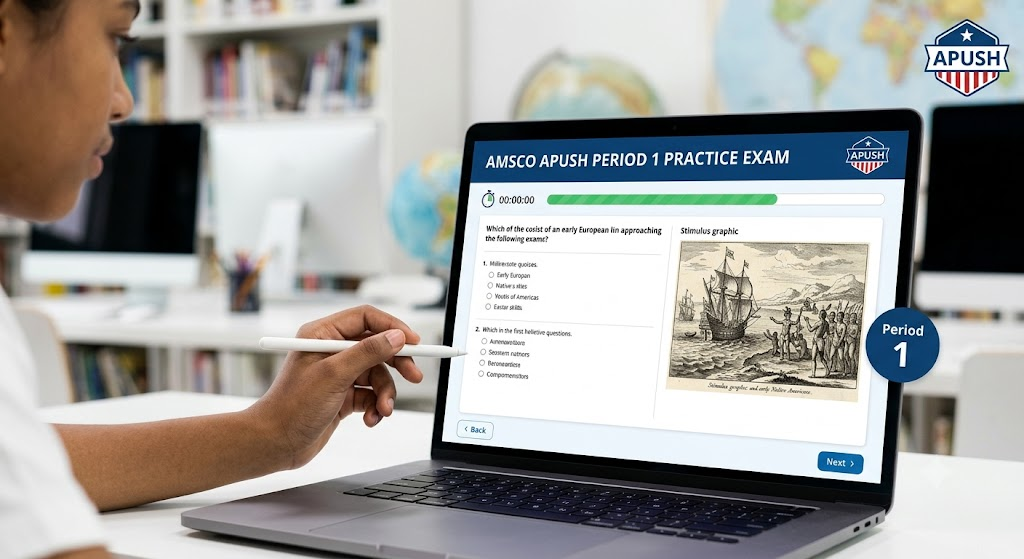
Additional Information
What the Course Entails and Exam Details
The APUSH course itself is a year-long, college-level survey course covering United States history from the pre-Columbian era to the present. It emphasizes critical thinking, document analysis, and historical argumentation. The course is structured around nine chronological periods.
Period 1 (1491-1607) focuses on the following key concepts and content areas, which are reflected in the practice test:
Native American Societies: The diverse cultures, economies, and social structures of indigenous populations across North America before European contact, shaped by their distinct environments.
European Exploration and Conquest: The motivations (economic, religious, political) and strategies of various European powers (Spanish, French, British, Dutch) as they explored and colonized the Americas.
The Columbian Exchange: The profound and far-reaching exchange of plants, animals, diseases, technologies, and ideas between the Old World and the New World, and its impact on both hemispheres.
Early Contact and Conflict: The complex interactions between Native Americans, Europeans, and Africans, including cooperation, conflict, and the emergence of new social and racial hierarchies (such as the Spanish encomienda system).
Labor Systems: The development of early labor systems, including the use of Native American labor and the beginnings of the trans-Atlantic slave trade.
The practice test typically consists of multiple-choice questions modeled after the format of the actual APUSH exam. These questions require students to not only recall factual information but also to analyze historical documents (such as excerpts, images, maps, and data), identify historical patterns, and evaluate historical interpretations.
What to Expect in the Final Exam
It is important to remember that the AMSCO Period 1 Practice Test is a study resource and not the official College Board AP United States History Exam. The official APUSH exam is administered annually in May.
The actual APUSH final exam has a total testing time of 3 hours and 15 minutes and is structured as follows:
Section I, Part A: Multiple Choice (55 questions | 55 minutes | 40% of score) – These are stimulus-based questions requiring analysis of primary and secondary sources.
Section I, Part B: Short-Answer Questions (3 questions | 40 minutes | 20% of score) – These require students to analyze historical evidence and develop coherent arguments.
Section II, Part A: Document-Based Question (DBQ) (1 question | 60 minutes, including a 15-minute reading period | 25% of score) – Students must construct an argument using a provided set of documents.
Section II, Part B: Long Essay Question (LEQ) (1 question | 40 minutes | 15% of score) – Students must develop an argument on a specified historical topic, using evidence from their knowledge base.
To achieve a passing score (typically a 3 or higher on the 1-5 scale) that may earn college credit, students must demonstrate a strong command of the course content and the ability to apply historical thinking skills under timed conditions.
How to Study and Exam Centers
How to Study Effectively:
Thorough Review: Closely read the Period 1 chapters in your AMSCO textbook (or other APUSH review book). Pay close attention to key terms, individuals, events, and thematic developments.
Take Detailed Notes: As you review, create outlines, concept maps, or flashcards for essential vocabulary, critical dates, and the major arguments associated with Period 1.
Practice with Stimulus Material: The core of APUSH success is analyzing historical documents. Practice reading and interpreting primary and secondary sources, identifying the author’s perspective, purpose, and audience.
Utilize the Practice Test: Take the AMSCO Period 1 Practice Test under timed conditions to simulate the exam environment. Review all answers, understanding not just why the correct answer is right, but also why the distractors are wrong.
Focus on Historical Thinking Skills: Actively practice comparison, causation, continuity and change over time, and contextualization as they apply to Period 1 content.
Join Study Groups: Discussing concepts and practicing document analysis with peers can provide new insights and reinforce your understanding.
Exam Centers:
Because the AMSCO Practice Test is a study supplement, you generally access it through your textbook purchase or an authorized educational platform used by your school.
The official College Board APUSH Exam is administered at registered high schools. Students typically register for the AP exam through their school’s AP Coordinator in the fall or early spring. The exam takes place on a specific date in May determined by the College Board.
Job Opportunities from the Course
While APUSH itself is a high school course, success in the course and on the exam develops valuable analytical, writing, and critical thinking skills that are highly sought after in many careers. Achieving college credit can also accelerate your path toward degrees in relevant fields.
Careers that strongly align with the skills and knowledge developed in APUSH include:
High School History Teacher
College Professor (specializing in American History)
Museum Curator
Archivist or Records Manager
Historian for government agencies, historical societies, or private organizations
Librarian (with a focus on research or special collections)
Archaeologist or Anthropologist
Lawyer or Legal Analyst
Political Scientist or Policy Advisor
Journalist (especially covering history, politics, or social issues)
Foreign Service Officer
Public Administrator
Technical Writer (specializing in historical or educational content)
Frequently Asked Questions
Reviews
5.0
Based on 0 reviews
Leave a Review
No reviews yet. Be the first to review!