
AMSCO AP Psychology – Cognitive Psychology / Cognition Practice Test
$69.00
- Buy to unlock unlimited access to all Quiz questions.
- After purchase you can print a PDF of the whole quiz at any point. The PDF will contain the questions and the correct answers.
About this Exam
The AMSCO AP Psychology publication is a widely respected resource designed to help high school students excel in their Advanced Placement Psychology course and prepare for the cumulative College Board exam. Specifically, the Cognitive Psychology section (often referred to simply as Cognition) focuses on the intricate mental processes that dictate how humans acquire, store, and utilize knowledge. This review material and its accompanying practice tests are tailored for students seeking a deeper understanding of how we think, remember, and communicate, ultimately aiming to score a 4 or 5 on the AP Exam to earn college credit.
Ready to test your knowledge?
Buy Now to Access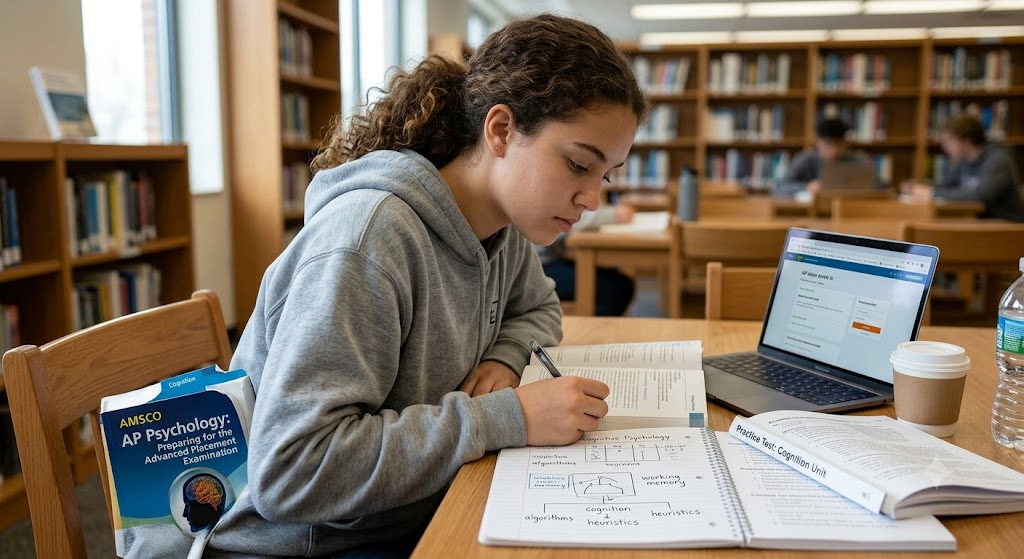
Additional Information
What the Course Entails and Exam Details
This section of the AP Psychology curriculum covers the fundamental processes of the human mind. Students will dive deep into theories of memory, including sensory, short-term, and long-term memory systems, alongside the biological bases of aging and memory distortion. The course also entails studying problem-solving strategies (like algorithms and heuristics), decision-making biases, and the structure of language acquisition. Intelligence—its measurement, theories, and the debate between genetics versus environment—is another cornerstone topic. The AMSCO guide closely parallels the College Board's unit outline, ensuring students study the exact concepts required for the final exam.
What to Expect in the Final Exam
While AMSCO provides excellent review practice tests, students must understand the format of the official AP Psychology Exam administered by the College Board in May. The final exam is divided into two sections. Section I is a 100-question multiple-choice section that lasts 1 hour and 10 minutes, making up 66.7% of the total score. This section tests factual knowledge, conceptual understanding, and the application of psychological theories. Section II consists of two free-response questions (FRQs) that require students to apply psychological concepts to real-world scenarios or analyze psychological research. Students have 50 minutes for this section, which counts for the remaining 33.3% of the score. The final score is reported on a scale of 1 to 5.
How to Study and Exam Centers
Effective preparation requires more than passive reading. Students should utilize the AMSCO practice test as a diagnostic tool. Take the test under timed conditions to simulate the pressure of the actual exam, then rigorously review every incorrect answer to understand the gap in knowledge. Active study techniques, such as creating concept maps for memory models or using flashcards for key vocabulary (e.g., proactive interference, availability heuristic), are highly effective. The physical AMSCO book is a personal study resource, not an official testing center. The official AP Psychology Exam is taken annually in May at the student's high school or an authorized testing location.
Job Opportunities from the Course
A strong performance in AP Psychology, particularly in the foundational area of cognition, opens doors to various psychology-related college majors and future career paths. Understanding mental processes is valuable in many fields. Here are potential careers for students who excel in this subject:
Psychologist (Clinical, Counseling, or Research)
Cognitive Scientist / Neuroscientist
Human Resources Specialist
Market Research Analyst
User Experience (UX) Researcher/Designer
Educator (High School or University Level)
Occupational Therapist
Speech-Language Pathologist
Frequently Asked Questions
Reviews
5.0
Based on 0 reviews
Leave a Review
No reviews yet. Be the first to review!