
AMPP Basic Coatings Inspector (CIP Level 1) Certification Practice Exam
$69.00
- Buy to unlock unlimited access to all Quiz questions.
- After purchase you can print a PDF of the whole quiz at any point. The PDF will contain the questions and the correct answers.
About this Exam
The AMPP Basic Coatings Inspector (CIP Level 1) Certification is the global benchmark for entry-level coatings inspection professionals. This certification, administered by the Association for Materials Protection and Performance (AMPP), is designed for individuals seeking to embark on a career in corrosion control, specifically focusing on the inspection of protective coatings applied to steel substrates. The program provides the foundational knowledge and practical skills required to perform basic, non-destructive inspections under the supervision of a qualified inspector. It is an essential credential for inspection trainees, quality assurance/control personnel, project managers, engineers, contractors, and technical sales representatives involved in the industrial coatings industry. By earning this certification, professionals demonstrate their understanding of coating materials, application techniques, surface preparation standards, and inspection documentation.
Ready to test your knowledge?
Buy Now to Access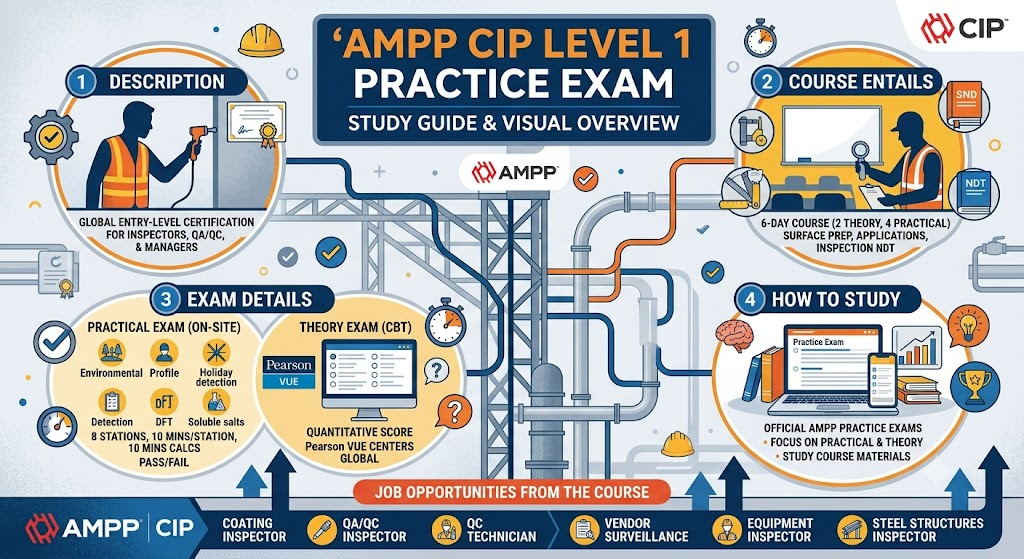
Additional Information
What the Course Entails and Exam Details
The path to certification begins with the intensive AMPP Coating Inspector Program Level 1 (CIP1) course, a comprehensive six-day program. This course blends classroom theory with extensive hands-on training, with four days dedicated to practical labs. Key topics covered include: an introduction to coatings and corrosion mechanisms; the defined role, responsibilities, and ethics of a coatings inspector; and critical safety procedures. Students learn various surface preparation methods, such as solvent cleaning, hand/power tool cleaning, wet and dry abrasive blasting, and water jetting, along with the relevant industry standards (SSPC, NACE, ISO). The syllabus details diverse coating types, application methods (including brush, roller, conventional, airless, and plural component spray), and curing mechanisms. A major focus is placed on inspection testing and instrumentation, covering both environmental condition monitoring and non-destructive test methods. Essential practical skills, such as measuring surface profile, wet and dry film thickness, and performing holiday detection, are taught. Finally, students gain proficiency in reviewing job specifications, data sheets, and maintaining proper logbook documentation.
What to Expect in the Final Exam
To achieve the Basic Coatings Inspector Certification, candidates must successfully pass two separate examinations: a practical hands-on exam and a theory-based written exam.
Basic Coating Inspector Practical Exam
This exam is administered on the final day of the CIP Level 1 course at the training facility. It is a closed-book, pass/fail assessment designed to verify your hands-on proficiency with inspection instruments and procedures. The practical exam consists of eight distinct stations, with candidates allowed exactly 10 minutes per station to perform the required tests and an additional 10 minutes at the end for calculations and double-checking work.
The stations are weighted to test critical skills:
Station 1: Environmental Test (20 points)
Station 2: Anchor Pattern — Comparators and Replica Tape (20 points)
Station 3: High-Voltage DC Holiday Detector (10 points)
Station 4: Coating Thickness — Magnetic Pull-off Gauge (Type I) (10 points)
Station 5: Wet Sponge Low-Voltage Holiday Detector (10 points)
Station 6: Wet-Film Thickness Gauge (5 points)
Station 7: Coating Thickness — Constant Pressure Probe (Type II) (20 points)
Station 8: Soluble Salts (5 points)
Basic Coatings Inspector (CIP Level 1) Theory Exam
This is a comprehensive, quantitative written exam delivered via Computer-Based Testing (CBT) through Pearson VUE. Candidates must schedule this exam separately after completing the course and must pass within one year of their course completion date. The specific number of multiple-choice questions, the total time limit, and the precise passing percentage can vary, but the exam rigorously tests all the theoretical concepts covered during the six-day course, including standards, application defects, and the application of inspection principles. Passing scores are typically set between 70% and 80%.
Candidates must also complete the "Ethics for the Corrosion Professional" online course to fullfill all certification requirements.
How to Study and Exam Centers
Preparation is paramount, as the AMPP CIP Level 1 program is intensive and the exams are demanding.
Effective Study Strategies:
Master the Course Materials: Your primary study resource should be the official AMPP CIP Level 1 student manual and all handouts provided during the course.
Focus on Practical Application: The best way to prepare for the practical exam is through repeat practice. Utilize the "AMPP Practical Preparation Guide" and focus on correctly calibrating and using every piece of equipment. Dedicate additional time to stations you find challenging.
Utilize Practice Exams: AMPP includes access to an official practice exam with your course purchase. This is the single most valuable tool for familiarizing yourself with the type of questions and format you will encounter in the CBT theory exam. Third-party apps and study guides can also offer supplementary practice questions.
Form Study Groups: Collaborating with colleagues who have taken or are taking the course can help clarify difficult topics and provide a platform for practicing practical scenarios.
Review the Exam Preparation Guides: AMPP provides specific preparation guides for both the theory and practical exams, outlining the exam blueprints and what to expect.
Exam Center Information:
Practical Exam: This exam is conducted on-site on the last day of your registered AMPP CIP Level 1 course.
Theory Exam (CBT): This exam must be scheduled by the candidate through their AMPP portal and is administered at official Pearson VUE testing centers worldwide. You can select the center and time that is most convenient for you.
Job Opportunities from the Course
Earning the AMPP Basic Coatings Inspector (CIP Level 1) Certification unlocks a wide range of career paths in the industrial maintenance and construction sectors. This recognized credential provides immediate credibility and demonstrates a high standard of competence.
Specific job titles and career opportunities available to a CIP Level 1 certified professional include:
Coating Inspector
Basic Coatings Inspector
Quality Assurance (QA) Inspector
Quality Control (QC) Inspector
Quality Control Technician
Coating Inspector Trainee
Paint and Coatings Applicator Supervisor
Maintenance Supervisor
Third-Party Vendor Surveillance Inspector
Rotating Equipment Inspector
Pump Inspector
Steel Structures Inspector
The certification provides a crucial foundation for career advancement, allowing professionals to work towards higher levels of inspection, including Level 2 and Level 3 Senior Certified Coatings Inspector, further expanding their responsibility and earning potential.
Frequently Asked Questions
Reviews
5.0
Based on 0 reviews
Leave a Review
No reviews yet. Be the first to review!