
Ammunition Publications Certification Practice Exam
$69.00
- Buy to unlock unlimited access to all Quiz questions.
- After purchase you can print a PDF of the whole quiz at any point. The PDF will contain the questions and the correct answers.
About this Exam
The Ammunition Publications Certification is a specialized credential designed for individuals seeking to validate their expertise in the critical field of ammunition technical documentation and regulatory guidelines.
This certification is essential for military ordnance personnel, defense contractors, ammunition logistics specialists, and technical writers within the defense sector.
It confirms that holders possess a comprehensive understanding of the standards required to manage, author, and disseminate official manuals, guides, and technical publications related to ammunition safety, storage, maintenance, and deployment.
Achieving this certification demonstrates a high level of proficiency and commitment to safety and operational effectiveness in the defense and ammunition industries.
Ready to test your knowledge?
Buy Now to Access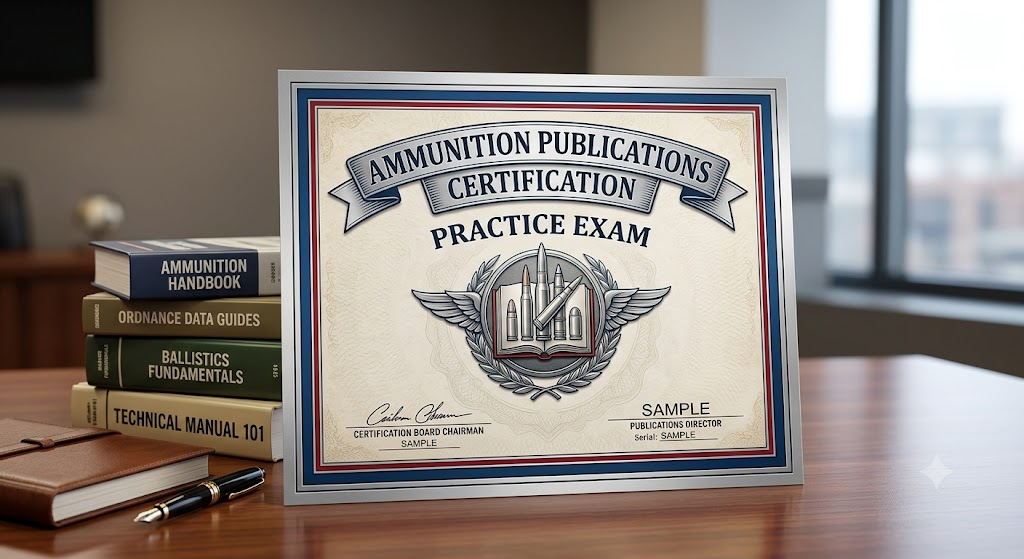
Additional Information
What the Course Entails and Exam Details
The core training curriculum for the Ammunition Publications Certification covers a wide range of essential topics. Candidates must master the intricate details of DoD and international regulations governing ammunition.
The training ensures that participants can accurately interpret ammunition classification systems, safety regulations (including explosive safety standards), and technical specification requirements.
The course syllabus typically covers the following key areas:
Understanding DoD/International Ammunition Regulations and Standards (e.g., MIL-STD, NATO STANAG).
Detailed Classification of Ammunition Types (Small Arms, Large Caliber, Guided Missiles, Explosives).
Technical Documentation Structure and Requirements (e.g., User Manuals, Maintenance Manuals, Special Bulletins).
Quality Assurance and Compliance in Ammunition Documentation.
Logistics, Identification, and Markings of Ammunition.
Ammunition Life Cycle Management and Destruction Protocols.
The final exam details include a proctored test environment with a focus on both theoretical knowledge and practical application scenario questions.
What to Expect in the Final Exam
The Ammunition Publications Certification final exam is designed to be rigorous. It is usually a closed-book, multiple-choice format, often taken online.
The number of questions typically ranges from 100 to 150, covering the entire breadth of the certification syllabus.
The time limit is usually generous but structured, with candidates having between 2 and 3 hours to complete the examination.
A passing score of at least 70% to 75% is typically required to receive the certification, ensuring that only those with a high level of competency succeed.
Questions are specifically crafted to test a candidate's ability to apply regulations and standards to real-world scenarios, not just recall facts.
How to Study and Exam Centers
A dedicated study approach is recommended for this comprehensive exam. Start by thoroughly reviewing the official certification body’s study guides and technical reference manuals.
Practice tests are an invaluable tool, allowing you to get familiar with the types of questions and the time management required during the actual exam.
Flashcards can be incredibly helpful for memorizing key regulatory numbers, acronyms, and ammunition classification codes.
Since this is often a specialized military/government-adjacent certification, the exam is usually administered via secured online portals provided by authorized training providers or through specialized testing centers.
Some authorized schools and defense contracting facilities may also serve as physical testing centers. Check the official certification website for the most up-to-date information on approved proctoring services and locations.
Job Opportunities from the Course
Earning the Ammunition Publications Certification opens the door to a variety of critical roles within the defense and logistics sectors. Common career paths include:
Ammunition Publications Specialist: Responsible for creating, updating, and maintaining official technical manuals and documentation for ammunition.
Ammunition Technical Writer: Focused on authoring clear and concise technical information, instructions, and safety protocols for ammunition users and maintainers.
Ordnance Logistics Analyst: Utilizing knowledge of ammunition specifications and documentation to manage the procurement, storage, and distribution of ordnance.
Ammunition Quality Assurance Manager: Overseeing the documentation compliance and procedural adherence within ammunition production or maintenance environments.
Defense Document Control Manager: Ensuring that all technical data packages and ammunition publications are correctly categorized, secured, and disseminated.
Ammunition Safety Officer (Documentation Compliance): Reviewing and enforcing safety standards, with a special emphasis on verifying all technical publications meet safety regulations.
Frequently Asked Questions
Reviews
5.0
Based on 0 reviews
Leave a Review
No reviews yet. Be the first to review!