
Ammunition Handlers Certification Practice
$69.00
- Buy to unlock unlimited access to all Quiz questions.
- After purchase you can print a PDF of the whole quiz at any point. The PDF will contain the questions and the correct answers.
About this Exam
The Ammunition Handlers Certification, often a required qualification for military personnel (such as the US Army's 89B Ammunition Specialist) and defense contractors, verifies that an individual possesses the specialized knowledge and skills to manage ammunition and explosives safely. This guide is designed for individuals preparing for the final certification, focusing on ensuring they are proficient in regulatory compliance, inventory control, and safe handling procedures, which are crucial for minimizing risks in logistical operations. The practice exam serves as a critical final review to measure readiness for the high-stakes official assessment.
Ready to test your knowledge?
Buy Now to Access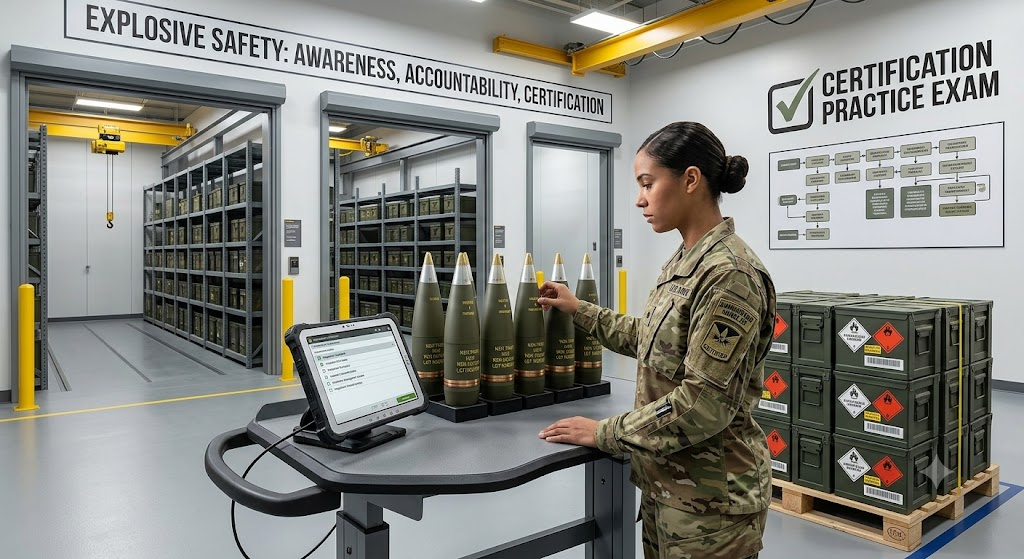
Additional Information
What the Course Entails and Exam Details
The course of study for the Ammunition Handlers Certification is extensive, covering the entire lifecycle of ammunition from forecast to final disposal. It details the precise processes for receiving, storing, inspecting, issuing, and accounting for all types of conventional ammunition. Key areas include identifying different types of ordnance by their specific nomenclature, lot numbers, and National Stock Numbers (NSN). Students must learn to interpret and apply complex safety regulations, including identifying hazardous materials via UN Hazard Classification Codes and Net Explosive Quantity/Weight calculations.
The curriculum places a heavy emphasis on proper documentation and the use of authorized military forms. Crucial regulatory publications, such as DA PAM 385-64 in the United States, provide the framework for safe storage in earth-covered magazines and during transportation. The final exam details are rigorously designed to test a candidate's ability to operate safely under pressure and strictly follow Standard Operating Procedures (SOPs).
What to Expect in the Final Exam
The final exam for the Ammunition Handlers Certification is a demanding test of both conceptual knowledge and practical application. Candidates can expect a multi-part evaluation, which almost always includes a significant timed multiple-choice section. This part focuses on regulatory knowledge, form identification, and the synthesis of information, such as determining compatibility for mixed storage of explosives. Many versions of the test also require scenario-based decision-making.
Furthermore, some certifications include a practical assessment where candidates must demonstrate proficiency in physical tasks. This could include conducting a physical inventory, correctly filling out issue and turn-in forms like DA Form 3151-R, or performing a basic safety inspection of a storage structure. A very high passing score is required, often around 80% or 90%, reflecting the critical nature of the duties. Due to the high-security environment, tight time limits are enforced, and strict rules against external aids are in place.
How to Study and Exam Centers
Preparation for this exam demands structured study and a focus on regulatory precision. The absolute best starting point is to thoroughly study the official course materials and the primary regulatory publications. Creating flashcards for common acronyms, form numbers, and the meanings of ammunition color-coding and hazard symbols is highly effective. The use of practice exams is perhaps the most crucial step, allowing candidates to become comfortable with the question style and manage their time under realistic test conditions. Active recall methods, where you force yourself to recall the process for a specific task, such as processing a live turn-in, are superior to passive reading.
Exam centers are highly specific to the certifying organization. For military personnel, testing typically occurs within military education facilities, such as the US Army's Ordnance School, or on base. Contractors and civilian personnel may take the exam at authorized physical testing centers that specialize in defense-related certifications, or via secure, proctored online portals, often requiring a Common Access Card (CAC) or other government credential for access.
Job Opportunities from the Course
This certification is a vital stepping stone for numerous careers within the defense and logistics sectors. Individuals who pass the exam have a clear path to high-responsibility roles that focus on the specialized management of ordnance. Specific job opportunities unlocked by this certification include:
Ammunition Specialist (US Army MOS 89B)
Ammunition Technician
Explosive Safety Inspector
Ordnance Logistics Clerk
Range Safety Officer (Support Staff)
Explosive Ordnance Disposal (EOD) Specialist (Advanced, requirement pathway)
Defense Contractor Logistics Manager (Ordnance focus)
Frequently Asked Questions
Reviews
5.0
Based on 0 reviews
Leave a Review
No reviews yet. Be the first to review!