
Ammo Block 2 Practice Test
$69.00
- Buy to unlock unlimited access to all Quiz questions.
- After purchase you can print a PDF of the whole quiz at any point. The PDF will contain the questions and the correct answers.
About this Exam
The "Ammo Block 2" exam is a critical component of a broader certification series designed for Department of Defense (DoD) military personnel, civilian employees, and contractors working in the specialized field of ammunition and explosives (A&E) logistics and safety.
This specific exam, often taken through a distributed learning (DL) platform, focuses on the essential principles of Physical Security and Integrated Defense for Ammunition Storage Areas (ASA). It is designed to ensure that all personnel understand how to protect valuable and hazardous munitions from theft, sabotage, and damage, while maintaining operational efficiency. Successful completion is a prerequisite for more advanced handlers and supervisory roles within the munitions field.
Ready to test your knowledge?
Buy Now to Access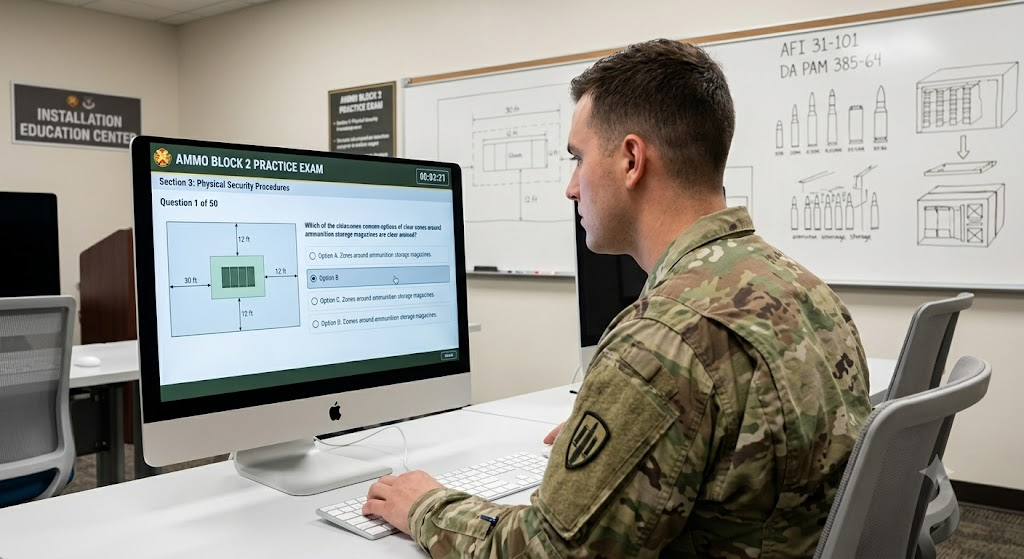
Additional Information
What the Course Entails and Exam Details
The course for Ammo Block 2 covers the technical and regulatory frameworks governing the protection of A&E. To prepare effectively, you must master several key areas, often defined by specific military regulations (such as AFI 31-101 in an Air Force context).
Core topics and skills you must master include:
Integrated Defense Principles: Understanding the goal of neutralizing threats to ensure unhindered operations.
Physical Security Measures: Identifying and applying methods to safeguard personnel, equipment, materials, and installations.
Controlled and Restricted Areas: Clearly defining and managing the boundaries, requirements, and limitations of different security zones, including the designated 'Block 2' areas.
Entry Control Points (ECP) and Access: Procedures for establishing, maintaining, and verifying authority at points of entry, including the use of Restricted Area Badges and Entry Authority Lists.
Barriers and Clear Zones: Understanding the design, purpose, and maintenance of physical barriers and defined clear zones to deter and delay unauthorized access.
Hazard Classification: Fundamental understanding of Hazard Class/Division 1 (Explosives) and how it dictates security and storage configuration.
What to Expect in the Final Exam
While the exact structure of "Ammo Block 2" can vary slightly depending on the specific branch or agency, it generally follows a standard format common to Distributed Learning (DL) or "ACE" (American Council on Education)-evaluated military courses.
You should expect:
Format: The exam is typically a multiple-choice test, consisting of 25 to 50 questions that assess your understanding of terms, definitions, and applying specific regulatory criteria to operational scenarios.
Delivery: This is almost universally an online exam, taken through a registered military portal.
Open-Book Nature: Many of these DL exams are "open-book," allowing you to use your course materials and official regulations during the test. Do not mistake this for ease; the challenge is quickly finding and applying the correct information under a time limit.
Passing Score: The required passing score is high, often requiring an 80% or 70% minimum to demonstrate mastery of safety and security protocols.
Time Limit: You will typically have a set time limit, common examples are 60 to 90 minutes, to complete the exam.
How to Study and Exam Centers
Preparation is key to succeeding on the Ammo Block 2 exam. Since it is often an online, open-book test, effective study means knowing where to find information quickly, not just memorizing.
Actionable Study Strategies:
Master the Regulations: Create or download a comprehensive digital copy of the specified regulations (e.g., AFI 31-101, DA PAM 385-64). Know how to search these documents quickly using key terms.
Utilize Practice Tests and Flashcards: If available through your learning portal (like ATIS or ALMS), use official practice tests. Also, focus on defining key acronyms and terms (e.g., ECP, controlled area, restricted area, clear zone, Hazard Class 1).
Focus on 'The Map': Be sure you can visually interpret a facility map to correctly identify all security zones and entry points based on descriptions.
Take the Official Practice: If provided, complete the practice exam multiple times, ensuring you can locate the correct reference for every question.
Exam Centers and How to Register:
Because this is a specialized DoD/military certification, registration and test delivery are standard:
Online Portals: The exam is taken through established military learning management systems, such as the Army Training Information System (ATIS) or the Air Force Portal.
Registration: You must register for the associated 'Ammo' course (e.g., Ammo-45-DL, Ammo-67-DL) through the standard military training request system (like ATRRS for the Army).
CAC Requirement: In almost all cases, a Common Access Card (CAC) and a government-networked computer are required to access and complete the coursework and the final exam.
Job Opportunities from the Course
A certification in Ammo Block 2, alongside its associated ammunition management courses, is highly valued and often mandatory for a wide range of logistics, safety, and security roles within the DoD and supporting contractor network. Successful students can pursue the following career paths:
Munitions Systems Specialist (Ammo Troop): Responsibilities include receiving, storing, assembling, and transporting all types of guided and unguided munitions.
Ammunition Handler/Foreman: Oversees the day-to-day operations of an Ammunition Storage Area (ASA), ensuring safe and secure storage.
Physical Security Specialist (Munitions): Specialized role focused on implementing and inspecting physical security measures, barriers, and access control for explosive storage areas.
QASAS (Quality Assurance Specialist - Ammunition Surveillance): A highly technical civilian (or military) role, ensuring that all military explosives and chemical weapons are maintained in a safe and ready state.
Logistics Manager (Ammunition): Oversees the end-to-end supply chain and inventory management for a variety of munitions.
Safety Officer (Explosives): Ensures all operations and storage facilities comply with explosives safety regulations.
Frequently Asked Questions
Reviews
5.0
Based on 0 reviews
Leave a Review
No reviews yet. Be the first to review!