
AMMO-69-CVN Shipboard Explosive Safety for Aircraft Carriers Practice Test
$69.00
- Buy to unlock unlimited access to all Quiz questions.
- After purchase you can print a PDF of the whole quiz at any point. The PDF will contain the questions and the correct answers.
About this Exam
The AMMO-69-CVN Shipboard Explosive Safety for Aircraft Carriers course is a critical safety and operational program designed for United States Navy personnel, civil service employees, and designated contractors responsible for the handling, stowage, maintenance, and transportation of ammunition and explosives aboard modern aircraft carriers (CVN). This rigorous certification ensures that all individuals working in these high-stakes environments are thoroughly trained in the essential principles, regulations, and specific procedures that safeguard both life and mission-critical assets. Given the complexity and inherent dangers of operating large-scale aviation and weapons systems on a confined platform like an aircraft carrier, this certification is non-negotiable for key personnel. A reliable practice test is a powerful tool to help candidates assess their knowledge, identify critical areas for improvement, and approach the final exam with confidence.
Ready to test your knowledge?
Buy Now to Access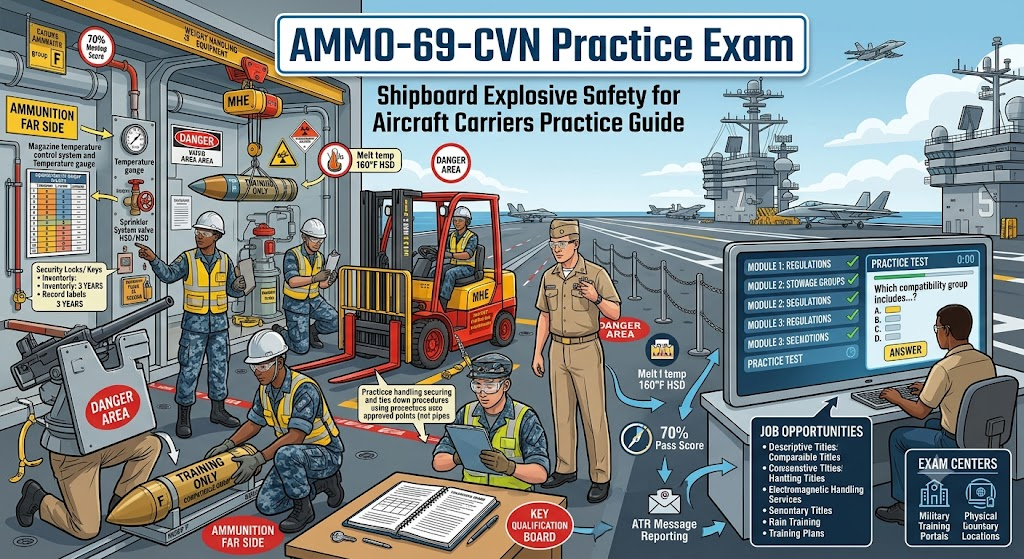
Additional Information
What the Course Entails and Exam Details
This comprehensive course covers a vast and detailed syllabus. It is designed to equip personnel with the knowledge and skills necessary to operate safely and effectively within the complex ecosystem of shipboard ammunition and explosives (AA&E) operations. Key focus areas include, but are not limited to:
Naval Sea Systems Command (NAVSEA) Regulations: Understanding and strictly adhering to the overarching safety directives (such as NAVSEA OP-4 and others) that govern shipboard ammunition handling.
Ammunition Handling and Stowage: Detailed procedures for the safe movement of explosives between various areas of the ship, including hangar decks, flight decks, ready-service areas, and primary magazines.
Magazine Operations: Precise knowledge of magazine temperature control, inventory systems, security procedures, access protocols, and specific stowage arrangements (compatibility groups, ready-service lockers).
Specific Explosive Types: Safety protocols and handling specifics for diverse ammunitions including bombs, missiles, small arms, and pyrotechnics.
Handling Equipment (OHE): Proper use, inspection, and maintenance of specialized ordnance handling equipment (cranes, hoists, forklifts, specialized carts, etc.) that must be contrasting in color and labeled with 3-inch block letters.
Fire Safety and Emergency Procedures: Magazine sprinkler systems (fh circuit alarms, heat sensing devices (HSD) that melt at 160°F, HSD density requirements, specific sprinkler head types), fire prevention techniques, and emergency response protocols for ordnance incidents, such as the catastrophic 1966 incident aboard the USS Oriskany due to lack of training.
Security & Accountability: Lock and key controls, access authorization, semi-annual inventories and record keeping (retained for 3 years), rescreening personnel annually, and the duties of the Qualification/Certification board and Commanding Officer.
The final course examination will typically consist of a substantial written portion and likely some practical components designed to test candidates on their ability to apply theoretical knowledge to real-world scenarios in a controlled training environment.
What to Expect in the Final Exam
You should approach the final AMMO-69-CVN exam with a high level of preparedness and a thorough understanding of the material. The primary written exam usually follows a standard professional certification format:
Multiple-Choice Questions: The majority of the exam will be multiple-choice questions, challenging your recall of regulations, procedures, safety limits, and technical specifications.
Scenario-Based Questions: Expect complex questions that present realistic scenarios on an aircraft carrier. You will be asked to identify correct actions, safety violations, or optimal procedures in situations involving ammunition movement, magazine issues, or equipment use.
Passing Score: To achieve a "Certified Pass" or equivalent, you must meet a minimum passing score, often around 70%. Be sure to confirm the specific passing score requirements with your training command or testing center.
Time Limits: A clear time limit will be imposed for the written exam. Effective time management is essential to answer all questions deliberately and thoroughly.
Rules & Integrity: Testing takes place in a proctored environment, with strict rules regarding communication, unauthorized materials, and electronic devices. Integrity is paramount in all military testing.
Practical Elements: Depending on the specific execution of the course by different training commands, there may also be assessed practical elements, such as correctly identifying OHE, simulating magazine access, or demonstrating emergency procedures. Your practice test results are a powerful indicator of how well you can recall and apply these details in a timed, professional assessment.
How to Study and Exam Centers
Effective study for AMMO-69-CVN requires a dedicated approach that goes far beyond simple cramming:
Thorough Review of Course Materials: Deeply engage with official guides, NAVSEA publications, and your training materials. Take comprehensive notes and build a strong foundation.
Official Navy Study Guides: Utilize any Navy-authorized study aids, glossaries, and review packages. These are typically the most aligned with the exam's content and structure.
AMMO-69-CVN Practice Tests: Consistent use of a high-quality practice test is invaluable. Regular practice simulates the exam experience, highlights your weakest areas, and allows you to build speed and accuracy. Many practice platforms can be accessed online or through specific Navy training portals.
Group Study & Discussion: Collaborate with fellow service members. Explaining complex procedures or safety rules to others can reinforce your own understanding and expose you to different perspectives.
Focus on Regulations and Specifics: Pay meticulous attention to specific numbers (temperatures, dimensions, times, retention periods), safety limits, equipment labels, compatibility groups, and key regulations within NAVSEA OP-4.
Seek Guidance: Don't hesitate to ask instructors or experienced personnel (Commanding Officers, Weapon Department heads, Board Chairmen) for clarification on difficult concepts.
Regarding testing locations, the actual AMMO-69-CVN exam is typically conducted through authorized US Navy training channels. Testing centers are generally located within military bases, training commands, or sometimes specifically authorized contractor schools for certain personnel. Practice tests are most commonly delivered through online portals or dedicated military training software, allowing you to access them from almost any location with appropriate network access. For official exam information and locations, you must consult with your chain of command or designated career counselor.
Job Opportunities from the Course
A certification in AMMO-69-CVN Explosive Safety is often a prerequisite or highly beneficial qualification for numerous crucial roles within the US Navy and related support sectors. The specific skills you acquire are essential for careers including:
Ordnance Handling Officer (US Navy Officer): Leading the planning, safety, and execution of AA&E operations on aircraft carriers and supporting commands.
Ammunition Handler/Technician (Enlisted): Directly involved in the physical handling, transport, and maintenance of explosives on ship and shore.
Weapons System Operator/Maintainer (Enlisted): Operating or maintaining weapons systems that require explosives, necessitating deep knowledge of their safe handling and safety systems (like CIWS 20mm rounds stowage, CWIS danger area, etc.).
Magazine Crew Member/Supervisor (Enlisted/Civil Service): Managing and ensuring the safe operation, maintenance, temperature control, and security of on-board ammunition magazines.
Shipboard Safety Officer (Officer/Civil Service): Overarching responsibility for safety protocols and compliance across all shipboard operations, with a strong focus on high-risk activities like explosives handling.
Quality & Certification Board Member/Chairman (Various): Personnel involved in the qualification and certification process for other handlers, ensuring all crew meet high standards of knowledge and proficiency, with records maintained in the board chairman's notebook and rescreened annually.
Naval Weapon Station Earle/Navy Munitions Command Personnel: Roles involving shore-based support, receiving, and issuing conventional ordnance and providing logistical support to the fleet, requiring consistent adherence to safety and formatting message reporting for ATR methods.
Frequently Asked Questions
Reviews
5.0
Based on 0 reviews
Leave a Review
No reviews yet. Be the first to review!