
AMMO 69 CDF Certification Practice Exam
$69.00
- Buy to unlock unlimited access to all Quiz questions.
- After purchase you can print a PDF of the whole quiz at any point. The PDF will contain the questions and the correct answers.
About this Exam
The AMMO 69 CDF (Conventional, Directed Energy, and Explosive) certification, formally known as Shipboard Explosive Safety for Aircraft Carriers (CVN), is a critical credential for personnel handling ordnance within the unique confines of a naval vessel.
It is designed for U.S. Navy Sailors—specifically Gunner's Mates (GM) and Aviation Ordnancemen (AO)—as well as Department of Defense (DoD) civilians and contractors whose duties require them to supervise, handle, store, or inspect conventional weapons, ammunition, and explosives aboard an aircraft carrier.
Ready to test your knowledge?
Buy Now to Access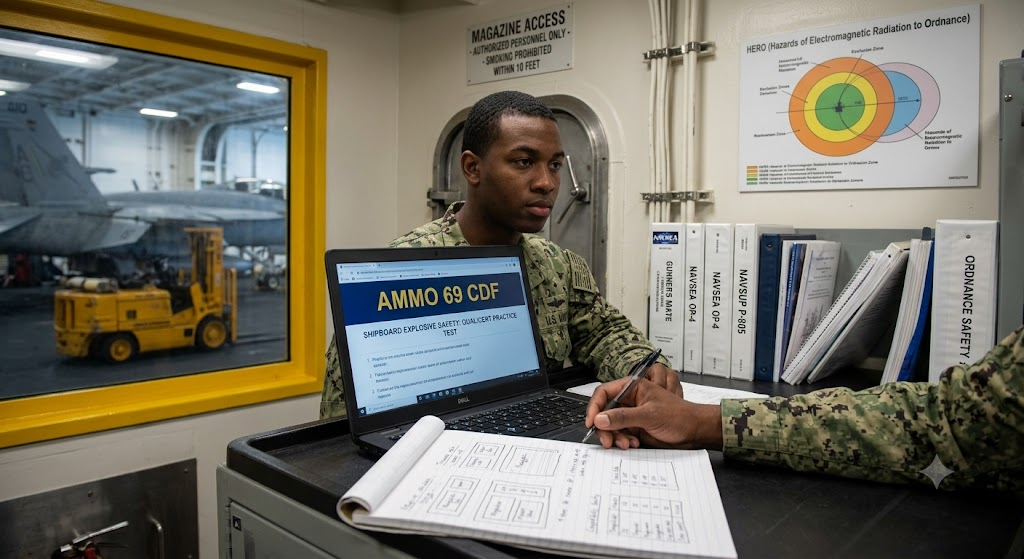
Additional Information
What the Course Entails and Exam Details
The AMMO 69 course focuses on ensuring maximum safety while executing mission-critical ordnance operations at sea.
Key areas covered include:
Ammunition & Explosive (A&E) Safety Principles: A foundational understanding of safety regulations, hazard classification, and the physical properties of explosives.
Qual/Cert Program: The rules, responsibilities, and documentation required for the Qualification and Certification program, ensuring all personnel are trained and certified for their specific task work codes.
Magazine Operations: Comprehensive knowledge of shipboard magazines, including stowage, compatibility groups, temperature monitoring, security, and sprinkler systems.
Hazards of Electromagnetic Radiation to Ordnance (HERO): Procedures to prevent accidental ignition of electrically initiated devices by radio frequency (RF) energy.
Ordnance Handling Equipment (OHE) and Weight Handling Equipment (WHE): Safety procedures for operating the specialized tools used to lift, transport, and position weapons systems.
Reporting: How to properly execute Ammunition Transaction Reports (ATR) and Transaction Item Reports (TIR) to maintain accurate inventory.
What to Expect in the Final Exam
The final certification exam for AMMO 69 CDF is designed to validate a candidate's mastery of the above material.
While specific formats can evolve, students should generally expect:
Format: A multiple-choice examination.
Passing Score: A minimum passing grade, often between 70% and 80%, depending on the specific component and the current command's training plan. It is crucial to aim for a perfect score to ensure complete safety proficiency.
Time Limit: A specified time limit, typically in the range of 90 minutes to two hours, which forces candidates to recall information efficiently.
Rules: The exam is typically closed-book and proctored. Only authorized personnel are permitted to administer the test.
How to Study and Exam Centers
Preparation is the key to success in AMMO 69.
Study Strategies
Master the Manuals: The primary sources of truth are the official publications. Study NAVSEA OP-4 (Ammunition and Explosives Safety Afloat) and NAVSUP P-805 (Ammunition Sentinels). Pay close attention to definitions, safety criteria, and compatibility tables.
Utilize Practice Exams: Practice with reputable practice exam tools to get a feel for the phrasing and structure of the questions. The generated image shows a Sailor using an online practice test as part of a structured study plan.
Active Recall and Spaced Repetition: Do not just reread. Create flashcards for Compatibility Groups (e.g., "Group B can only stow with other Group B"), HERO distances, and specific equipment handling check-offs.
Practical Application: If possible, correlate what you read with the physical equipment. Visually inspect a magazine hatch or the HERO EMCON Bill to cement your understanding.
Exam Centers
Accessing the exam depends on your duty status.
Military Personnel: The primary method for completing the training and taking the proctored final exam is through online portals like the Navy eLearning (NeL) system or the Marine Corps Learning Management System (Moodle).
Physical Testing: For those who need a traditional environment, exams can be taken at Naval Operational Support Centers (NOSC), authorized schoolhouses, or specific Pearson VUE professional centers if designated by the commanding officer. Always consult your chain of command or training officer for the correct path.
Job Opportunities from the Course
A strong score on the AMMO 69 CDF exam is a massive step toward critical shipboard roles. This certification is a prerequisite or significant accelerator for career paths including:
Ordnance Handler / Technicians (GM/AO)
Magazine Supervisor
Quality Assurance / Certification Board Member
Explosive Safety Officer (ESO)
Ammunition Logistics Manager
Gunner’s Mate First Class / Chief (GMC)
Aviation Ordnanceman First Class / Chief (AOC)
DoD Civilian Ordnance Contractor
Successful completion of the AMMO 69 CDF exam not only advances a career but also directly contributes to the safety of the entire crew and the operational success of the aircraft carrier. Use this guide and the associated practice resources to make safety your priority.
Frequently Asked Questions
Reviews
5.0
Based on 0 reviews
Leave a Review
No reviews yet. Be the first to review!