
AMF Checkride Practice Test
$69.00
- Buy to unlock unlimited access to all Quiz questions.
- After purchase you can print a PDF of the whole quiz at any point. The PDF will contain the questions and the correct answers.
About this Exam
The AMF Checkride is a premier certification designed for aviation professionals aiming to validate their advanced technical knowledge and practical skills within specific Aircraft Maintenance Functions (AMF). This rigorous practical test serves as the final gateway to earning specialized ratings or privileges. It is engineered for highly skilled maintenance technicians, leads, and quality assurance personnel who seek to demonstrate mastery beyond standard A&P licensing, confirming their ability to operate effectively within an environment demanding exceptional proficiency and adherence to specific regulatory requirements. This guide is your essential companion for preparing for this comprehensive assessment and achieving first-time success.
Ready to test your knowledge?
Buy Now to Access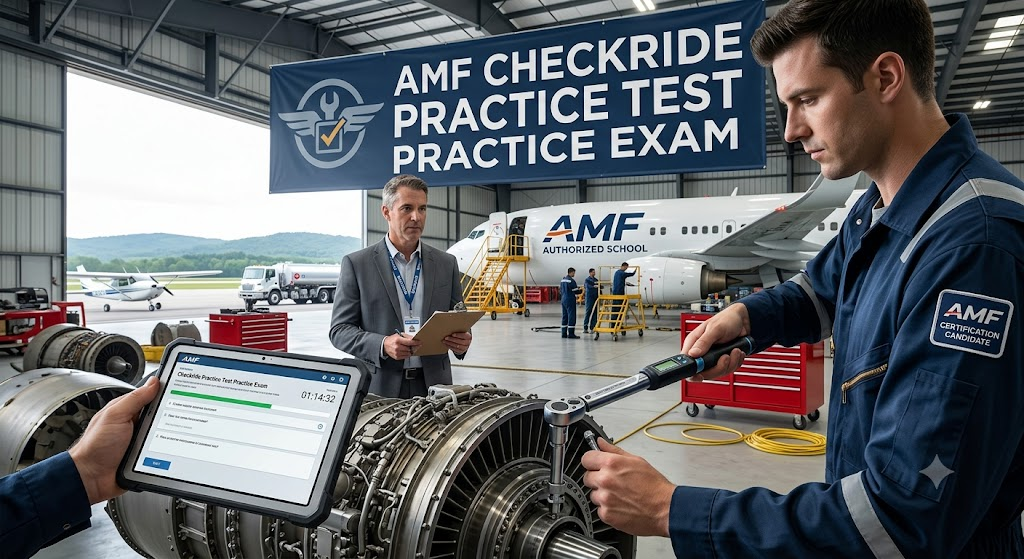
Additional Information
What the Course Entails and Exam Details
The path to the AMF Checkride involves completing an authorized training program tailored to your specific certification path. While individual programs vary, they are all built upon a standardized core of topics designed to ensure deep competence.
The core technical syllabus includes a deep dive into the specific Federal Aviation Regulations (FARs) relevant to the AMF, ensuring complete regulatory compliance. Candidates must also demonstrate an intricate understanding of advanced aircraft systems, far exceeding fundamental knowledge, including complex electronics, avionics integration, and composite structures. Risk Management and Aeronautical Decision-Making (ADM) are critical elements, training professionals to identify, assess, and mitigate risks in a maintenance environment. Finally, the training culminates in ensuring complete proficiency in using specialized tools, diagnostic equipment, and technical data.
The actual exam details hinge on the completion of this preparatory training and the fulfillment of specific experience prerequisites, culminating in the two-part checkride.
What to Expect in the Final Exam
The AMF Checkride is not a traditional written exam; it is a practical, all-encompassing evaluation conducted by a Designated AMF Examiner (DAE). You must satisfactorily complete both portions of the test:
The Oral Examination: This phase usually takes 1 to 3 hours. The examiner will engage you in a scenario-based conversation, probing your depth of knowledge in areas like regulations, specific system operations, and maintenance procedures. You must demonstrate an analytical understanding and the ability to apply complex concepts to real-world maintenance situations.
The Practical/Skill Test: Following a successful oral exam, this is the hands-on demonstration. You will be assigned a series of maintenance tasks, which must be performed to exact tolerances and standards. Evaluated areas include precision in following technical data, the correct and safe use of tools, quality of workmanship, and complete environmental and safety compliance.
There is no "passing score" in the form of a number. The outcome is "satisfactory" or "unsatisfactory" for each tested task. Failure on a single element can result in an overall unsatisfactory result, emphasizing the need for comprehensive preparation across all potential assessment areas.
How to Study and Exam Centers
Your study strategy for the AMF Checkride must be proactive and multi-faceted. The most effective approach includes the following steps:
Master the Standards: The AMF Practical Test Standards (AMF-PTS) or equivalent Airman Certification Standards (ACS) are your testing blueprint. Review every task, knowledge area, and skill tolerance listed. Assume anything in this document is fair game.
Conduct Mock Checkrides: Practice explaining complex technical concepts out loud to a peer or mentor. The key is simulating the oral exam's scenario format.
Hands-On Practice: Spend additional time in the hangar. Practice each task from the PTS/ACS to a standard that exceeds the required tolerances. Consistency is critical.
Internalize Data: While open books are allowed in practice, you must be intimately familiar with finding specific, non-delegated data within maintenance manuals, wiring schematics, and structural repair guides.
Regarding exam centers, the AMF Checkride is always conducted in person, either at your authorized training facility (such as a part 141 flight or specialized maintenance school), a designated aviation examiner's location, or a certified Aircraft Maintenance Facility. Online portals are primarily used for scheduling and preparatory knowledge tests, not for the physical checkride.
Job Opportunities from the Course
Earning your AMF certification unlocks numerous advanced and highly specialized career paths. Key job opportunities include:
Specialized Aircraft Technician (e.g., Avionics, Composite Repair)
Quality Assurance (QA) Inspector
Maintenance Lead/Supervisor
Director of Maintenance (DOM)
Maintenance Instructor
Field Service Representative for an OEM
Technical Consultant
Flight Dispatcher with Maintenance Specialization
This certification provides a distinct competitive edge, allowing you to assume roles with greater responsibility, authority, and compensation within the aviation maintenance industry.
Frequently Asked Questions
Reviews
5.0
Based on 0 reviews
Leave a Review
No reviews yet. Be the first to review!