
American Society of Addiction Medicine (ASAM) Assessment Practice Test
$69.00
- Buy to unlock unlimited access to all Quiz questions.
- After purchase you can print a PDF of the whole quiz at any point. The PDF will contain the questions and the correct answers.
About this Exam
The American Society of Addiction Medicine (ASAM) is a leading professional organization dedicated to improving the quality of addiction treatment and education. ASAM has established universally recognized guidelines, particularly The ASAM Criteria, which provide a comprehensive framework for assessing patient needs, determining appropriate levels of care, and developing effective, patient-centered treatment plans for individuals with substance use disorders and co-occurring conditions.
This guide focuses on preparing for the ASAM Assessment Practice Test, a vital step in validating your proficiency in applying these critical criteria. The knowledge and skill set validated by this assessment are essential for a wide range of healthcare professionals, including addiction counselors, clinical social workers, psychologists, physicians, registered nurses, and case managers. Whether you are seeking to enhance your current skills, enter the field of addiction medicine, or satisfy professional development requirements, mastering ASAM assessments through structured practice is a significant career milestone.
Ready to test your knowledge?
Buy Now to Access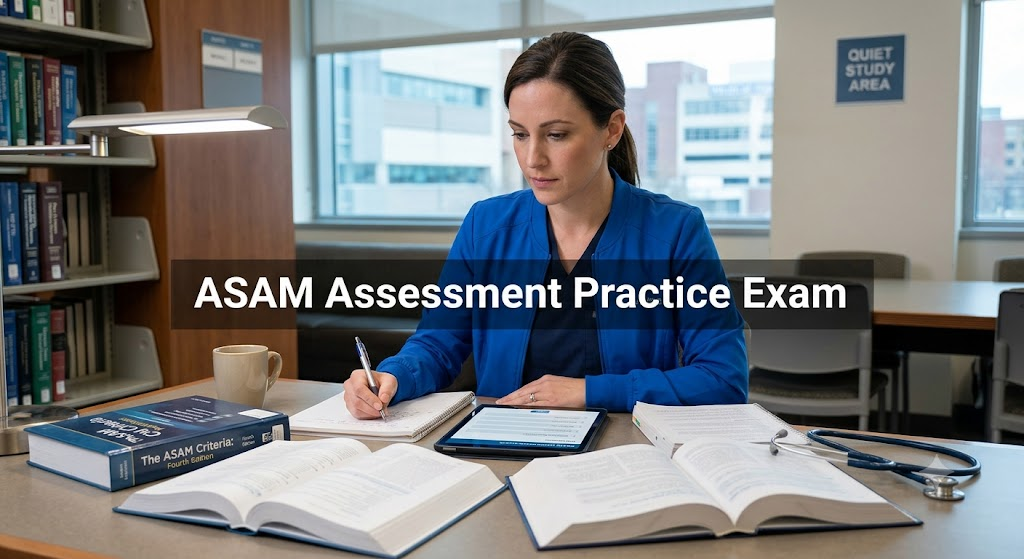
Additional Information
What the Course Entails and Exam Details
Successfully navigating the ASAM assessment landscape requires a deep understanding of core concepts. Key topics and skills that typical preparation courses and the final assessment cover include:
The Six ASAM Dimensions: Understanding and applying the six dimensions of multidimensional assessment, which analyze a patient's physical and mental health history, readiness to change, relapse potential, and recovery environment.
The ASAM Continuum of Care: Mastery of the varying levels of care, from early intervention to intensive inpatient services, and how to match a patient’s needs with the appropriate intensity.
Patient-Centered Assessment and Treatment Planning: Learning how to gather complete patient data, identify strengths and challenges across all dimensions, and craft tailored, measurable treatment goals.
Clinical Decision Making: Developing the skills to make objective, evidence-based decisions regarding patient admission, continuing care, and discharge or transfer.
Understanding Co-occurring Conditions: Addressing the intersection of substance use disorders with medical and behavioral health conditions.
The preparation typically involves engaging in self-paced or virtual live training that combines educational modules, case scenario applications, and structured practice opportunities.
What to Expect in the Final Exam
While the format and specifics can vary by program, a final assessment validating your ASAM assessment skills generally includes the following components:
Format: Typically administered online, the assessment frequently consists of multiple-choice questions designed to test your understanding of ASAM terminologies, principles, and concepts. It often incorporates clinical vignettes or case studies, requiring you to apply the criteria to realistic patient situations to determine the appropriate dimensional risk and level of care.
Passing Score Requirements: Candidates must typically achieve a passing score, often around 70% or higher, across the relevant assessment modules or the entire exam to demonstrate competency and receive a completion certificate.
Time Limits and Attempts: Online portals usually provide specific, often self-paced but generous, timeframes to complete the assessment. It's common to allow candidates a limited number of attempts (e.g., 2-3) to achieve the passing score.
Rules: The assessment is generally taken via a secure online learning management system. Specific rules regarding proctoring, collaboration, and resources allowed can vary. Ensure you read the guidelines provided by your specific training provider.
How to Study and Exam Centers
Effective preparation is the key to success. Utilize these actionable strategies and resources to master the ASAM assessment:
Study Strategies:
Master the Criteria: Thoroughly study official ASAM materials, including textbooks and the current edition of The ASAM Criteria guidelines. Pay close attention to definitions, risk levels for each dimension, and the rationale for matching patients to levels of care.
Engage with Prep Courses: Take advantage of foundational courses (online or virtual live) offered by ASAM and other authorized providers. Actively participate in modules, scenario applications, and discussion groups.
Utilize Question Banks and Practice Tests: This is crucial. Use official study tools like the Board Exam Study Tool (BEST) for more extensive questions, and complete all practice quizzes provided within your course modules. Actively analyze why specific answers are correct, especially for questions you missed.
Active Recall and Application: Use flashcards for key terms. Practice applying the ASAM criteria dimensions to real or fictional patient cases. Work on identifying relevant information and making structured, reasoned assessments.
Time Management: Create a structured study schedule and dedicate consistent time to review.
Simulate Test Conditions: Practice taking sample assessments under timed conditions to get comfortable with the pacing and reduce exam anxiety.
Exam Centers and Access:
Online Portals: The vast majority of foundational ASAM assessments and related practice tests are conveniently administered through the ASAM eLearning Center or other specific, authorized online learning management systems. Once registered for a course, you will typically access and take the test directly within that portal.
Authorized Training Providers: Many hospitals, universities, and professional development organizations offer approved ASAM training. These courses will have their own specific access points, but the final assessment is still often an online component.
No Dedicated Physical Centers: Unlike large-scale general certification exams that might utilize major testing networks, the ASAM-specific foundational assessment covered here primarily relies on secure, authorized online platforms, allowing candidates to complete it from anywhere with a reliable internet connection.
Job Opportunities from the Course
A strong understanding of the ASAM Criteria, validated by assessment proficiency, is highly valued and often required in various healthcare and social service settings. This validation can unlock or enhance numerous career paths, including:
Addiction Counselor
Clinical Social Worker
Psychologist
Registered Nurse (Addiction & Recovery)
Licensed Professional Counselor
Case Manager
Treatment Center Director/Manager
Utilization Review Specialist (Addiction Services)
Admissions Coordinator
Substance Abuse Treatment Specialist
Primary Care Physician with Addiction Focus
Therapeutic Recreation Specialist in Treatment Settings
These positions can be found in a wide variety of environments, including outpatient treatment clinics, residential treatment facilities, hospitals, community health centers, correctional institutions, and private practices.
Frequently Asked Questions
Reviews
5.0
Based on 0 reviews
Leave a Review
No reviews yet. Be the first to review!