
American Society for Quality Certification Practice Test
$69.00
- Buy to unlock unlimited access to all Quiz questions.
- After purchase you can print a PDF of the whole quiz at any point. The PDF will contain the questions and the correct answers.
About this Exam
The American Society for Quality (ASQ) offers a prestigious suite of certifications designed to validate expertise in various facets of quality management and engineering. These globally recognized credentials are a gold standard for professionals across industries, from manufacturing and healthcare to software development and services. Pursuing an ASQ certification signals a commitment to excellence and a mastery of essential quality tools and methodologies. Whether you are aiming for the foundational Certified Quality Improvement Associate (CQIA), the highly sought-after Certified Six Sigma Green Belt (CSSGB), or the advanced Certified Quality Engineer (CQE), which will serve as our detailed example in this guide, these programs are tailored for ambitious individuals seeking to drive continuous improvement and lead quality initiatives within their organizations.
Ready to test your knowledge?
Buy Now to Access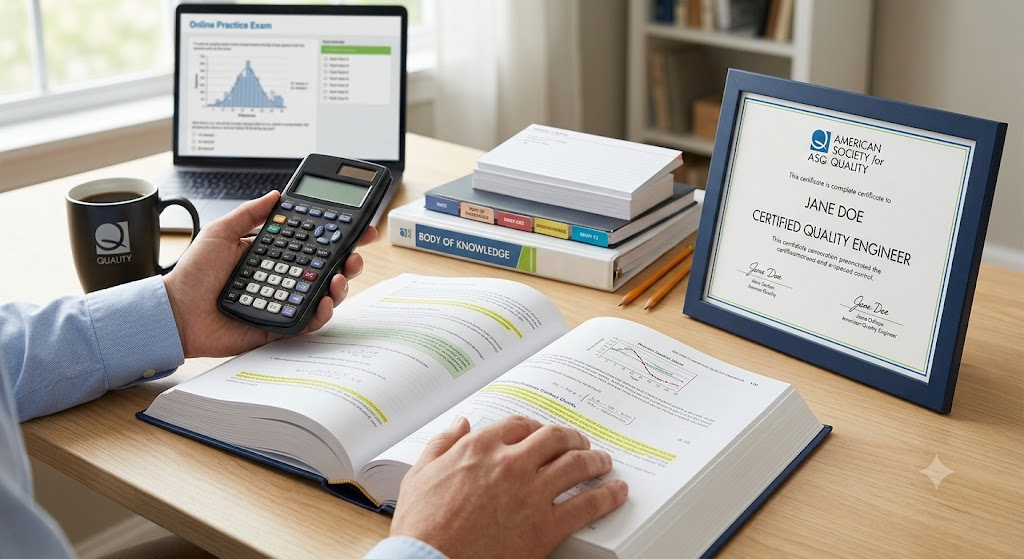
Additional Information
What the Course Entails and Exam Details
Each ASQ certification is built upon a rigorous Body of Knowledge (BoK) that outlines the specific skills and domain expertise required for that role. The "course" for these certifications is, therefore, a structured study of this BoK, which candidates typically undertake through self-study, ASQ-provided training, or third-party courses.
Using the ASQ Certified Quality Engineer (CQE) as a detailed example, the core topics you must master include:
Quality Philosophies and Foundations: Understanding the history and key thinkers in quality management.
Quality Management System (QMS): Development, implementation, and verification, including auditing principles.
Product, Process, and Service Design: Design inputs, verification, validation, and tools like Design of Experiments (DOE).
Product and Process Control: Techniques for monitoring and control, including acceptance sampling and metrology.
Continuous Improvement: Methodologies like Lean and Six Sigma, problem-solving tools, and corrective/preventive actions.
Quantitative Methods and Tools: Comprehensive statistical analysis, probability, statistical process control (SPC), and risk management (often integrated).
It is crucial to understand that while this CQE example illustrates the breadth of a "course," each specific ASQ certification, such as the CSSGB (which focuses heavily on DMAIC) or the Certified Quality Auditor (CQA), has its own unique, detailed Body of Knowledge.
What to Expect in the Final Exam
ASQ certification exams are robust and designed to thoroughly test your ability to apply quality principles. While specific details vary by certification, most follow a consistent multiple-choice format.
Continuing with our CQE example, here is what you can expect on exam day:
Exam Format: The computer-delivered exam consists of 175 multiple-choice questions. Out of these, 160 are scored, and 15 are unscored pilot questions.
Time Limit: You will have a total appointment of 5.5 hours, with an actual exam time of 5 hours and 18 minutes. This long duration requires significant stamina.
Passing Score: ASQ uses a scaled score. The passing score is set at 550 points out of a possible 750.
Special Rules: The CQE exam, like many from ASQ, is open-book. Candidates are permitted to bring specified reference materials, such as a bound handbook or study guide, into the testing center. This makes the exam a test of speed, judgment, and knowledge retrieval, rather than pure memorization. Non-programmable calculators are also typically allowed.
For other certifications, the exam details will differ. For instance, the CSSGB exam has 110 multiple-choice questions (100 scored) and a total actual exam time of 4 hours and 18 minutes.
How to Study and Exam Centers
Preparation is the absolute key to success on an ASQ certification exam. Given the comprehensive nature of the Body of Knowledge, a structured study plan is essential.
Actionable Study Strategies:
Master the Body of Knowledge: Start by downloading the official BoK for your specific certification. Use it as your roadmap to ensure you cover every required topic.
Utilize Official Resources: Invest in the official ASQ Handbook for your certification. These are invaluable reference tools that you can often use in the open-book exam. ASQ also offers official question banks and preparation courses.
Take Multiple Practice Tests: This is perhaps the most effective preparation method. Practice tests help you become familiar with the question style, build mental stamina for the long exam, and crucially, identify your knowledge gaps. Analyze every wrong answer to understand the underlying concept.
Practice with Your Open-Book Materials: Don't just own the handbook; learn how to navigate it efficiently. Create a personalized index, tab key sections, and practice finding information under time pressure. The exam isn't a lookup contest; it's an interpretation and application test.
Form or Join a Study Group: Collaborating with peers can provide new perspectives and motivation.
Where and How to Take the Exam:
ASQ primarily delivers its computer-based testing (CBT) exams through Prometric testing centers worldwide. This offers flexibility with year-round testing windows. When you apply and are approved by ASQ, you will receive an eligibility ID to schedule your exam appointment directly on the Prometric website.
In some locations and for specific translated exams, paper-based testing (PBT) may be offered on set dates, typically a few times per year. Furthermore, ASQ has begun offering remote proctoring options for certain exams, allowing candidates to take the test from the comfort of their home or office, subject to specific technology and security requirements.
Job Opportunities from the Course
Earning an ASQ certification can significantly boost your career trajectory, leading to increased responsibility and higher earning potential. It signals to employers that you possess verified skills to improve processes and ensure quality.
Here is a list of job opportunities that a certification like the Certified Quality Engineer (CQE) can unlock:
Quality Engineer
Senior Quality Engineer
Quality Assurance (QA) Manager
Process Engineer
Manufacturing Engineer
Supplier Quality Engineer
Quality Systems Manager
Continuous Improvement Manager
Process Improvement Specialist
Regulatory Affairs Specialist
Validation Engineer
A Certified Six Sigma Green Belt (CSSGB) might pursue paths such as:
Process Improvement Analyst
Project Manager
Operations Manager
Six Sigma Consultant
Quality Analyst
While a Certified Quality Auditor (CQA) could find roles as:
Internal Auditor
Supplier Auditor
Compliance Manager
Quality Systems Auditor
Each ASQ certification opens unique doors, but all share the common goal of advancing your career in the quality profession.
Frequently Asked Questions
Reviews
5.0
Based on 0 reviews
Leave a Review
No reviews yet. Be the first to review!