
American Society for Nondestructive Testing (ASNT) Radiographic Testing Practice Test
$69.00
- Buy to unlock unlimited access to all Quiz questions.
- After purchase you can print a PDF of the whole quiz at any point. The PDF will contain the questions and the correct answers.
About this Exam
The American Society for Nondestructive Testing (ASNT) Radiographic Testing (RT) Certification is a prestigious credential recognizing individuals skilled in interpreting and inspecting materials using penetrating radiation, like X-rays and Gamma rays. This certification is crucial for ensuring the structural integrity, quality, and safety of components across vital industries such as aerospace, oil and gas, energy, manufacturing, and construction. Our comprehensive ASNT RT Practice Exam is specifically designed as an essential study aid for aspiring Nondestructive Testing (NDT) technicians and inspectors preparing to take the formal ASNT Radiographic Testing Level II certification examination. It is an indispensable tool for engineers, inspectors, and current NDT professionals seeking to rigorously evaluate their knowledge, build confidence, and identify critical areas requiring further review before the high-stakes final test. This practice guide is engineered to simulate the actual exam experience, helping candidates master the key principles and practical applications of radiographic inspection.
Ready to test your knowledge?
Buy Now to Access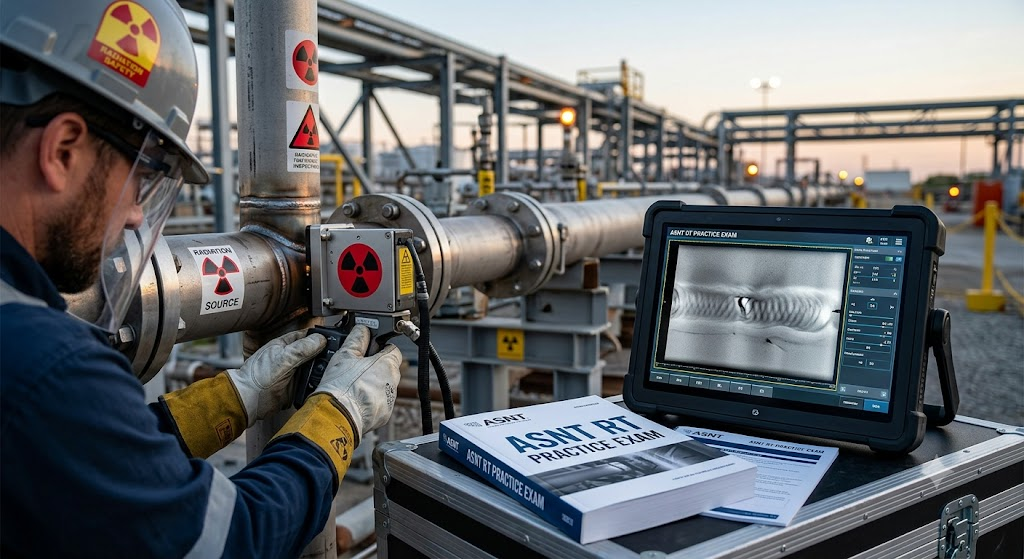
Additional Information
What the Course Entails and Exam Details
To achieve ASNT RT Level II certification, candidates must satisfy rigorous prerequisites defined by ASNT standards, such as SNT-TC-1A, the ASNT Central Certification Program (ACCP), or CP-189. These requirements typically demand significant classroom training hours (e.g., typically 80 hours for Level II from Level I, or 120 combined hours, along with extensive documented, hands-on experience in the method—often several hundred hours depending on educational background). The formal written exam itself is structured into distinct sections, primarily the General Examination and the Specific Examination. The General Exam covers the foundational concepts common to all industries using RT. The Specific Exam focuses on rules, regulations, specifications, and procedures particularly relevant to a specific industry or program (such as aerospace, welding, casting, etc.). Both of these theoretical knowledge components, which this study guide primarily addresses, use a multiple-choice format to assess comprehensive understanding.
Principles of Radiation Physics (Production of X-rays and Gamma rays, characteristics of radiation)
Equipment Operation (X-ray machines, isotope sources, collimators)
Radiation Safety (Time, distance, shielding, regulatory requirements, personnel monitoring)
Radiographic Quality (Film density, contrast, sensitivity, image quality indicators (IQIs/penetrameters), screens, filtration)
Darkroom and Processing (Chemistry, techniques, film handling and storage)
Interpretation of Radiographs (Identifying and evaluating discontinuities versus defects, understanding material conditions in welds, castings, forgings, etc.)
Industry Standards and Codes (ASME Boiler and Pressure Vessel Code, AWS Structural Welding Code, API codes, military and aerospace standards)
What to Expect in the Final Exam
When candidates sit for the official ASNT Radiographic Testing Level II exam, they must prepare for multiple components, usually delivered in a high-pressure, closed-book environment. The theoretical written portion generally consists of multiple-choice questions for both the General and Specific exams. In addition to these written tests, a separate Practical Examination is required to achieve full certification, wherein the candidate must demonstrate their ability to correctly perform the radiographic testing method. For the ACCP program, exams are highly standardized and often administered at independent test centers.
Format: Multiple-choice questions for the General and Specific written components. A separate hand-on Practical performance test is also required.
Number of Questions: Varies by certification program and Level. General and Specific tests often have 30–50 questions each.
Time Limit: Significant time is allotted, often several hours per session, depending on the number of questions and exam structure.
Passing Score: Typically, an overall score of 80% is required for SNT-TC-1A employer-based programs (with a minimum of 70% in each individual exam component). For the ASNT Central Certification Program (ACCP), a minimum of 70% on each written component is required to pass.
Specific Rules: Closed book for General and Specific exams (although the Specific exam may allow authorized codes/standards with prior approval). The Practical test must be proctored and performed on certified test samples with known defects. Valid identification is always required.
How to Study and Exam Centers
Effective preparation for the ASNT RT Level II exam involves combining formal classroom training, extensive documented experience, and targeted self-study. Start by obtaining and thoroughly reviewing the relevant ASNT reference materials, including the official ASNT Level II Study Guide for RT, the Recommended Practice No. SNT-TC-1A, and foundational textbooks. Make sure you are intimately familiar with any industry codes and standards specific to your field (e.g., ASME Section V for NDT, API 1104 for pipelines, or AWS D1.1 for welding).
Integrating ASNT RT Practice Exams into your study routine is arguably one of the most effective strategies for success. These practice tests are designed to mimic the complexity and style of the questions found in the actual examination. Taking multiple practice tests under timed conditions helps you gauge your time management skills, build stamina, reduce test anxiety, and identify precise knowledge gaps. Don't simply look up answers; understand the rationale behind correct and incorrect choices, referring back to the study guides and standards. Create flashcards for critical equations (like the Inverse Square Law), safety procedures, and defect interpretations. Consider forming a study group to discuss complex interpretations of radiographic discontinuities.
When you are ready to take the official exam, the method of administration depends on which ASNT program you are pursuing.
ASNT Central Certification Program (ACCP) and ASNT Level III Exams: These exams are typically scheduled directly with ASNT and administered through third-party testing organizations with authorized physical test centers worldwide, such as Pearson VUE. Candidates must first submit a comprehensive application to ASNT and receive an authorization to test before they can schedule their appointment.
Employer-Based Certification (SNT-TC-1A): If you are seeking certification through your employer according to SNT-TC-1A, the examinations (both written and practical) are often written, administered, and graded by the employer's appointed Level III (either internal or external) at the company facilities or at specific, approved training locations or vocational schools.
Job Opportunities from the Course
Earning an ASNT Radiographic Testing Level II certification significantly enhances an individual's value in the industrial sector, opening doors to advanced career opportunities and increased earning potential within quality assurance and safety inspection roles. This vital credential qualifies you to perform inspections independently and to supervise Level I technicians. Key career paths and job titles for those with an ASNT RT Level II certification include:
Radiographic Testing (RT) Technician – Level II
Nondestructive Testing (NDT) Inspector
Quality Control (QC) Inspector – Radiography
Quality Assurance (QA) Inspector
Pipeline Inspector
Aerospace NDT Technician (specifically specializing in RT)
Pressure Vessel and Piping Inspector
Foundry or Casting Inspector
Structural Steel NDT Inspector
NDT Specialist in the Power Generation/Nuclear Industry
Welding Inspector (Certified Welding Inspector - CWI, often paired with RT for increased versatility)
Third-Party Inspector for specialized projects
NDT Supervisor or Team Lead
NDT Trainer or Instructor (with additional experience)
NDT Consultant
These positions are in high demand across multiple sectors, including Oil & Gas, Aerospace, Construction, Automotive Manufacturing, Shipbuilding, Railroad Operations, and Infrastructure Development, where validating the internal integrity of materials is paramount for safety and compliance.
Frequently Asked Questions
Reviews
5.0
Based on 0 reviews
Leave a Review
No reviews yet. Be the first to review!