
American Society for Clinical Pathology (ASCP) Histotechnologist Practice Test
$69.00
- Buy to unlock unlimited access to all Quiz questions.
- After purchase you can print a PDF of the whole quiz at any point. The PDF will contain the questions and the correct answers.
About this Exam
The ASCP Histotechnologist (HTL) certification, offered by the American Society for Clinical Pathology Board of Certification (BOC), is a premier credential for laboratory professionals specializing in the intricate process of preparing tissue samples for microscopic examination.
This certification is designed for individuals who have completed the necessary education and clinical experience, demonstrating advanced technical proficiency in complex histology procedures.
Histotechnologists play a critical role in the diagnostic process, as the quality of the slides they produce directly impacts a pathologist’s ability to accurately diagnose diseases, including cancer.
Achieving the HTL designation signifies a high level of competence and commitment to quality and patient safety in laboratory medicine.
Ready to test your knowledge?
Buy Now to Access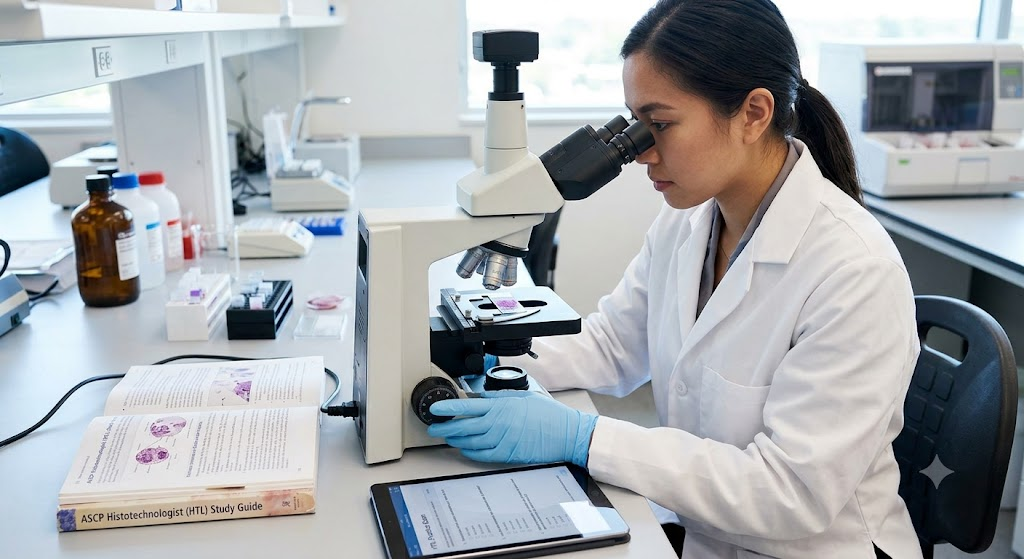
Additional Information
What the Course Entails and Exam Details
Preparing for the HTL certification involves mastering a broad and deep curriculum in the theory and practice of histotechnology.
Candidates must demonstrate comprehensive knowledge across several core areas outlined by the ASCP BOC, including tissue fixation techniques to preserve cellular morphology, and complex processing steps to prepare tissues for embedding in paraffin or other media.
The exam heavily emphasizes microtomy, requiring detailed understanding of sectioning different tissue types and troubleshooting equipment issues.
Furthermore, comprehensive knowledge of staining principles is crucial, covering routine Hematoxylin and Eosin (H&E) staining as well as specialized staining techniques for identifying specific cellular components, microorganisms, and pigments.
The syllabus also includes topics on laboratory operations, health and safety regulations, and quality control procedures essential for maintaining a high-standard histology laboratory.
What to Expect in the Final Exam
The ASCP Histotechnologist exam is a rigorous, computer-based test (CBT) administered in a proctored environment.
The examination consists of approximately 100 multiple-choice questions that must be completed within a 2-hour and 30-minute time frame.
The ASCP uses Computer Adaptive Testing (CAT), which means the difficulty of the questions adjusts based on the examinee's performance; this measurement model allows for a precise assessment of the candidate's knowledge level.
To pass the exam, candidates must achieve a scaled score of at least 400 on a scale ranging from 100 to 999.
Strict regulations are enforced during the exam, and candidates are typically prohibited from bringing personal items, including study materials and electronic devices, into the testing room.
How to Study and Exam Centers
Effective preparation for the HTL exam requires a structured study plan and utilization of diverse resources.
Candidates are strongly advised to thoroughly review the official ASCP BOC content outline, which serves as the blueprint for the exam.
A primary recommended resource is the current edition of the BOC Study Guide: Histotechnology Certification Examinations, which offers comprehensive review materials and practice questions specifically tailored to the exam content.
Incorporate practical application into your study routine by reviewing digital slide libraries to reinforce tissue identification and staining characteristics.
Taking timed practice tests is essential for assessing knowledge gaps and becoming familiar with the format and pacing of the actual computer-based exam.
The ASCP HTL exam is administered at Pearson VUE professional testing centers located globally; candidates can schedule their exam appointment at a convenient location once their application has been processed and eligibility is confirmed by the ASCP BOC.
Job Opportunities from the Course
Securing the ASCP Histotechnologist certification significantly enhances career prospects and opens doors to specialized roles within laboratory medicine.
Certified HTLs are highly sought after in various healthcare and research settings. Possible career paths and job titles include:
Histotechnologist (HTL, ASCP)
Histology Laboratory Supervisor or Manager
Immunohistochemistry (IHC) Specialist
Dermatopathology Technologist
Mohs Technician
Research Histotechnologist (in biotech, pharmaceutical, or academic laboratories)
Pathologist Assistant (often as a foundational step toward this advanced role)
Frequently Asked Questions
Reviews
5.0
Based on 0 reviews
Leave a Review
No reviews yet. Be the first to review!