
American Society for Clinical Pathology (ASCP) Histotechnician Certification Practice Exam
$69.00
- Buy to unlock unlimited access to all Quiz questions.
- After purchase you can print a PDF of the whole quiz at any point. The PDF will contain the questions and the correct answers.
About this Exam
The American Society for Clinical Pathology (ASCP) Histotechnician (HT) Certification is an essential credential for laboratory professionals dedicated to the processing and preparation of tissue samples for microscopic examination by a pathologist. This certification validates an individual's knowledge and skill in a wide range of histotechnological techniques. It is designed for entry-level histotechnicians, ensuring they are competent in a histology laboratory environment, encompassing hospitals, research centers, and private labs. Earning this certification not only signifies high professional standards but also demonstrates a commitment to patient care through the production of high-quality tissue slides. A robust study guide and a dedicated practice exam are your first steps toward this milestone.
Ready to test your knowledge?
Buy Now to Access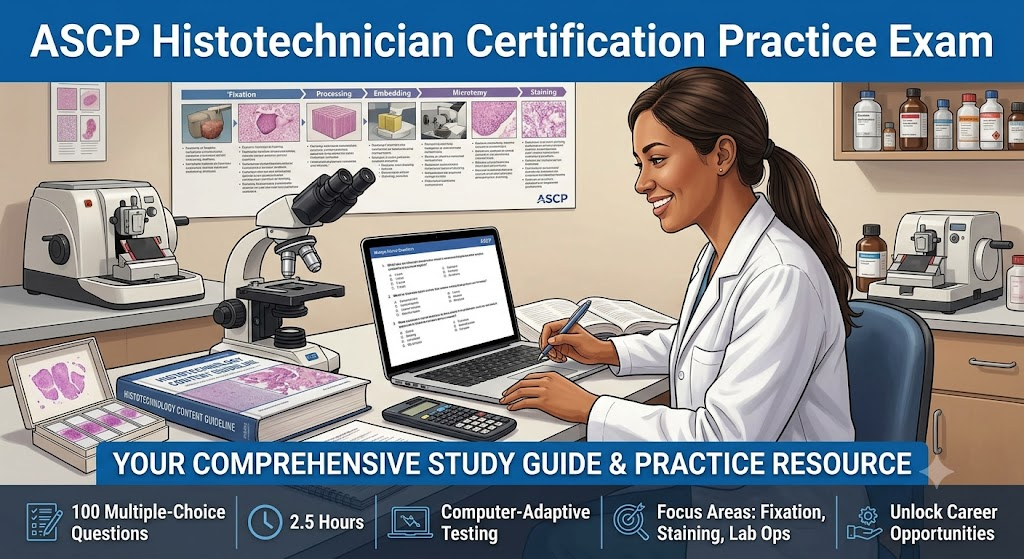
Additional Information
What the Course Entails and Exam Details
While this guide focuses on the practice exam, it reflects the material covered in the comprehensive coursework or experience required for the actual certification. The ASCP HT content outline is the foundation for all study materials. The core focus areas, and their approximate weighting on the exam, include: Fixation (15%-25%), covering principles, methods, and troubleshooting. Processing (10%-20%), detailing dehydration, clearing, and infiltration of tissue specimens. Embedding and Microtomy (15%-25%), testing proficiency in creating tissue blocks and cutting thin sections, including frozen sections. Staining (30%-40%), a large portion of the exam, which covers the chemistry and procedures for common stains like Hematoxylin and Eosin (H&E), a wide variety of special stains, and immunohistochemistry (IHC), alongside quality control. Laboratory Operations (10%-15%), focusing on laboratory mathematics (metric system, dilutions, molar solutions), general safety, quality assurance, and specimen handling protocols. This breadth of topics ensures that a certified histotechnician is well-prepared for all facets of the laboratory workflow.
What to Expect in the Final Exam
Understanding the final exam format is a critical component of your test preparation. The official ASCP HT Certification exam is a computer-adaptive test (CAT). This means the difficulty of the next question is determined by your performance on the previous one. The exam consists of 100 multiple-choice questions, and you have 2.5 hours to complete it. Because of the CAT format, there is no set number of questions you must answer correctly to pass; instead, you must demonstrate a knowledge level above the minimum passing standard. Scores are reported on a scale of 100 to 999, with a minimum passing scaled score of 400. You cannot skip questions. During the exam, specific rules apply, including biometric checks (palm vein pattern capture) and a strict prohibition on electronic devices and programmable calculators, though non-programmable calculators are allowed. Plan to arrive at least 30 minutes early.
How to Study and Exam Centers
Effective study strategies are the cornerstone of exam success. We recommend starting with a formal study schedule, dedicating structured time to each of the content areas outlined in the previous section. Utilize the ASCP’s own HT Content Guideline to ensure complete coverage. Incorporating a robust [ASCP Histotechnician Certification Practice Exam] into your routine is invaluable. These practice tests help you identify your weak areas, familiarize yourself with the question types, and improve your time management. Consider creating flashcards for key terms, staining procedures, and mathematical formulas. There are also comprehensive study guides, videos, and articles tailored specifically to this exam. As for the exam centers, all ASCP BOC certification examinations, including the HT, are administered exclusively at approved Pearson VUE Testing Centers throughout the United States and Canada. Once your application is accepted, you will receive an admission notification enabling you to schedule your appointment at a location and time that works for you.
Job Opportunities from the Course
Earning your ASCP Histotechnician certification opens doors to several rewarding career paths in healthcare and research. Here is a list of potential job titles and career paths available to certified professionals:
Histotechnician (HT) – The core role, processing and preparing tissue for diagnosis.
Laboratory Assistant – An entry point into the lab, often providing support to histotechnicians.
Histology Technician – A similar title focusing on technical aspects of the field.
Histotechnologist (HTL) – A higher level of certification, requiring a bachelor's degree and leading to supervisory or specialized roles.
Biomedical Research Technician – Working in research, preparing tissue for scientific studies.
Veterinary Histotechnician – Applying these skills in a veterinary or animal research environment.
Mohs Technician – Working closely with dermatologists in the specialized Mohs surgery process.
Forensic Histology Technician – Supporting forensic investigations.
We hope this study guide has been highly informative and provides the clarity and encouragement you need to embark on this journey. Remember to utilize quality resources, including an [ASCP Histotechnician Certification Practice Exam], to turn your professional goals into a reality. Good luck!
Frequently Asked Questions
Reviews
5.0
Based on 0 reviews
Leave a Review
No reviews yet. Be the first to review!