
American Sign Language (ASL) 1B Practice Exam
$69.00
- Buy to unlock unlimited access to all Quiz questions.
- After purchase you can print a PDF of the whole quiz at any point. The PDF will contain the questions and the correct answers.
About this Exam
The American Sign Language (ASL) 1B Practice Exam is a critical self-assessment tool for students who have completed the initial phase of their beginning ASL sequence. This exam serves as a bridge between understanding basic signs and engaging in fluid, everyday conversations. It is specifically designed for learners who have completed a course equivalent to ASL 1B and want to evaluate their progress in both expressive and receptive skills, as well as essential knowledge of Deaf culture. This practice exam helps identify strengths and weaknesses, preparing students for the formal final assessment required to advance to the intermediate level.
Ready to test your knowledge?
Buy Now to Access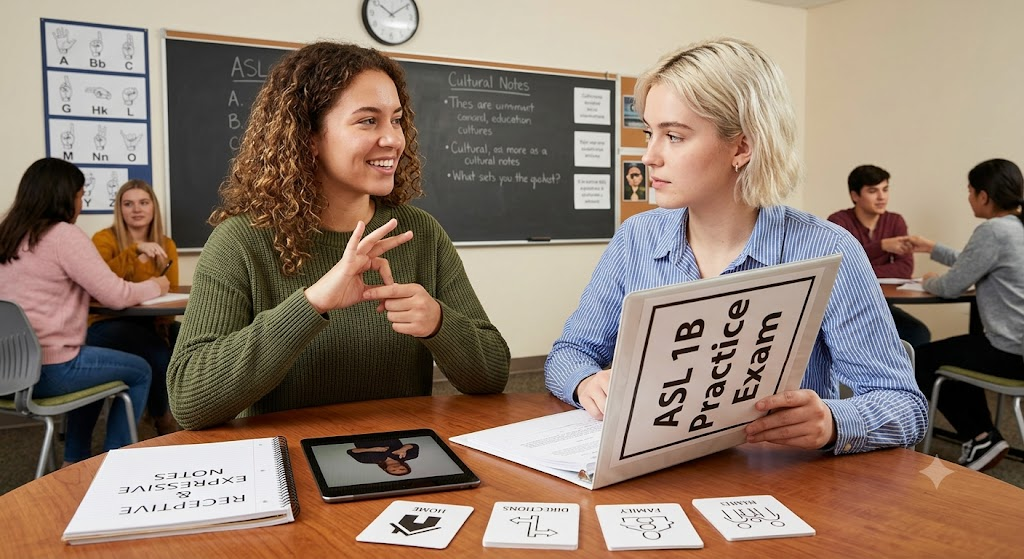
Additional Information
What the Course Entails and Exam Details
ASL 1B is the second half of a beginning ASL curriculum. It goes beyond simple vocabulary lists to focus on syntax, facial expressions, and more complex communicative interactions. The practice exam mirrors this, covering a broad range of topics and skills.
Core areas assessed in the ASL 1B Practice Exam include:
Expanded Vocabulary: Signs related to the home (rooms, furniture), school (courses, locations), community (places, directions), describing personalities and physical characteristics, and expressing emotions.
Grammar and Syntax: Proper use of non-manual markers (NMMs) such as raised/furrowed eyebrows for yes/no and wh-questions. Mastering basic sentence structures like topic-comment and object-subject-verb. Correct indexing (pointing to referents) and establishing time through verb tense and timeline principles.
Numercial Skills and Fingerspelling: Reviewing and advancing fingerspelling speed and clarity. Understanding special number systems, including age, time, and currency.
Culture and Community: Knowledge of common practices in Deaf culture, attention-getting strategies, the importance of eye contact, and key aspects of the linguistic heritage of the Deaf community.
What to Expect in the Final Exam
While formats can vary slightly by institution, the ASL 1B Practice Exam is structured to give you an authentic simulation of the actual final evaluation. The real final exam typically includes a mix of written, video comprehension (receptive), and video production (expressive) components.
A typical final exam at this level will require students to:
Complete Multiple-Choice and Written Questions: This section tests your knowledge of ASL grammar rules, cultural facts, and history. You might be asked to identify a correct sentence pattern or choose the appropriate non-manual marker for a given scenario.
Demonstrate Receptive Skills (Video Comprehension): You will watch pre-recorded videos of a native or proficient signer and answer questions about the content. This might involve translating a short story, identifying specific details, or answering multiple-choice questions based on a dialogue.
Demonstrate Expressive Skills (Video Production): This is often a critical part of the assessment. You may be asked to record yourself signing a specified dialogue, telling a story based on visual prompts, or answering an open-ended question. Examiners look for clarity, accuracy in handshape/location/movement, appropriate use of facial expressions, and smooth flow.
Adhere to Time Limits: The expressive portion often has a defined time limit per prompt, requiring you to be concise and natural.
Passing Score Requirements: Passing scores generally fall between 70% and 80%, depending on the institution. The practice exam allows you to see how your performance stacks up before it counts.
How to Study and Exam Centers
Preparation for an ASL exam is uniquely hands-on. Success requires a combination of self-study, active practice, and exposure to authentic signing.
Actionable study strategies:
Immerse Yourself in Video Resources: Use tools like Lifeprint (Dr. Bill Vicars), StartASL, or the resources provided by your curriculum. Practice with a wide variety of signers to adapt to different styles and speeds.
Film and Review Your Expressive Signing: Don't just practice in front of a mirror. Record yourself answering prompts from your practice exam or recounting your day. Compare your videos to native signers, paying close attention to your non-manual markers and clarity.
Practice with a Partner or Group: If possible, meet with classmates or find an ASL conversational group. Practice role-playing the common scenarios you will face, such as giving directions or describing your family.
Use Flashcards for Grammar and Culture: Create flashcards for non-vocabulary items like "yes/no question facial expressions" and "how to get attention in a Deaf setting."
Exam Centers and How to Take the Exam:
ASL 1B exams are almost exclusively administered through the educational institution or platform where you completed the course. This may include authorized online high school portals (like Michigan Virtual), community colleges, university modern language departments, or authorized adult education centers. When you register for the course, your instructor or program coordinator will provide details on where and how the final evaluation will occur.
Job Opportunities from the Course
While ASL 1B is a beginning proficiency level, it is a crucial prerequisite for many job paths and can enhance your resume in any public-facing role.
Career paths where ASL proficiency is an asset include:
Pre-Requisite for Certified ASL Interpreter: Completing ASL 1B is a non-negotiable step towards entering a formal Interpreter Training Program (ITP), leading to certification as a medical, legal, community, or educational interpreter.
Educational Aide or Paraeducator: Supporting teachers in classrooms with Deaf or Hard of Hearing (D/HH) students.
Healthcare Provider with ASL Skills: Enhancing communication and care for D/HH patients (e.g., Nurse, Physician, EMT, Speech-Language Pathologist).
Customer Service Representative: Providing direct, accessible support to D/HH clients.
Social Service Worker/Aide: Supporting D/HH individuals in accessing community resources.
Childcare Worker: Facilitating language development for D/HH children or those with D/HH parents (CODA).
Human Resources Specialist: Enhancing accessibility and support for D/HH employees.
Frequently Asked Questions
Reviews
5.0
Based on 0 reviews
Leave a Review
No reviews yet. Be the first to review!