
American Registry of Magnetic Resonance Imaging Technologists (ARMRIT) Practice Test
$69.00
- Buy to unlock unlimited access to all Quiz questions.
- After purchase you can print a PDF of the whole quiz at any point. The PDF will contain the questions and the correct answers.
About this Exam
The American Registry of Magnetic Resonance Imaging Technologists (ARMRIT) certification is a highly regarded national credential designed specifically for technologists whose primary focus is MRI. Unlike other registries that cover multiple imaging modalities, ARMRIT offers a direct pathway to certification that recognizes expertise in magnetic resonance technology. This examination is designed for graduates of dedicated MRI programs and working technologists who meet the registry's strict eligibility requirements regarding education and clinical experience. By earning the ARMRIT credential, you demonstrate a specialized level of competence, safety knowledge, and technical skill that is valued by employers across the country. A dedicated ARMRIT practice test is an invaluable tool to assess your readiness and build the confidence needed to succeed on the official certification exam.
Ready to test your knowledge?
Buy Now to Access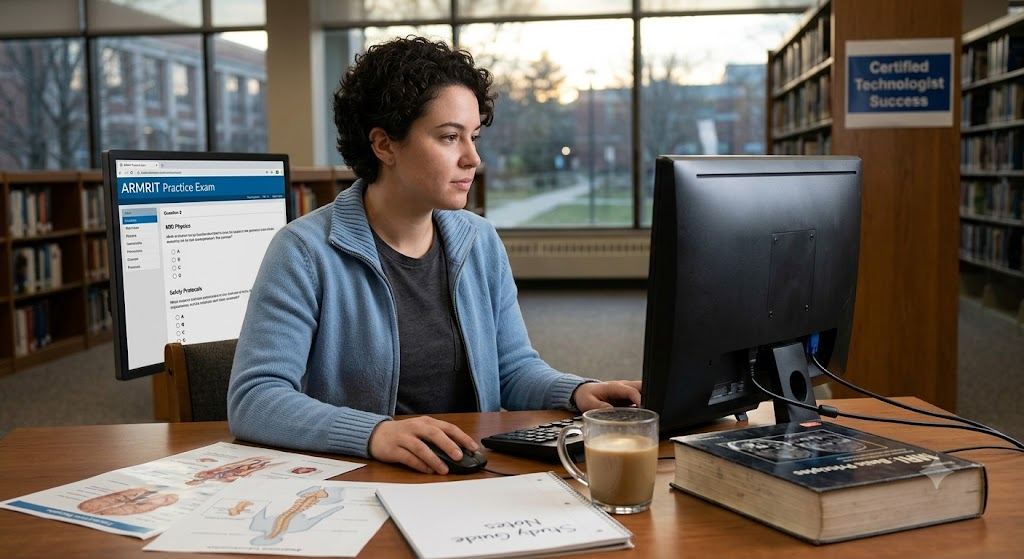
Additional Information
What the Course Entails and Exam Details
Preparing for the ARMRIT exam involves a deep dive into the specific domains of MRI practice. While the course itself refers to the comprehensive knowledge base required, the certification exam focuses purely on evaluating this expertise. The core areas covered include:
MRI Physics and Instrumentation: You must master the fundamental principles of magnetism, radiofrequency (RF) energy, gradient magnetic fields, and how these elements interact to create an MR signal. Key topics include the Larmor equation, T1 and T2 relaxation, signal-to-noise ratio, spatial localization, and specialized pulse sequences like spin echo, gradient echo, and inversion recovery.
Clinical Applications and Image Production: This domain tests your ability to apply physical principles to clinical scenarios. It includes patient positioning, coil selection, protocol optimization for different anatomy (e.g., neuro, musculoskeletal, body), and identification and correction of common MRI artifacts. You will also be evaluated on your understanding of contrast-enhanced imaging and vascular applications.
MRI Safety, Bioeffects, and Patient Care: Safety is paramount in the MRI environment. The exam covers safety screening procedures for patients and staff, knowledge of magnetic field hazards (the missile effect), radiofrequency heating, specific absorption rates (SAR), acoustic noise, and emergency response protocols. You must also demonstrate competence in general patient care within a specialized imaging suite.
Cross-Sectional Anatomy: A strong knowledge of multiplanar anatomy is crucial for a successful MRI technologist. The exam includes sections identifying anatomical structures in axial, sagittal, and coronal views across all major body systems imaged with MRI.
The official ARMRIT examination is a computer-based test composed of approximately 225 to 240 multiple-choice questions. It is a comprehensive assessment that must be completed within a single session, with a total allotted time of approximately 3.5 to 4 hours.
What to Expect in the Final Exam
When you step into the testing center for the official ARMRIT certification exam, you can expect a rigorous but fair evaluation of your MRI knowledge. The exam uses a standard multiple-choice format with one correct or best answer for each question; there are no complex "multiple-multiple" combinations to select. The questions are designed to assess both theoretical understanding and practical clinical application.
A passing score on the ARMRIT examination is a scaled score of 75. Candidates are typically allowed one break during the lengthy test, though specific rules and time constraints for breaks are detailed at the testing center. You will be monitored throughout the session, and no external study materials or electronic devices are permitted in the testing room. Since you will have approximately 1 minute per question, pacing yourself is a key strategy for success. Using a practice exam can help you become familiar with this time management and the types of scenario-based questions you will encounter.
How to Study and Exam Centers
Preparation is the single most important factor for success on the ARMRIT exam. To develop a robust study plan, consider these steps:
Utilize Multiple Resources: Start by downloading the official content outline from the ARMRIT website. This document is your map for what to study. Complement it with comprehensive MRI textbooks, specifically those that focus on physics and instrumentation.
Take a Practice Test: An ARMRIT practice test is an essential diagnostic tool. Use it early to identify your weak areas and again later in your studying to simulate the real exam's timing and pressure.
Engage with Active Learning: Create flashcards for critical formulas, anatomy, and safety zones. Form a study group with peers to explain complex concepts to each other, which reinforces your own understanding.
Connect Theory to Practice: As you study, constantly relate physical principles to your clinical experience. For example, when reading about signal-to-noise ratio, think about how you adjust a protocol on the scanner to improve image quality for a specific patient.
To take the official exam, you must first verify your eligibility and apply through the ARMRIT official portal on their website. Once your application is approved and the examination fee (approximately $300 plus administrative costs) is paid, you will receive authorization to schedule your test. The ARMRIT exam is administered via standardized, computerized testing centers, often through professional proctoring services like PSI, which have locations nationwide. This allows you to choose a testing site that is convenient for you.
Job Opportunities from the Course
Earning the ARMRIT certification unlocks numerous doors to a rewarding and stable career path dedicated entirely to MRI technology. This specialized credential is widely recognized by employers and satisfies regulatory and accreditation requirements in many states. Career paths and specific job titles available to ARMRIT-certified technologists include:
MRI Technologist: The core role, working in hospitals, imaging centers, or physician offices.
Lead MRI Technologist: A supervisory position involving workflow management, protocol oversight, and training new staff.
MRI Supervisor/Manager: An administrative role responsible for the entire MRI department, including staffing, budgeting, and regulatory compliance.
Traveling MRI Technologist: Short-term contract positions that offer the opportunity to work in various facilities across the country.
Research MRI Technologist: Working in academic medical centers or private research facilities, managing scanning protocols for clinical trials and technical studies.
MRI Application Specialist: A role with an equipment manufacturer (e.g., GE, Siemens, Philips), traveling to install new systems and train technologists on their specific software and features.
Frequently Asked Questions
Reviews
5.0
Based on 0 reviews
Leave a Review
No reviews yet. Be the first to review!