
American Red Cross R.24 Lifeguarding Practice Exam
$69.00
- Buy to unlock unlimited access to all Quiz questions.
- After purchase you can print a PDF of the whole quiz at any point. The PDF will contain the questions and the correct answers.
About this Exam
The American Red Cross Lifeguarding course is a pivotal program designed to equip individuals with the knowledge and skills necessary to prevent, recognize, and respond to aquatic emergencies, and provide care for breathing and cardiac emergencies, injuries, and sudden illnesses until emergency medical services (EMS) personnel take over.
This comprehensive certification is primarily designed for individuals, often aged 15 and older, who wish to become professional lifeguards in various aquatic environments, including swimming pools, waterparks, and waterfronts. The program has been recently updated to version R.24 to reflect the latest science in resuscitation and evidence-based lifeguarding practices. A critical part of successful preparation for this challenging course is thorough review, practical skill practice, and utilizing the American Red Cross R.24 Lifeguarding Practice Exam to gauge readiness and identify areas for improvement.
Taking official practice exams is an excellent way to familiarize yourself with the format, timing, and types of questions you will encounter, building both your knowledge and your confidence ahead of the real certification assessments.
Ready to test your knowledge?
Buy Now to Access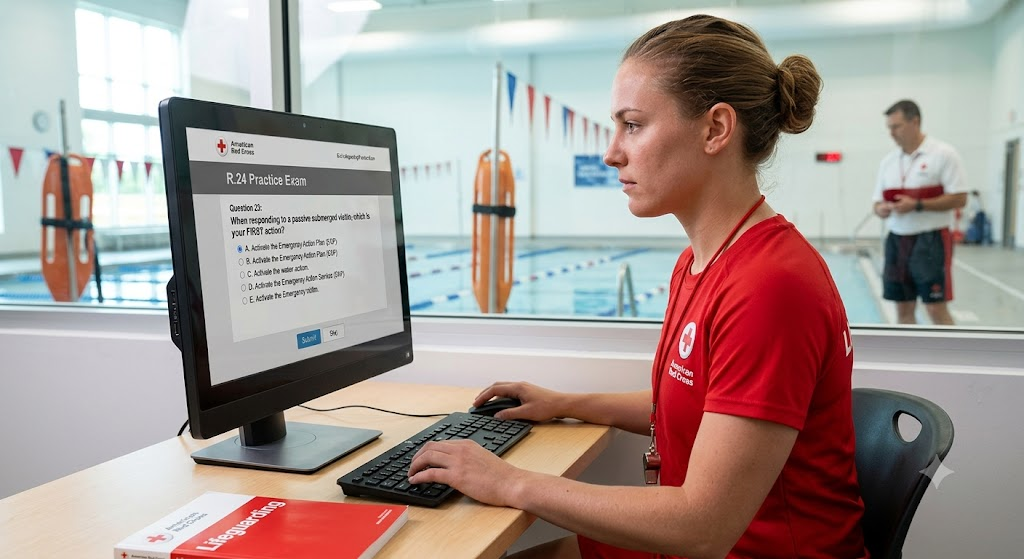
Additional Information
What the Course Entails and Exam Details
The R.24 Lifeguarding course is an intensive and comprehensive training program. To even begin, participants must demonstrate prerequisite swimming skills to ensure they are physically capable of performing rescues. Once in the course, which can range from approximately 21 to 27 total instruction hours depending on the format (in-person instructor-led or blended learning with online modules), students delve into critical topics.
The curriculum is unmatched and science-backed, focusing on practical application. Core areas include:
Water Safety and Injury Prevention: Learning to maintain safe environments, understand drowning processes, implement surveillance, and enforce facility rules effectively.
Surveillance and Recognition: Mastering scanning techniques, understanding zones of surveillance, and recognizing the different behaviors of swimmers and victims (distressed, active drowning, passive drowning).
Water Rescue Skills: Developing proficiency in various entries, approaches, and rescue techniques for both active and passive victims at the surface and submerged in different water depths.
Extrication and Removal: Safely removing victims from the water, both with and without assistance and potentially for those with suspected head, neck, or spinal injuries.
First Aid and Emergency Response: Gaining skills in basic first aid, including care for wounds, sudden illnesses, and musculoskeletal injuries.
CPR/AED for Professional Rescuers: Mastering cardiopulmonary resuscitation (CPR) and the use of an automated external defibrillator (AED) for adults, children, and infants in single and multi-rescuer scenarios.
Teamwork and Communication: Learning how to work effectively with other lifeguards, staff, and emergency services.
Facility-Specific Protocols: Understanding the importance of an Emergency Action Plan (EAP) and in-service training.
The R.24 specific practice exam and subsequent final assessments will directly test your competence across all these foundational and critical areas.
What to Expect in the Final Exam
Successfully completing the Red Cross Lifeguarding course culminates in a final certification assessment. This consists of two main parts, which the practice exams and course study prepare you for:
Written Exam:
The written exam requires a deep understanding of all cognitive elements of the course. It typically consists of multiple-choice questions (the number can vary but is often around 50 questions), and you must achieve a minimum grade of 80% to pass. This exam will assess your knowledge of protocols, procedures, first aid rules, CPR steps, and legal concepts related to lifeguarding. This is precisely the part of the certification process where the American Red Cross R.24 Lifeguarding Practice Exam provides invaluable, targeted support. The questions in the practice test are designed to mirror the actual exam’s style and content, allowing you to identify knowledge gaps and refine your understanding.
Practical Skills Assessment:
You must demonstrate proficiency in all critical skills learned throughout the course in realistic scenarios. This is a crucial hands-on component and usually includes three specific final skill assessments:
Timed Response Scenario: A timed drill involving multiple skills, such as recognizing and rescuing a submerged passive victim, extrication with assistance, and a rapid assessment with initial ventilations within specific time limits (e.g., 1 minute 30 seconds), followed by a 3-minute single-rescuer CPR performance.
Timed Single-Rescuer CPR Scenario: Demonstrating correct CPR and AED use on an adult manikin within a set time frame.
Multiple Rescuer Response Scenario: Participating as part of a multi-rescuer team to manage an emergency.
Both the written and practical components are necessary for certification, which is valid for two years upon successful completion. Remember to stay focused on maintaining quality technique and following all official protocols during both segments.
How to Study and Exam Centers
Effective preparation is key to passing the Red Cross Lifeguarding certification. Here are actionable study strategies and methods for practice:
Actionable Study Strategies:
Review the Manual: Thoroughly study the official American Red Cross Lifeguarding Manual, which is a required material and is available in print or as an eBook. Pay close attention to definitions, protocols, safety steps, and care procedures.
Take Official Practice Tests: Utilize the American Red Cross R.24 Lifeguarding Practice Exam. These tests are essential for simulating the written exam environment, understanding the question structure, and testing your retention. Analyze your results after each attempt to target weak areas.
Practical Skill Practice: Spend significant time in the water and on land practicing the practical skills. This includes swimming, treading, victim approaches, rescues, extrications, and practicing CPR/AED steps on manikins (if available). Practice with a partner or small group to make scenarios realistic and practice effective teamwork. Focus on timing and proper form as required by the final assessments.
Scenario-Based Study: Create scenario cards and work with a buddy to discuss appropriate responses and the necessary steps. This helps build critical thinking for real-life emergencies.
Instructor Guidance: Actively participate in all class sessions, listen carefully to your certified instructor's explanations and demonstrations, and ask questions when in doubt.
Physical Conditioning: Ensure your physical fitness level allows you to complete the demanding swimming and rescue components of the course.
Exam Centers and Where to Take the Exam:
Training Providers: The certification exam (both written and practical portions) is always administered as part of an official American Red Cross Lifeguarding course or recertification course. You can find these courses scheduled by authorized training providers, local aquatic facilities, community centers, schools, and even some municipal parks and recreation departments.
Search Online: The best way to find a class near you is to search the official American Red Cross website using their "Find a Class" feature or by contacting local aquatic centers directly.
Online Portals (Part of Blended Learning): For blended learning formats, a significant part of the study content and potentially certain assessments can be accessed through an online Red Cross portal. However, the final skills assessments and often the final written exam require an in-person, proctored session with a certified instructor. Always ensure you are participating with an official and authorized provider to ensure your certification is valid.
Job Opportunities from the Course
Earning the American Red Cross Lifeguarding certification is a significant achievement and unlocks a variety of rewarding job opportunities and career paths in the aquatic industry. The skills learned are transferable and in demand at numerous locations. This certification can lead to roles such as:
Pool Lifeguard: Guarding public, community, hotel, or private swimming pools, and ensure the safety of patrons through proactive surveillance and response.
Waterfront Lifeguard: Specializing in open-water environments such as lakes, bays, and beaches, handling unique challenges like currents, waves, and varying depths.
Waterpark Lifeguard: Guarding in complex waterpark environments, which include slides, wave pools, and interactive water attractions, and managing high visitor volumes.
Swim Instructor: Using your understanding of water safety and skills to teach people of all ages how to swim and become water competent (often requires an additional Water Safety Instructor certification).
Camp Waterfront/Pool Director: Overseeing aquatic operations and supervising other lifeguards at summer camps.
Aquatic Facility Supervisor/Manager: With experience, moving into leadership roles where you manage facility operations, scheduling, training, and emergency response planning.
Community Safety Educator: Using your expertise to educate the public about water safety and drowning prevention.
Lifeguard Trainer/Instructor: Certifying the next generation of lifeguards (requires a specialized instructor certification course).
This certification not only prepares you for immediate employment but also demonstrates critical skills in safety, emergency response, and teamwork that are valued in many fields. It is a vital step for anyone passionate about water safety and helping others.
Frequently Asked Questions
Reviews
5.0
Based on 0 reviews
Leave a Review
No reviews yet. Be the first to review!