
American Midwifery Certification Board (AMCB) Practice Exam
$69.00
- Buy to unlock unlimited access to all Quiz questions.
- After purchase you can print a PDF of the whole quiz at any point. The PDF will contain the questions and the correct answers.
About this Exam
The American Midwifery Certification Board (AMCB) offers two primary certifications: the Certified Nurse-Midwife (CNM) and the Certified Midwife (CM). These prestigious credentials are for midwives who have completed graduate-level midwifery education programs accredited by the Accreditation Commission for Midwifery Education (ACME). The certifications are designed to ensure that midwives meet the highest standards of knowledge and clinical competency.
The AMCB practice exams are essential tools for candidates preparing for the final certification examination. They serve a crucial role in self-assessment, helping aspiring midwives to understand the exam format, identify areas of strength and weakness, and build the confidence necessary to pass the rigorous national test. By taking these practice exams, students can familiarize themselves with the style and scope of questions they will encounter on their path to becoming a certified midwifery professional.
Ready to test your knowledge?
Buy Now to Access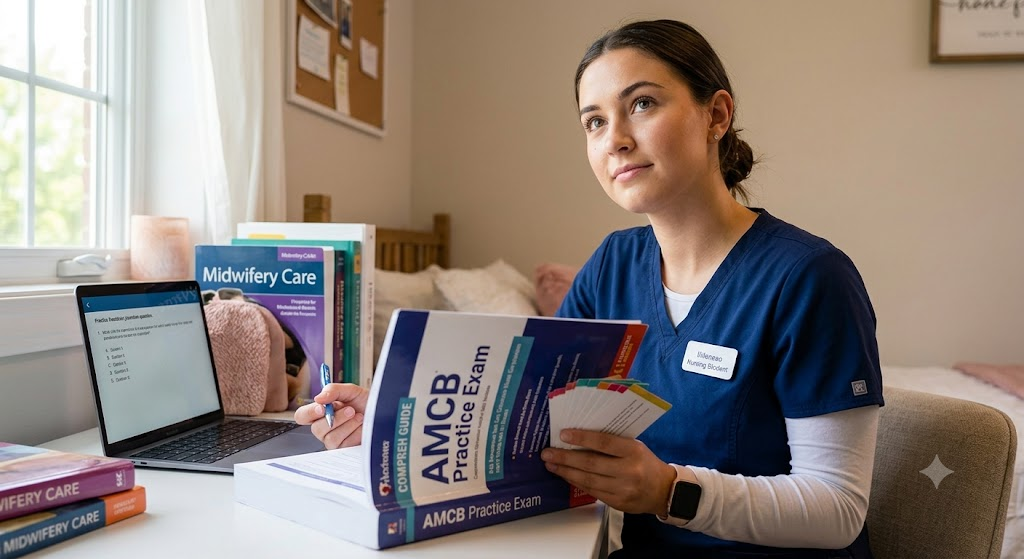
Additional Information
What the Course Entails and Exam Details
The AMCB final certification exams for both CNMs and CMs are comprehensive, covering the full scope of midwifery practice. The core topics, which are mirrored in the practice exams, include the following:
Antepartum Care: Assessment and management of pregnant individuals throughout pregnancy, including risk assessment, health promotion, and common complications.
Intrapartum Care: Management of labor and birth, including fetal monitoring, pain management, and the management of normal and abnormal birth scenarios.
Postpartum Care: Care of the parent following birth, focusing on physical recovery, psychological adjustment, and breastfeeding support.
Newborn Care: Assessment and management of the neonate, including initial stabilization, common newborn conditions, and health promotion.
Well-Woman/Gynecologic Care: Comprehensive care for women throughout the lifespan, including family planning, preconception care, gynecologic screening, and the management of common gynecological issues.
Women's Health/Primary Care: Providing general primary care to women, including the diagnosis and management of common acute and chronic health conditions.
Practice exams can vary in length, often available in sets of 100 or more unique questions. Their main purpose is to simulate the actual exam content outline, allowing you to test your knowledge in these key areas before the high-stakes final test.
What to Expect in the Final Exam
While you are preparing with a practice exam, it is vital to know the details of the final, actual AMCB certification exam to focus your efforts correctly. The AMCB final exam for both CNMs and CMs has the following key characteristics:
Format: The exam consists entirely of multiple-choice questions. It is a computer-based test, taken at an official testing center.
Number of Questions: The final certification exam typically consists of 175 questions.
Time Limit: Candidates are given four hours to complete the 175-question test. This requires good pacing, which can be honed through practice.
Passing Score: The AMCB uses a scaled scoring system. The raw score needed to pass is converted to a scaled score, with a passing score typically set at 75 on a scale of 0 to 100. Official score reports are usually provided immediately at the testing center.
Specific Rules: On the day of the final exam, you must present a valid, government-issued photo ID. No outside materials, such as textbooks, notes, or calculators, are allowed in the testing room. Cell phones and other electronic devices must be stored outside of the testing area.
How to Study and Exam Centers
Effective preparation is the key to success on the AMCB final exam. Here are actionable study strategies and information on where to take your test:
Actionable Study Strategies:
Utilize Practice Exams: This is a top strategy. Take multiple practice exams, both in "explanation mode" to learn from your mistakes and in "timed mode" to build your speed and stamina for the actual four-hour test.
Identify Weaknesses: Use the results of your practice exams to pinpoint specific content areas where you struggle. Focus your study time on these topics.
Create a Study Schedule: Develop a consistent study plan that covers all the major content areas leading up to your test date. Space your studying over several weeks or months.
Understand the Content Outline: Familiarize yourself with the AMCB's exam blueprint, available on their official website. This will show you the exact percentage distribution of questions across different topic areas.
Use Flashcards and Study Guides: Use digital or physical flashcards for active recall of key terms, drugs, and facts. Study guides can provide consolidated information on core concepts.
Join a Study Group: Collaborating with peers can expose you to different perspectives and help you clarify difficult concepts through discussion.
Stay Physically and Mentally Healthy: Ensure you are getting enough sleep, eating well, and exercising. A rested and focused mind is far more effective.
Exam Centers and Where to Take the Test:
Practice Exams: These are almost exclusively accessed online through specific educational platforms. You can take them from any location with a reliable internet connection on your computer or mobile device.
Final Exam: The official AMCB certification exam is administered at specialized testing centers throughout the United States. The AMCB contracts with PSI Services to provide these test sites. There are over 300 locations across the country, making it accessible to candidates nationwide. You will need to receive an Authorization to Test (ATT) from the AMCB before scheduling your final exam at a PSI testing center.
Job Opportunities from the Course
Earning your AMCB certification opens doors to a rewarding career as a recognized expert in midwifery. Certified Nurse-Midwives (CNMs) and Certified Midwives (CMs) have a broad scope of practice and can work in a variety of settings. Here is a clear list of job titles and career paths available to certified professionals:
Certified Nurse-Midwife (CNM)
Certified Midwife (CM)
Midwifery Director
Clinical Nurse-Midwife
Hospitalist Midwife
Birth Center Midwife
Home Birth Midwife
Women's Health Nurse Practitioner (for CNMs with additional NP certification)
Primary Care Provider
Midwifery Educator
Consultant in Women's Health
Researcher in Maternal and Child Health
Public Health Advocate
With their comprehensive skills, certified midwives are in high demand across hospitals, private practices, community clinics, birth centers, and academic institutions, playing a critical role in providing quality, patient-centered care for women and families.
Frequently Asked Questions
Reviews
5.0
Based on 0 reviews
Leave a Review
No reviews yet. Be the first to review!