
American Imperialism Practice Exam
$69.00
- Buy to unlock unlimited access to all Quiz questions.
- After purchase you can print a PDF of the whole quiz at any point. The PDF will contain the questions and the correct answers.
About this Exam
The American Imperialism Practice Exam is a preparatory assessment tool created for individuals studying a critical phase of United States history. It is specifically designed for high school students in Advanced Placement (AP) U.S. History courses, college-level introductory history classes, and dedicated history buffs preparing for larger comprehensive exams.
This practice test focuses on the period often defined from the late 19th century through the early 20th century, exploring the United States' emergence as a global power. By utilizing this resource, learners can identify knowledge gaps, practice test-taking strategies, and build confidence for their primary examinations, solidifying their command over the complex interactions, conflicts, and policies that defined America's expansionist age. It is not a formal certification itself but an essential step towards mastery in the subject.
Ready to test your knowledge?
Buy Now to Access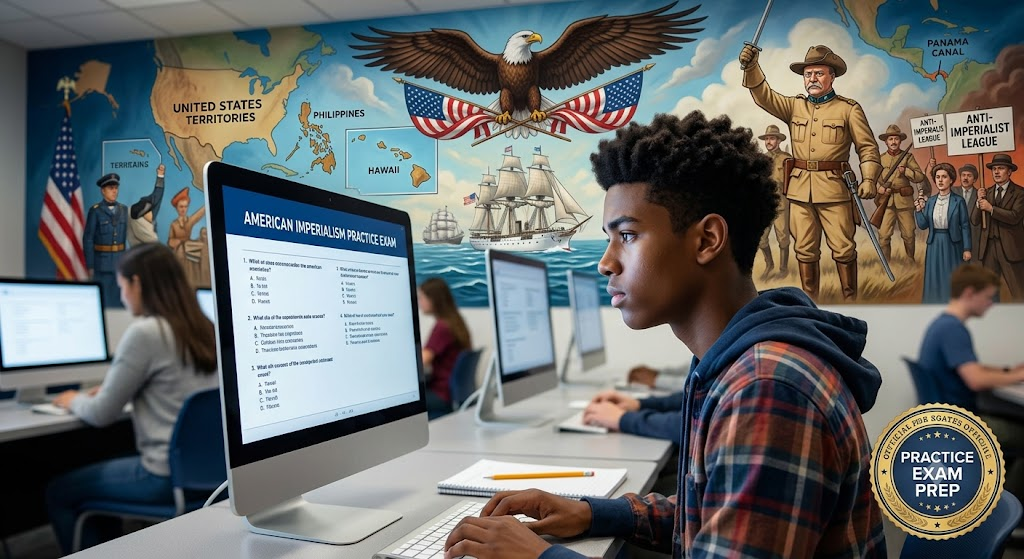
Additional Information
What the Course Entails and Exam Details
This comprehensive preparation material covers the core topics, events, and figures associated with American Imperialism. To excel, students must develop a deep understanding of the diverse factors, both internal and external, that drove U.S. foreign policy during this transformative period.
The syllabus for this practice exam covers several fundamental pillars of historical knowledge:
Manifest Destiny and Early Expansionism: Understanding the roots of expansion in ideological beliefs like Manifest Destiny and the shift towards looking beyond continental boundaries.
The Spanish-American War (1898): Detailed analysis of the war's causes, including yellow journalism, economic interests, and the explosion of the USS Maine, as well as its consequences, such as the acquisition of territories like the Philippines, Guam, and Puerto Rico.
Imperialism in the Pacific: Examining the annexation of Hawaii, the Philippine-American War, and the introduction of the Open Door Policy in China.
Big Stick Diplomacy: The foreign policy of Theodore Roosevelt, including the construction of the Panama Canal, the Roosevelt Corollary to the Monroe Doctrine, and interventionism in Latin America.
Dollar Diplomacy: Assessing William Howard Taft’s strategy of promoting U.S. commercial interests abroad as a method of extending influence.
Moral Diplomacy: Understanding Woodrow Wilson’s approach to foreign affairs, emphasizing American exceptionalism and democratic ideals, yet often resulting in interventions.
The Anti-Imperialist Debate: Exploring the motivations and arguments of those who opposed expansion, such as the Anti-Imperialist League, featuring prominent figures like Mark Twain and Andrew Carnegie.
Economic Motives: Analyzing industrial growth, the need for new markets, resources, and coaling stations for a powerful new navy (inspired by Alfred Thayer Mahan).
Cultural and Social Darwinist Ideologies: The influence of beliefs regarding Anglo-Saxon superiority and a perceived "civilizing mission."
This knowledge is structured into practice questions and scenarios to test both content recall and critical analysis of historical documents and evidence.
What to Expect in the Final Exam
As a practice exam designed to simulate actual test environments, the "American Imperialism Practice Exam" focuses primarily on multiple-choice questions (MCQs), which are a dominant format in high-stakes history tests. The exam consists of approximately 50 to 75 questions, covering all the thematic areas listed above.
The exam structure includes:
Format: Digital delivery, typically delivered through an online learning platform or test preparation software.
Question Types: Multiple Choice Questions, including stimulus-based questions that require reading a short document or analyzing a primary source (map, cartoon, quote) before selecting an answer.
Time Limit: A realistic time constraint of approximately 60-90 minutes is enforced to mirror actual testing conditions.
Scoring: A simulated passing score is often set around 70% to demonstrate adequate content proficiency.
Rules: The exam is intended to be taken without the use of external aids like textbooks or notes, encouraging self-assessment and memory retrieval.
While the practice exam might not include complex essays like a Document-Based Question (DBQ) found on AP exams, the knowledge tested provides a direct foundation for responding effectively to such higher-level writing prompts.
How to Study and Exam Centers
Effectively preparing for this practice exam, and the formal assessments it mirrors, requires disciplined study strategies. Success comes not from simple memorization but from a deep understanding of historical relationships, themes, and consequences.
Study Strategies:
Create Timelines and Maps: Visualize the sequence of events and geographical shifts of American influence. Map the territorial acquisitions after the Spanish-American War and trace the impact of Big Stick Diplomacy.
Master the Presidents and Policies: Develop a clear comparison of the foreign policy doctrines of Roosevelt, Taft, and Wilson, including examples of where each was applied.
Read Primary Sources: Practice analyzing period sources, such as political cartoons about imperialism, excerpts from the presidents’ speeches, and writings by anti-imperialists.
Practice with Multiple Iterations: Use the practice exam multiple times, learning from each attempt and focusing review efforts on weak areas.
Flashcards for Terms: Use digital or physical flashcards for key vocabulary, legislation, and key figures (e.g., Roosevelt Corollary, Rough Riders, Emilio Aguinaldo, Open Door Policy).
Thematic Outlines: Group information by motivation (economic, military, political) and impact (positive, negative, regional differences).
Exam Location:
Since this is a preparatory tool, the American Imperialism Practice Exam is widely accessible online. You won't typically need to visit a physical Pearson VUE center or specific authorized schools. Students can locate various practice resources and simulations on dedicated educational platforms, test preparation websites, and through many online academic portals. It can often be taken in the comfort of your own home or from an internet-enabled device, providing flexibility and immediate feedback to guide your study efforts.
Job Opportunities from the Course
While this specific practice exam is an educational step rather than a job-qualifying certification, mastering the complex period of American Imperialism provides the deep historical understanding that is crucial for numerous related career paths. Employers in various fields value the critical thinking, research skills, and strong contextual knowledge gained through this type of rigorous historical study.
A deep command of this subject can contribute significantly to the following professional roles and career trajectories:
Historian
History Teacher (High School or Middle School)
Political Scientist
Policy Analyst (Focusing on International Relations or Foreign Policy)
Archivist or Museum Curator
Foreign Service Officer (Diplomat)
Journalist (Specially for International or Political Beats)
Legislative Aide or Assistant
Research Analyst for Think Tanks or Non-Profits
By excelling in your study and preparation, you are developing skills that extend far beyond this practice test, opening doors to a wide array of fascinating and impactful careers.
Good luck with your studies and preparation! This guide is an excellent resource to help you navigate your way to success on the American Imperialism Practice Exam and all your future academic endeavors.
Frequently Asked Questions
Reviews
5.0
Based on 0 reviews
Leave a Review
No reviews yet. Be the first to review!