
American College of Osteopathic Family Physicians (ACOFP) Practice Test
$69.00
- Buy to unlock unlimited access to all Quiz questions.
- After purchase you can print a PDF of the whole quiz at any point. The PDF will contain the questions and the correct answers.
About this Exam
The ACOFP Practice Test is a crucial step for osteopathic family medicine residents and other eligible physicians aiming for board certification. Formally administered by the American Osteopathic Board of Family Physicians (AOBFP) and supported by the American College of Osteopathic Family Physicians (ACOFP), this formative assessment is designed to gauge readiness for the AOBFP Initial Certification Exam. It is primarily tailored for osteopathic (DO) residents in family medicine, as well as MD residents in programs with Osteopathic Recognition, providing them with invaluable feedback on their clinical knowledge and application of Osteopathic Principles and Practice (OPP).
Ready to test your knowledge?
Buy Now to Access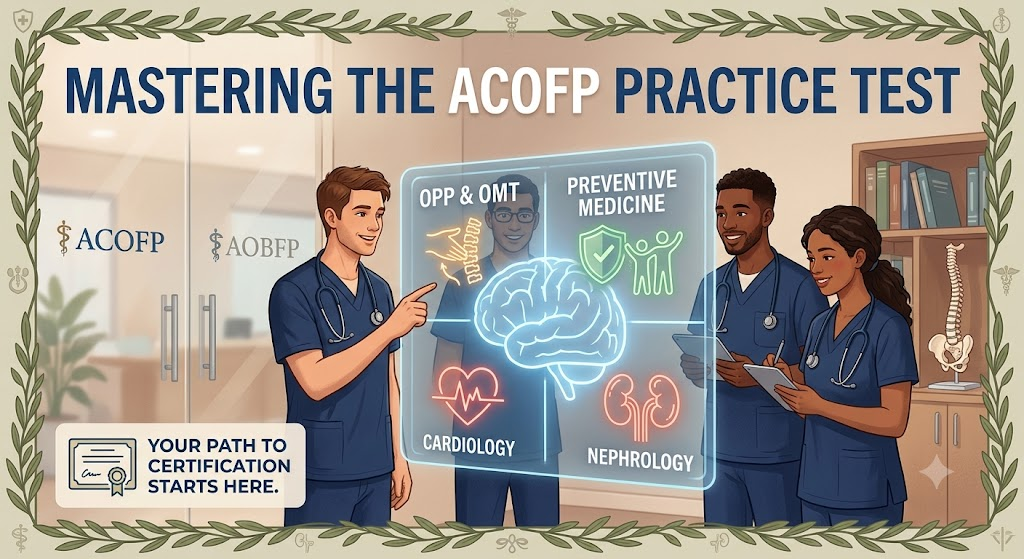
Additional Information
What the Course Entails and Exam Details
The ACOFP practice exam is comprehensive, mirroring the breadth of the actual certification test. It is not just a review of family medicine but also a deep dive into the unique tenets of osteopathic medicine. The content is meticulously developed based on a job task analysis of the fundamental knowledge and skills required for a family physician. Key topics include:
Core Family Medicine: Cardiology, Pulmonology, Gastroenterology, Endocrinology, Nephrology, Urology, Orthopedics, Musculoskeletal & Sports Medicine, Pediatrics, Geriatrics, and Preventive Medicine.
Osteopathic Distinctiveness: A significant portion (approximately 75 questions) is dedicated to Osteopathic Principles and Practice (OPP) and Osteopathic Manipulative Treatment (OMT). This section assesses a candidate’s ability to integrate osteopathic philosophy into patient care, diagnosis, and treatment planning.
What to Expect in the Final Exam
While the ACOFP Practice Test itself is a formative tool, its structure often reflects the Cognitive (Written) Exam of the AOBFP Initial Certification. For the full AOBFP Initial Certification Cognitive Exam, candidates can expect:
Format: The exam is a computer-based, multiple-choice assessment consisting of approximately 275 to 300 single-answer questions, including a number of unscored pretest items.
Time Limits: The examination is typically a full-day event, lasting roughly 5.5 hours, including structured sections and optional breaks.
Osteopathic Component: A required component specifically focuses on OPP/OMT, making it a critical area of preparation.
Scoring: A passing score is determined through rigorous psychometric analysis to ensure a valid measurement of minimum competency. A separate practical performance exam in OMT is also a component of the full certification pathway, although it can be taken independently of the cognitive exam.
How to Study and Exam Centers
Effective preparation for the ACOFP Practice Test is key to identifying knowledge gaps. Actionable strategies include:
Utilize Official Resources: Leverage the ACOFP’s online educational video library for OMT procedures, past Board Review presentations, and the eLearning portal, which includes practice questions with detailed explanations.
Review OPP/OMT: Dedicate significant time to reviewing the core principles of osteopathic medicine and practicing hands-on OMT skills.
Practice with Purpose: Take advantage of the formative nature of the In-Service Exam (ISE), which is often the direct "practice" exam mentioned. Use the immediate feedback and educational resources provided to reinforce learning.
Regarding exam locations, the practice In-Service Exam (ISE) is often delivered on user-friendly online platforms like NBOME’s CATALYST, allowing residents to take it remotely on their own schedule within a specific two-week window. For the actual AOBFP Initial Certification Cognitive Exam, administrations are computer-based and are typically proctored remotely (using platforms like MonitorEDU, which requires a webcam and mobile camera for integrity) or held at specified Pearson VUE testing centers, offering flexibility for candidates to take the test in a secure, convenient environment.
Job Opportunities from the Course
Earning the ACOFP and AOBFP certification opens up diverse and rewarding career paths in the medical field. Graduates from an osteopathic family medicine residency program who achieve board certification have a distinct professional advantage. Career titles unlocked by this comprehensive process include:
Board-Certified Family Physician (DO or MD with Osteopathic Distinction)
Osteopathic Manipulative Medicine (OMM) Specialist
Primary Care Physician
Geriatrician
Sports Medicine Physician
Urgent Care Physician
Rural Health Physician
Academic Medicine Faculty/Residency Program Director
Hospitalist
Frequently Asked Questions
Reviews
5.0
Based on 0 reviews
Leave a Review
No reviews yet. Be the first to review!