
American Chemical Society (ACS) Laboratory Safety Practice Test
$69.00
- Buy to unlock unlimited access to all Quiz questions.
- After purchase you can print a PDF of the whole quiz at any point. The PDF will contain the questions and the correct answers.
About this Exam
The American Chemical Society (ACS) Laboratory Safety Practice Test is a essential assessment designed to measure a candidate’s understanding of fundamental safe practices within a chemical laboratory environment. It is primarily created for undergraduate chemistry students, academic researchers, graduate teaching assistants (TAs), and chemical industry professionals who are entering or working in laboratory settings. This test serves as a critical checkpoint to ensure that all individuals possess the necessary knowledge to recognize potential hazards, assess risks, and implement proper safety protocols to prevent accidents and injuries before they begin actual experimental work.
Ready to test your knowledge?
Buy Now to Access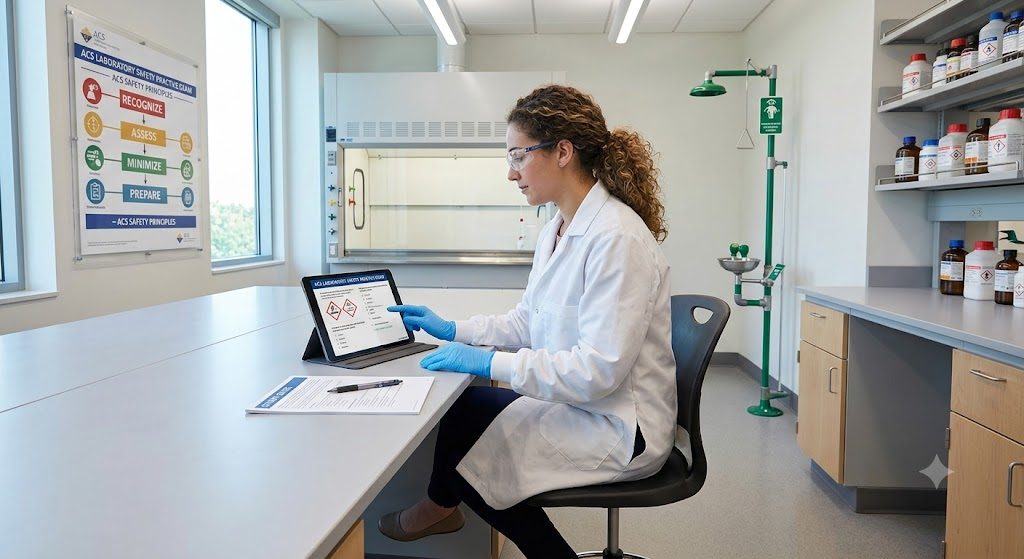
Additional Information
What the Course Entails and Exam Details
The curriculum leading to this test comprehensively covers several key domains of laboratory safety based on established regulatory standards and best practices. The main syllabus topics include:
The RAMP Framework: Recognizing hazards, Assessing risks, Minimizing risks, and Preparing for emergencies.
GHS Communication: Understanding the Globally Harmonized System (GHS) including pictograms, hazard classes, and labels.
Safety Data Sheets (SDS): How to locate, read, and interpret critical safety information on an SDS.
Personal Protective Equipment (PPE): Proper selection, use, maintenance, and limitations of gloves, safety glasses, goggles, and lab coats.
Laboratory Equipment Safety: Safe operation of common apparatus such as fume hoods, rotovaps, centrifuges, and heating devices.
Chemical Handling and Storage: Guidelines for identifying incompatible chemicals, proper segregation, and safe transport.
Emergency Procedures: Response protocols for spills, cuts, burns, chemical exposures, and fires.
Hazardous Waste Management: Fundamentals of safe collection, labeling, and disposal of chemical and biological waste.
What to Expect in the Final Exam
The official ACS Laboratory Safety Assessment, which this practice test prepares you for, is typically administered as a modern online examination through an academic institution's Learning Management System (LMS) or the ACS Institute platform itself. The final assessment usually consists of approximately 10 to 25 multiple-choice questions designed to test both theoretical knowledge and practical scenario-based decision-making. You will likely be given a time limit, typically between 30 to 60 minutes, to complete the test in a single session. To earn the widely recognized Certificate of Completion, a minimum passing score of 80% is generally required. A notable and student-friendly detail is that candidates are often allowed unlimited attempts to achieve this passing score, enabling them to review their mistakes and mastery of the material before moving forward.
How to Study and Exam Centers
Preparing for the ACS Laboratory Safety Practice Test requires both a review of key concepts and active application of knowledge through realistic scenarios.
Study Strategies:
Master GHS and SDS: Spend dedicated time memorizing the nine GHS hazard pictograms and knowing exactly where to find information like exposure limits and first aid measures within an SDS.
Utilize the RAMP Method: Practice applying the four steps of the RAMP framework to hypothetical experiments to build your proactive safety mindset.
Review Textbook Resources: Study the official ACS textbook, "Laboratory Safety for Chemistry Students," or the safety chapters in your general or organic chemistry textbook.
Take Practice Quizzes: Complete any available practice questions, simulations, or pre-tests provided within your ACS course modules or university curriculum to identify your weak points.
Exam Centers: Unlike standardized professional licensure exams, the ACS Laboratory Safety Test is not taken at physical, authorized exam centers like Pearson VUE. It is entirely an online exam. Students and professional candidates take the test through their academic institution’s internal LMS or by accessing the ACS Institute’s e-learning portal from any computer with a stable internet connection. Registration and access instructions are provided by your university department or employer.
Job Opportunities from the Course
Demonstrating proficiency in laboratory safety through this assessment is not just a course requirement; it is a fundamental credential that makes candidates significantly more competitive and safer employees across a broad range of scientific and technical career paths.
Below is a list of job opportunities and career paths where holding this level of lab safety knowledge is absolutely critical:
Chemical Laboratory Technician
Academic or Industrial Research Assistant
Chemical Safety Officer (CSO)
Environmental Health and Safety (EHS) Specialist
Quality Control (QC) or Quality Assurance (QA) Analyst
Academic Laboratory Coordinator
Chemical Process Engineer
Lab Supervisor or Manager
Clinical Laboratory Scientist
Toxicology Research Associate
Frequently Asked Questions
Reviews
5.0
Based on 0 reviews
Leave a Review
No reviews yet. Be the first to review!