
American Board of Surgical Assistants (ABSA) Certification Practice Exam
$69.00
- Buy to unlock unlimited access to all Quiz questions.
- After purchase you can print a PDF of the whole quiz at any point. The PDF will contain the questions and the correct answers.
About this Exam
The ABSA Certification, leading to the designation of Surgical Assistant – Certified (SA-C), is a premier credential for experienced surgical professionals. It is designed specifically for individuals who have already established a foundation in the operating room, including Surgical Technologists (CSTs), Registered Nurses (RNs), Physician Assistants (PAs), and other qualified allied health professionals. This certification validates your advanced knowledge, clinical skills, and dedication to patient safety, enabling you to practice as a surgical first assistant and assume a critical role in complex surgical procedures.
Ready to test your knowledge?
Buy Now to Access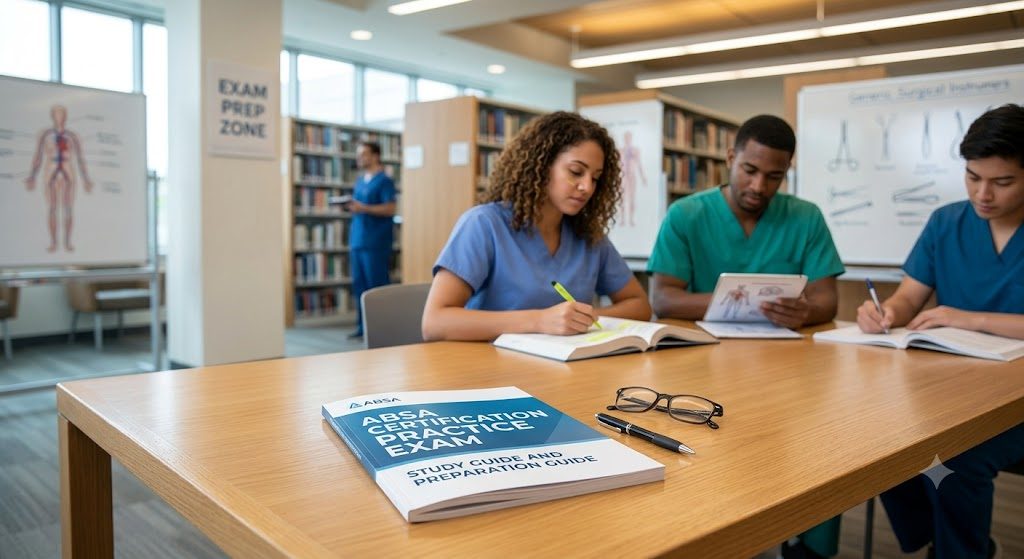
Additional Information
What the Course Entails and Exam Details
This section outlines the broad knowledge base required to succeed on the ABSA SA-C exam. Since ABSA does not offer a single "course" but validates existing expertise, your preparation should focus on these key domains derived from a national job analysis of surgical assistants:
Surgical Anatomy and Physiology: In-depth knowledge of all major body systems and their interrelated functions.
Medical Terminology and Pharmacology: Expert understanding of surgical terminology and common pharmacological agents used in perioperative care, including anesthesia.
Surgical Microbiology and Infection Control: Principles of aseptic technique, sterilization, and strategies to prevent surgical site infections.
Wound Healing and Hemostasis: Processes of tissue repair and techniques for bleeding control.
Surgical Techniques and Procedures: Detailed knowledge of steps for diverse surgical specialties, including General Surgery, Gynecological, Orthopedic, Neurosurgical, and Cardiothoracic procedures.
Professionalism and Ethics: Standards of conduct, legal responsibilities, and team communication.
What to Expect in the Final Exam
The ABSA SA-C certification exam is a comprehensive evaluation designed to test your mastery of the topics listed above. It is crucial to manage your time effectively and understand the test format.
Exam Format: The test consists of 150 single-select, multiple-choice questions. Each question has four possible options.
Time Limit: You will be given three (3) hours to complete the entire computer-based examination. This averages to about 1.2 minutes per question.
Passing Score: To successfully pass the exam and become an SA-C, you must achieve a minimum score of 70%.
Language: The examination is offered exclusively in English.
How to Study and Exam Centers
Effective preparation is key to your success on the ABSA SA-C exam. As ABSA does not require, provide, accredit, or endorse any specific study guides, practice exams, or training courses, your preparation strategy should be proactive and multi-faceted.
Actionable Study Strategies:
Use the ABSA Content Outline: Start by thoroughly reviewing the official ABSA Content Outline (available on the ABSA website). Use it as a checklist to identify your knowledge gaps.
Review Your Core Materials: Revisit your original training materials, surgical textbooks (e.g., Alexander's Care of the Patient in Surgery, Surgical Technology for the Surgical Technologist), and anatomy atlases.
Leverage Third-Party Resources: Seek out reputable online platforms, review courses, or textbooks that specifically cover "Surgical First Assisting" or the SA-C exam content. While not official, they are highly beneficial for reinforcing key concepts.
Practice with Multiple-Choice Questions: Familiarize yourself with the format by taking practice quizzes and simulation exams. This builds test-taking stamina and improves your ability to analyze questions efficiently.
Form a Study Group: Collaborating with colleagues who are also preparing can provide mutual support and fresh perspectives on difficult topics.
Where and How to Take the Exam:
Computer-Based Format: The final exam is a computer-based test (CBT).
Testing Centers: While ABSA does not operate its own centers, the exam is typically delivered through an established network of secure, proctored computer testing centers. Once your application is approved, you will receive information on how to schedule your exam at a local center.
Process: The standard process involves applying for the exam via the ABSA website, paying the required fees, receiving an Authorization to Test (ATT) letter, and then using the specified testing provider's online portal to find a suitable location and time.
Job Opportunities from the Course
Earning your Surgical Assistant – Certified (SA-C) credential opens doors to advanced roles and specialization within the perioperative environment. The certification demonstrates your capability to perform complex first-assistant tasks and make critical decisions.
Specific job titles and career paths this certification unlocks include:
Certified Surgical Assistant (SA-C)
Surgical First Assistant
Perioperative First Assistant
Traveling Surgical Assistant
Surgical Assistant Instructor / Educator
Surgical Sales Specialist (clinical support)
Potential employers and settings include:
Hospitals (general, teaching, and specialty)
Outpatient surgery centers (ASCs)
Private physician practices
Medical device and surgical technology companies
Good luck with your preparation for the ABSA Certification Practice Exam! With dedication and structured study, you can achieve this valuable credential.
Frequently Asked Questions
Reviews
5.0
Based on 0 reviews
Leave a Review
No reviews yet. Be the first to review!