
American Airlines Fleet Service Practice Exam
$69.00
- Buy to unlock unlimited access to all Quiz questions.
- After purchase you can print a PDF of the whole quiz at any point. The PDF will contain the questions and the correct answers.
About this Exam
The American Airlines Fleet Service Practice Exam is a comprehensive study and simulation tool tailored for individuals seeking a career in airline ground operations, specifically as a Fleet Service Agent. This position, often known as a Ramp Agent, is the backbone of an airline's ground presence. The exam and its associated study materials are designed to evaluate and enhance the cognitive abilities, job knowledge, safety awareness, and physical coordination required to handle baggage, manage cargo, operate complex ground support equipment, and ensure the safe, efficient turn-around of aircraft. It serves both as a self-assessment tool for potential applicants and a crucial component of American Airlines' internal initial training and qualification program. Success indicates a readiness to join a fast-paced team dedicated to on-time performance and passenger safety.
Ready to test your knowledge?
Buy Now to Access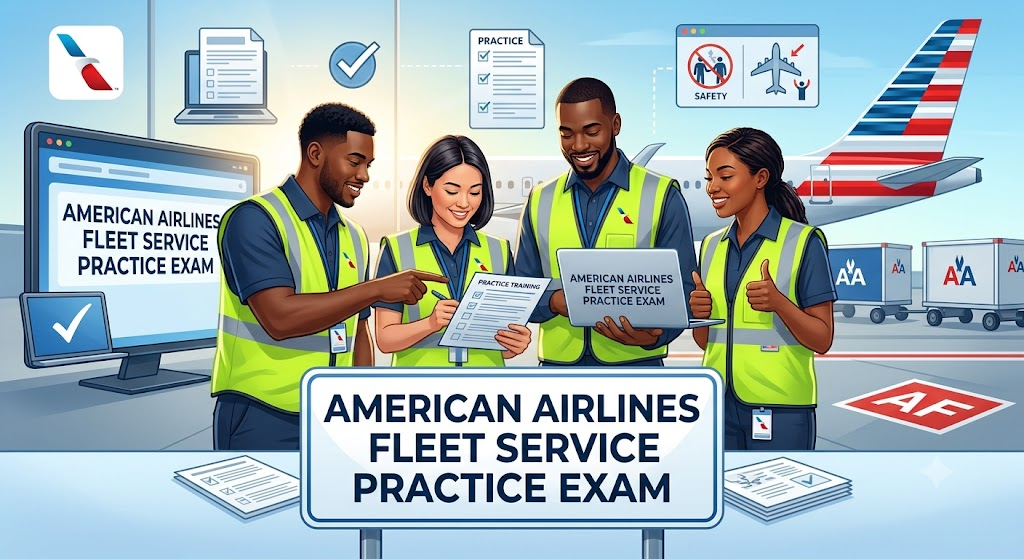
Additional Information
What the Course Entails and Exam Details
This section outlines the extensive topics and skills covered in the American Airlines Fleet Service comprehensive assessment pathway. Candidates must demonstrate proficiency in several key areas:
Aviation Fundamentals: Understanding the airline industry, basic terminology, and the specific ecosystem of American Airlines.
Ramp Operations and Safety: Rigorous training on aircraft marshalling, hand signals, safe movement of aircraft, and all associated safety protocols to prevent injury and damage. This includes Foreign Object Debris (FOD) control.
Baggage and Cargo Handling: Techniques for proper loading, unloading, sorting, and securing of different types of baggage, mail, and freight, including dangerous goods regulations and ULD (Unit Load Device) management.
Ground Support Equipment (GSE): Knowledge of and operational skills for various equipment, including belt loaders, tugs, tractors, air start units, de-icing trucks, and catering high-lifts.
Aircraft Turnaround Procedures: Comprehensive understanding of the "turn" process, timeline, communication with the flight deck, and teamwork required for a seamless operation.
Communication and Teamwork: Principles of effective radio communication, working within a crew, and using established airline-specific systems and protocols.
Physical and Spatial Aptitude: The ability to visualize spatial relationships for efficient aircraft loading and have the physical stamina for repetitive lifting and working in varied weather conditions.
AA Policies and Procedures: In-depth knowledge of American Airlines’ internal safety standards, customer service philosophy, and general employee conduct.
What to Expect in the Final Exam
The "final exam" in this context refers to the multi-stage qualification process a new Fleet Service hire must pass to become a fully certified team member. While American Airlines has various intermediate tests, the overall evaluation combines multiple formats:
Cognitive and Aptitude Assessments: These initial, often online, tests use multiple-choice questions to measure numerical reasoning, verbal reasoning, logical thinking, problem-solving, and situational judgment. They often feature timed sections.
Practical Skills Examinations: Hands-on evaluations are a significant part of training. New hires must demonstrate proficiency in real-world simulations, such as correctly marshalling a plane, operating GSE, and following a loading plan without error.
Knowledge Validation Tests: Multiple-choice, scenario-based, and short-answer exams covering all theoretical and procedural topics detailed in Section 2, ensuring comprehensive regulatory and company knowledge.
Check-Rides and Final On-the-Job Evaluation: These are culminating performance reviews where a supervisor or instructor observes the trainee performing actual Fleet Service duties on the active ramp, assessing their ability to apply everything they have learned safely and efficiently under real pressure.
Passing scores for knowledge tests and practical check-rides are exceptionally high, reflecting the safety-critical nature of the work. Specific time limits apply to many components, particularly simulation tasks and aptitude tests.
How to Study and Exam Centers
Preparation for the American Airlines Fleet Service assessments requires a dual focus on cognitive practice and practical knowledge. Effective study strategies include:
Practice Aptitude Tests: Use industry-standard practice resources that simulate numerical, verbal, logic, and multitasking aptitude tests to improve speed and accuracy.
Master the AA Content: Study the extensive training materials, manuals, and online modules provided by American Airlines during the hiring and initial training process. Focus heavily on safety rules, GSE operation, and aircraft loading.
Learn the Tarmac: Familiarize yourself with airport ground operations by reading general industry guides and manuals (such as IATA resources), focusing on airport layout, signaling, and ground crew roles.
Create Flashcards: Memorize critical aviation terms, FAA regulations, Dangerous Goods classifications, and AA-specific procedures.
Practice Spatial Problems: Enhance spatial reasoning by mentally or physically creating loading scenarios and visualizing the safest path for ground vehicles.
Exam Centers and Test Locations:
Hiring Assessments: The initial cognitive and personality aptitude tests are typically conducted online. If successful, candidates may attend a physical AA assessment center for interviews and potential group exercises.
Initial Training: Once hired, extensive formal training occurs at a dedicated, physical American Airlines facility, such as the TechOps Training Center or another company hub.
On-the-Job Evaluation: The final practical check-rides and on-the-job training are conducted at the active airport station (base) where the employee is assigned to work, under real operational conditions.
Job Opportunities from the Course
Successfully navigating the American Airlines Fleet Service assessments unlocks a clear career path within one of the largest airlines, offering significant opportunities for growth.
American Airlines Fleet Service Agent / Ramp Agent (Initial role)
American Airlines Baggage Handler (Initial role, with potential specializations)
American Airlines Cargo Agent (Initial role, with advanced cargo handling options)
Lead Fleet Service Agent / Ramp Lead
Ground Support Equipment (GSE) Mechanic (With technical training)
Supervisor, Fleet Service / Ramp Operations
Manager, Airport Operations
Operations Coordinator / Tower Coordinator
Opportunities for internal transfer to other airline functions like Passenger Service, Flight Service (Flight Attendant), or even Flight Operations (Pilot).
By mastering the materials and passing the comprehensive assessments, you establish a strong foundation for a dynamic and rewarding career in the aviation industry with American Airlines.
Frequently Asked Questions
Reviews
5.0
Based on 0 reviews
Leave a Review
No reviews yet. Be the first to review!