
America's Foreign Policy Practice Ecam
$69.00
- Buy to unlock unlimited access to all Quiz questions.
- After purchase you can print a PDF of the whole quiz at any point. The PDF will contain the questions and the correct answers.
About this Exam
The America's Foreign Policy Practice Exam is designed as a summative and formative assessment tool for individuals seeking to demonstrate mastery of the historical foundations, institutional frameworks, and contemporary challenges of U.S. foreign engagement. It is an ideal resource for undergraduate and graduate students in political science or international relations, as well as professionals preparing for competitive government exams.
This practice exam serves as a simulated testing environment, allowing candidates to evaluate their understanding of key doctrines, the roles of various government branches, and the nation's response to global events. Utilizing this tool transforms passive studying into active learning, which is proven to increase retention and improve scores on actual, high-stakes examinations.
Ready to test your knowledge?
Buy Now to Access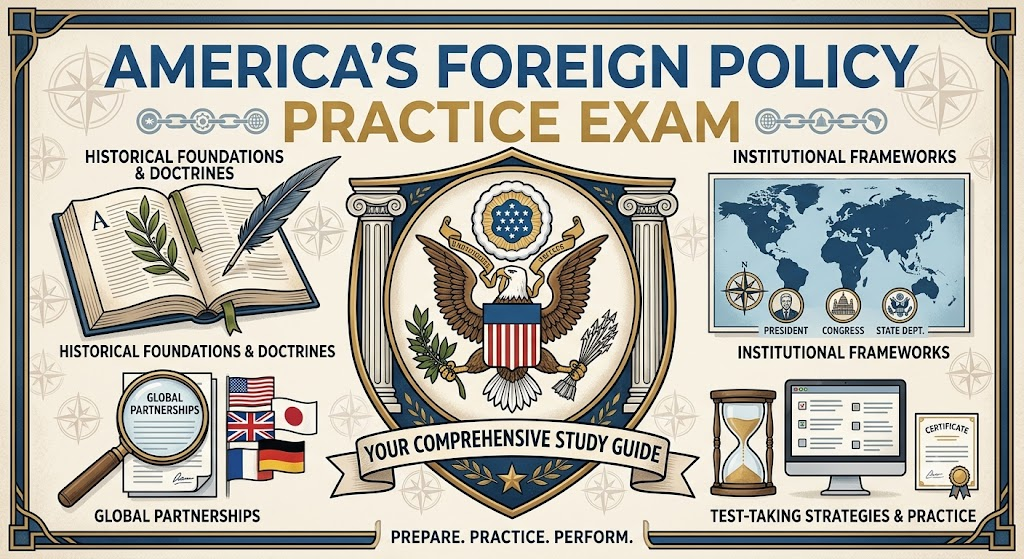
Additional Information
What the Course Entails and Exam Details
A comprehensive America's Foreign Policy Practice Exam typically covers a syllabus and skills comparable to a rigorous semester-long university course or the specialized knowledge required for entry-level diplomatic roles. While specific exam details vary by the source of the practice material (e.g., educational platforms, textbook publishers, or course instructors), a high-quality practice test always mirrors the depth and breadth of standard professional assessments.
Core Topics Covered
Historical Foundations and Turning Points: Analysis of major eras, from early isolationism and the Monroe Doctrine to the World Wars, the Cold War (containment, détente, escalation), and the post-Cold War and post-9/11 world.
Theories and Frameworks: Application of international relations theories (realism, liberalism, constructivism) to interpret historical and contemporary U.S. actions.
Key Institutions and Actors: Examination of the constitutional roles of the President, Congress, and the judiciary, as well as the functions of the Department of State, Department of Defense, National Security Council, and the intelligence community.
Tools of Foreign Policy: Evaluation of diplomatic, economic (sanctions, aid, trade), and military instruments of power and statecraft.
Contemporary Global Challenges: Analysis of current issues such as terrorism, nuclear proliferation, climate change, regional conflicts, international organizations, and great power competition.
What to Expect in the Final Exam
While the America's Foreign Policy Practice Exam is a preparatory tool, its primary value is simulating the experience of a final, professional, or standardized test. In the absence of a single, universal certification, the "final exam" refers to the actual high-stakes test for which a candidate is preparing. Common characteristics of comprehensive assessments in this field include:
Exam Format
Final exams often consist of two main components:
Multiple-Choice Questions: These test broad knowledge of historical facts, key concepts, institutional processes, and influential figures. Questions may ask to identify a doctrine, analyze a specific event, or interpret a theoretical model.
Free-Response or Essay Questions: These assess critical thinking, synthesis of information, and argumentative skills. A typical essay might require a policy analysis of a past crisis, an evaluation of a specific foreign policy tool, or an assessment of current strategic challenges.
Time Limits and Passing Scores
Final exams are generally timed, typically ranging from two to three hours. A rigorous practice exam will also enforce strict timing to help you develop a sustainable pace. Passing scores and requirements are set by the specific institution or testing body. For professional exams like the FSOT, competitive performance is required to advance in the selection process.
How to Study and Exam Centers
Effective preparation requires a blend of comprehensive content review and targeted practice. The America's Foreign Policy Practice Exam should be the focal point of your review cycle.
Study Strategies
Integrated Content Review: Use a textbook and primary sources (speeches, treaties, policy documents) to build a strong foundational knowledge.
Take the Practice Exam Under Timed Conditions: Replicate the stress and time pressure of the actual test. This is essential for building endurance and learning to manage your time across different sections.
Detailed Answer Review: Do not just look at your final score. Thoroughly analyze the explanations for both correct and incorrect answers. Identify why a distractor was plausible and why the correct answer is definitive.
Identify and Attack Weaknesses: If you consistently miss questions on the role of Congress in foreign policy, devote additional time to studying relevant legislation and historical case studies.
Utilize Flashcards and Timelines: Create study aids for key doctrines, events, treaties, and influential figures to enhance recall during the multiple-choice section.
Exam Centers for Practice and Actual Exams
It is important to understand the distinction between accessing practice material and sitting for a formal final exam.
Practice Exams: America's Foreign Policy Practice Exams are study tools, not formal certifications themselves. They do not have dedicated physical testing centers. You can typically find high-quality practice material through online educational portals, inside comprehensive study guide books, or as part of university course resources. These materials allow for flexible, self-paced, and repeat testing from any location with internet access.
Actual Final Exams: The locations for formal, high-stakes exams depend entirely on the program or organization administering them. For example, university final exams are held in specific campus classrooms. Standardized tests and professional entrance exams like the FSOT are often administered at authorized, secure, and proctored testing centers, such as those managed by Pearson VUE, located in major cities worldwide, or at specific institutional locations. Always check the specific guidance from your academic department or the official government testing website for information on scheduling and locations for your actual final exam.
Job Opportunities from the Course
A proven mastery of U.S. foreign policy, validated by success in a demanding final exam and reinforced through a rigorous study guide like this, opens doors to diverse and critical career paths in the public and private sectors.
The following list details specific job opportunities that directly leverage expertise in America's Foreign Policy:
Foreign Service Officer (Diplomat): Represents U.S. interests abroad, promotes diplomacy, and implements foreign policy.
Intelligence Analyst: Collects, analyzes, and interprets data to advise policymakers on foreign threats and international developments.
International Relations Specialist: Works in government agencies, international organizations (e.g., UN, NATO), or NGOs, managing programs and advising on foreign affairs.
Policy Advisor/Legislative Assistant: Works for members of Congress, government departments, or think tanks, crafting legislation and providing expert analysis on foreign policy issues.
Journalist/Foreign Correspondent: Reports on and analyzes international news and America's global role for media organizations.
Non-Governmental Organization (NGO) Program Manager: Oversees international aid, development, or human rights programs influenced by U.S. foreign policy.
Political Risk Analyst: Advises multinational corporations and financial institutions on how political events and foreign policy decisions affect business operations.
Academic/Researcher: Teaches and conducts research on international relations, U.S. history, and foreign policy.
Proper spacing has been provided between paragraphs for ease of copying and reading. This guide is your first step towards a successful career in the international arena. Good luck with your studies!
Frequently Asked Questions
Reviews
5.0
Based on 0 reviews
Leave a Review
No reviews yet. Be the first to review!