
AME Canadian Aviation Regulations (CAR) Practice Test
$69.00
- Buy to unlock unlimited access to all Quiz questions.
- After purchase you can print a PDF of the whole quiz at any point. The PDF will contain the questions and the correct answers.
About this Exam
The Canadian Aviation Regulations (CAR) are the set of laws governing civil aviation in Canada, and they are critical for anyone working in the aviation industry.
For aspiring Aircraft Maintenance Engineers (AMEs), understanding these regulations is not just about compliance; it is a fundamental requirement for securing and maintaining licensure. This practice exam is designed to help students and working professionals master the intricacies of the CAR, specifically those sections relevant to aircraft maintenance, airworthiness, personnel licensing, and operational rules. It provides a realistic simulation of the final examination experience, ensuring that candidates are fully prepared to demonstrate their regulatory knowledge and committed to the highest standards of safety. This guide serves as an essential tool for AMEs in training, technicians moving towards licensing, and maintenance managers who need to stay current with Transport Canada standards.
Ready to test your knowledge?
Buy Now to Access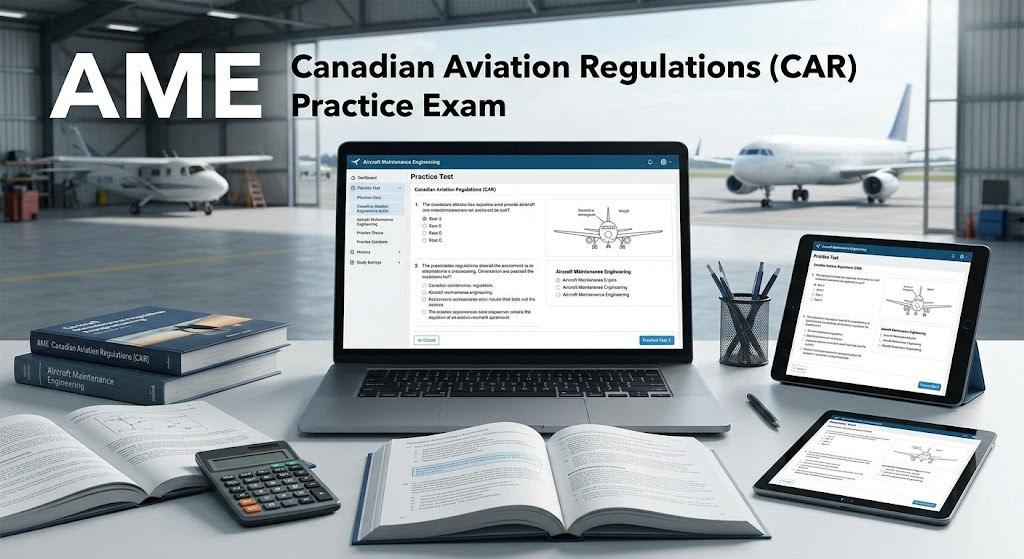
Additional Information
What the Course Entails and Exam Details
The foundation of this course is a thorough examination of the Transport Canada Canadian Aviation Regulations. Candidates will delve into the regulatory framework that dictates safety, licensing, and operational procedures for all civil aircraft in Canada.
The specific topics covered are extensive and critical, encompassing sections such as: Part I (General Provisions), Part III (Aerodromes and Airports), and focusing heavily on parts relevant to AMEs like Part IV (Personnel Licensing and Training), Part V (Airworthiness), and Part VI (General Operating and Flight Rules). Understanding the specific subparts, such as CAR 571 (Maintenance) and CAR 573 (Approved Maintenance Organizations), is central to the curriculum. This practice test goes beyond simple rote memorization, challenging candidates with scenario-based questions that require applying regulatory knowledge to real-world maintenance situations. The goal is to ensure a deep, practical understanding of how to find and interpret the regulations needed for daily operations.
What to Expect in the Final Exam
While a practice exam, it is crucial to understand the structure of the final, official Transport Canada examination. This exam is typically computer-based, administered in controlled environments.
It primarily consists of multiple-choice questions designed to test knowledge retrieval, interpretation, and application. There are dozens of questions, often numbered in the range of 30 to 60, and a substantial time limit is provided, usually around 2.5 to 3 hours, which must be carefully managed. The required passing score for regulatory exams is often 70%. It is not an open-book exam; candidates must rely on their preparation and understanding of the regulations. Security protocols are strict, and you will need valid identification. Understanding the format of the official exam allows you to use this practice test more effectively for preparation and to build stamina for the actual event.
How to Study and Exam Centers
Effective studying for the AME CAR exam requires a multi-faceted approach. Relying solely on practice tests is insufficient; you must master the source material.
Begin by downloading and studying the relevant parts of the Canadian Aviation Regulations directly from the Transport Canada website. Look for interpretive guidelines and Advisory Circulars (ACs), which provide crucial context and real-world examples. Utilize this practice exam repeatedly, not just to check your answers, but to understand why a particular section or subpart makes a given answer correct. Create flashcards for key regulations, definitions, and requirements. Form a study group with peers. Simulate exam conditions when taking this practice test to improve your speed and accuracy. Remember, the key to success is knowing how to navigate the regulations quickly and accurately to find the information you need.
To take the final, official examination, you must coordinate with Transport Canada. Exams are administered at Transport Canada Centers (TCCs) located across the country. Additionally, some specific accredited institutions, including certain aviation colleges, are authorized to conduct these exams on Transport Canada's behalf. You must usually apply and be approved to write the exam before you can book a time slot.
Job Opportunities from the Course
A licensed AME with a strong understanding of the CAR is uniquely positioned for a diverse and fulfilling career in Canadian aviation. A comprehensive grasp of the regulations, as validated by this exam, is not just a requirement but a key differentiator for advancement. Successful completion and licensure can lead to roles such as:
Aircraft Maintenance Engineer (E, M1, or M2 Category)
Approved Maintenance Organization (AMO) Manager
Quality Assurance Inspector (Aviation)
Director of Maintenance (DOM)
Technical Records Specialist
Maintenance Planner/Controller
Safety Management System (SMS) Coordinator
Aircraft Inspector (Regulatory/Compliance)
Civil Aviation Safety Inspector (with Transport Canada)
Avionics Technician/Specialist
Frequently Asked Questions
Reviews
5.0
Based on 0 reviews
Leave a Review
No reviews yet. Be the first to review!