
AMCA Phlebotomy Technician Certification (PTC) Practice Exam
$69.00
- Buy to unlock unlimited access to all Quiz questions.
- After purchase you can print a PDF of the whole quiz at any point. The PDF will contain the questions and the correct answers.
About this Exam
The American Medical Certification Association (AMCA) Phlebotomy Technician Certification (PTC) is a premier national credential designed to validate the essential skills and knowledge of individuals performing phlebotomy procedures. This certification is specifically for aspiring and current phlebotomists who have completed a formal training program or possess equivalent work experience. By earning the PTC credential, healthcare professionals demonstrate their mastery of safe blood collection techniques, specimen processing, and crucial patient care standards. The AMCA PTC sets a high bar, signaling to employers and patients a commitment to excellence, professionalism, and infection control within the vital field of laboratory science.
Ready to test your knowledge?
Buy Now to Access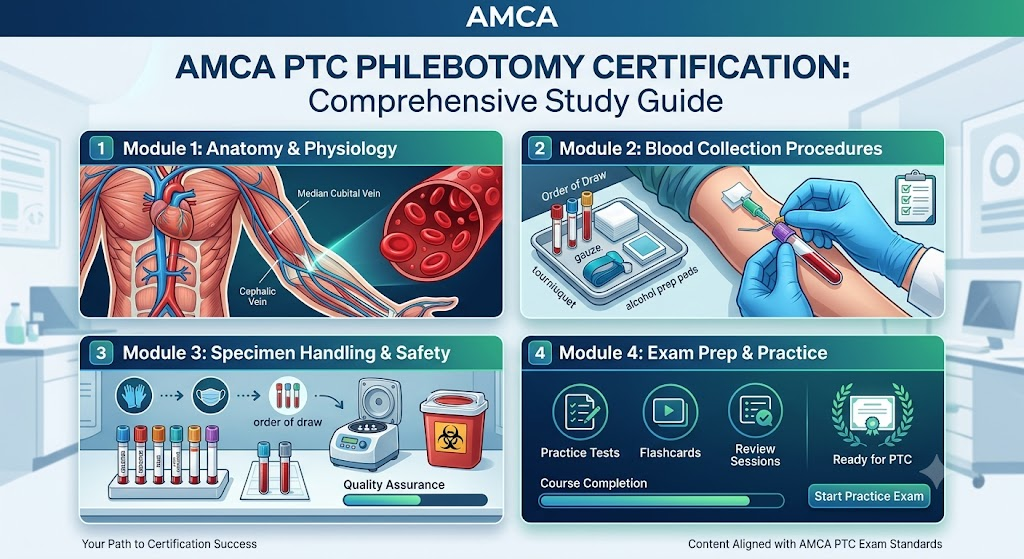
Additional Information
What the Course Entails and Exam Details
To prepare for the national certification exam, a comprehensive course or equivalent experience is necessary. The PTC exam is knowledge-based and meticulously covers a range of critical content areas, ensuring candidates are fully equipped for the diverse challenges of a phlebotomy role. The core knowledge domains tested on the exam include:
Professionalism and Regulatory Compliance: Understanding ethical standards, HIPAA regulations, scope of practice, and maintaining licensure.
Infection Control and Safety: Mastering OSHA guidelines, CDC standards, bloodborne pathogen safety, proper personal protective equipment (PPE) use, and hand hygiene.
Patient Identification and Assessment: Accurate patient identification procedures, patient interaction, site assessment, and managing special patient populations.
Equipment Selection and Maintenance: In-depth knowledge of different blood collection systems, tubes (and the order of draw), needles, and ensuring equipment integrity.
Collection of Blood Specimens: Expert proficiency in venipuncture techniques, capillary sticks, specialized collections (e.g., blood cultures, heel sticks), and handling collection complications.
Collection of Non-Blood Specimens: Proper procedures for collecting urine, semen, stool, and other body fluid samples.
Specimen Processing and Transportation: Guidelines for labeling, centrifuging, aliqoting, storing, and transporting specimens to ensure stability and accurate results.
What to Expect in the Final Exam
The AMCA PTC Final Exam is a rigorous, knowledge-focused assessment delivered in a secure environment. It is primarily a Computer-Based Test (CBT).
Exam Format: The knowledge component consists of approximately 100 multiple-choice questions. These questions evaluate critical thinking and application of principles across all the core domains.
Passing Score Requirements: Candidates must achieve a minimum passing score, typically calculated as a scaled score, to demonstrate the required level of competency to AMCA standards. AMCA’s scaled scores ensure consistent standards across different exam forms.
Time Limits: Candidates are typically allotted two hours (120 minutes) to complete the multiple-choice section.
Practical Component: The national certification knowledge exam is distinct from the practical skills assessment. While some training programs or states may require a practical exam for local licensure or completion, AMCA’s primary PTC credential is a knowledge-based exam. Candidates must usually provide evidence (often dynamic logs from their school or employer) that they have successfully performed a specific number of venipunctures (e.g., 30) and capillary sticks (e.g., 10) on live individuals to be eligible for the knowledge exam itself.
Exam Rules: Strict security measures apply. Candidates must provide valid, government-issued photo identification. Personal belongings, including electronic devices, notes, and watches, are typically prohibited in the testing room. Exams are monitored by a certified proctor, and security cameras are often in use.
How to Study and Exam Centers
Preparation is paramount for PTC success. Here are actionable study strategies and details on how and where to test.
Actionable Study Strategies:
Utilize multiple sources: Rely on your primary phlebotomy textbook, supplemented by official AMCA candidate handbooks and study materials if available.
Take multiple practice exams: Engaging with PTC Practice Exams is the most effective way to understand the question style, identify knowledge gaps, and practice time management. Focus on why correct answers are right and why distractors are wrong.
Focus on weak areas: After practice tests, dedicate extra time to the domains where your score was lowest (e.g., Infection Control or Order of Draw).
Review anatomy and terminology: Consistently review the anatomy of the circulatory system, vein selection, and key medical terminology and abbreviations relevant to phlebotomy.
Review procedural steps: For the knowledge exam, be able to mentally list, in order, the correct steps for a venipuncture, a capillary stick, and special collections.
Exam Centers:
The AMCA PTC knowledge exam is offered year-round at authorized external testing centers throughout the United States. Candidates typically register for the exam via the AMCA website and then schedule their testing appointment at a location convenient to them. Common test delivery networks utilized by AMCA and other major certifying bodies include specialized third-party test administrators and approved local vocational schools or authorized medical training academies. In some cases, educational institutions with authorized testing facilities can administer the exam to their own students. Always confirm the exact scheduling and location process through the official AMCA candidate portal upon registration.
Job Opportunities from the Course
Earning the AMCA PTC credential significantly boosts career prospects, validating competency to healthcare employers across various settings. A non-exhaustive list of job titles and career paths available after successful certification includes:
Phlebotomy Technician
Medical Laboratory Assistant
Donor Phlebotomist (Blood Banks)
Mobile Phlebotomist (Home Health or Mobile Units)
Clinical Laboratory Assistant
Healthcare Associate (Phlebotomy-focused)
Research Phlebotomist (Clinical Trials)
Lab Liaison Technician
Frequently Asked Questions
Reviews
5.0
Based on 0 reviews
Leave a Review
No reviews yet. Be the first to review!