
AMC 12 Math Practice Test 2012
$69.00
- Buy to unlock unlimited access to all Quiz questions.
- After purchase you can print a PDF of the whole quiz at any point. The PDF will contain the questions and the correct answers.
About this Exam
Welcome to your definitive guide to preparing for the AMC 12 Math Practice Exam 2012.
This prestigious American Mathematics Competition (AMC 12) is not a certification but a rigorous math examination designed for high school students with an exceptional passion and skill for mathematics.
The AMC 12 aims to foster problem-solving skills, critical thinking, and mathematical knowledge across various demanding topics.
It is particularly suitable for students in grades 12 and below, offering a significant challenge and a pathway to advance into further elite mathematical competitions.
Success in competitions like the AMC 12 is highly respected by top-tier universities and can open doors to numerous opportunities in STEM fields.
Ready to test your knowledge?
Buy Now to Access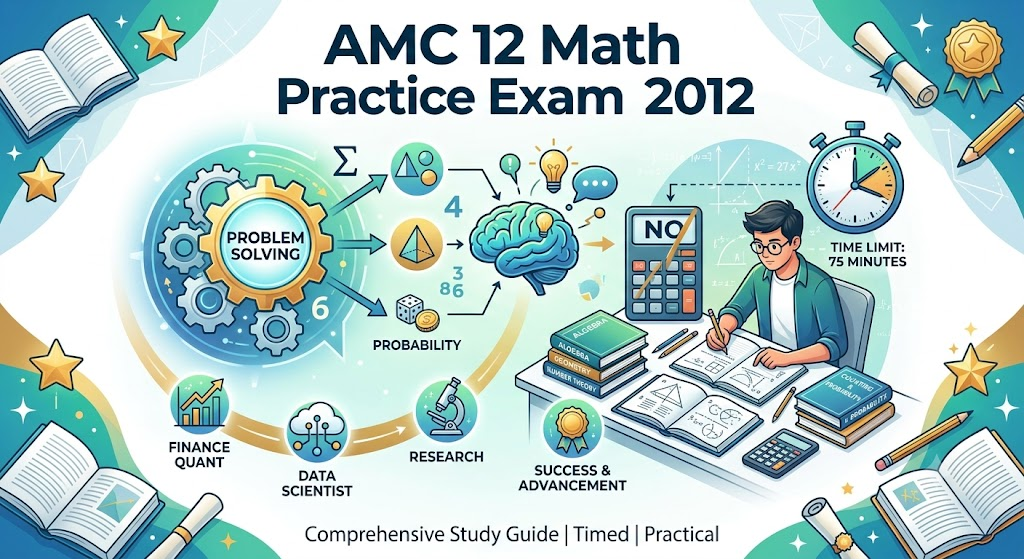
Additional Information
What the Course Entails and Exam Details
While not a conventional structured course, succeeding in the AMC 12 requires mastery of specific high school mathematics topics up to pre-calculus.
You can think of your preparation as engaging with a challenging curriculum that covers essential mathematical areas.
The core domains you must master include:
Algebra: Mastery of complex algebraic expressions, equations, inequalities, functions, and systems of equations is essential.
Geometry: In-depth understanding of Euclidean geometry, covering triangles, circles, polygons, three-dimensional geometry, and coordinate geometry, is tested.
Number Theory: You will face challenging problems involving properties of integers, prime factorization, divisibility rules, and modular arithmetic.
Counting and Probability: Questions often explore intricate arrangements, combinations, permutations, and fundamental probability concepts, demanding creative thinking.
Other Topics: Be prepared for questions that blend these areas, alongside complex numbers and logarithmic and trigonometric principles (though calculus is not included).
The content is designed to be highly demanding, often requiring the creative application of known mathematical concepts to novel problems. Your preparation involves extensive practice with these various topic areas, particularly using previous year exams like the 2012 edition.
What to Expect in the Final Exam
When sitting for the official AMC 12 exam, it's vital to know the rules, format, and scoring system so you can manage your time and strategy effectively.
The exam details are:
Format: The AMC 12 is a multiple-choice exam consisting of 25 questions. It is a competition, not a PASS/FAIL certification test.
Time Limit: You will have exactly 75 minutes to complete the exam, demanding speed, accuracy, and strong time management skills.
Calculators: No calculators are allowed during the AMC 12. This emphasizes mental math skills and fundamental mathematical understanding.
Scoring (based on 2012 rules & typical AMC format):
You will receive 6 points for each correct answer.
You will receive 1.5 points for each question left blank.
You will receive 0 points for each incorrect answer.
Note: While skipping questions did earn 1.5 points in 2012, this scoring can vary by year, so always check official rules for the specific competition year.
Total Points & Progression: The total possible score is 150. Your goal is not simply to "pass," but to achieve a score high enough to qualify for the next level, the American Invitational Mathematics Examination (AIME). The AIME qualification cutoff score varies each year depending on the overall performance of all participants.
This unique scoring system means that careful strategy, including when to answer or when to leave a question blank, is a crucial part of the test-taking process.
How to Study and Exam Centers
Preparation for the AMC 12, especially when targeting a strong score like one might have achieved in the 2012 competition, requires a dedicated and well-rounded approach. Actionable strategies include:
Practice, Practice, Practice: The absolute best way to prepare is by solving numerous problems from previous AMC 12 exams. Utilize past tests, specifically the 2012 exam, as your primary practice material to understand the problem style and difficulty level. Set aside time to work through entire tests under timed conditions to simulate the real exam experience.
Utilize Competition Math Resources: Beyond past exams, invest time in studying competition mathematics books and resources. Textbooks and online materials specifically tailored for competitions like the AMC series cover advanced topics and problem-solving techniques not always taught in standard high school math classes.
Join Online Forums and Math Clubs: Engaging with a community of fellow math enthusiasts can be incredibly motivating and helpful. Online forums, such as those on Art of Problem Solving (AoPS), are excellent places to discuss challenging problems, learn different solving approaches, and find practice partners. School math clubs can also offer valuable group study and proctoring support.
Focus on Fundamentals & Problem-Solving Strategies: While practicing specific problems is crucial, ensure you have a rock-solid foundation in all the core topics. Understand the why behind mathematical principles, not just the how. Develop various problem-solving strategies, such as working backwards, breaking problems into smaller parts, and checking edge cases.
Register through Authorized Centers: The AMC 12 is primarily administered within schools by contest managers or mathematical faculty who register their schools with the competition organizers. Students interested in participating must coordinate with their school's administration or math department to find out if the school registers for the AMC. Some institutions might also act as independent contest centers or authorized schools where students from other schools or homeschooled students can sometimes register to take the test. There are generally no public, online testing portals for the official proctored competition, though practice materials are widely available online. Students can check the official Mathematical Association of America (MAA) website for detailed registration information and potential independent test center locations if their school does not participate.
By combining extensive practice, strong fundamental knowledge, and effective time management, you can maximize your chances of success in the AMC 12.
Job Opportunities from the Course
While the AMC 12 itself is not a professional certification that directly unlocks specific jobs, excellent performance, followed by success in higher-level mathematical competitions, is incredibly valuable. It demonstrates exceptional analytical and problem-solving skills, critical thinking, and mathematical talent, all of which are highly sought after in many prestigious careers.
High achievement in the AMC 12 can indirectly pave the way to future job opportunities in fields that demand high quantitative and analytical skills. Here is a list of career paths where a strong mathematical background and problem-solving abilities, honed by competitions like the AMC, can provide a significant advantage:
Quantitative Analyst (Finance): Use complex mathematical and statistical models for pricing and trading assets in the financial industry.
Data Scientist (Tech, Various Industries): Analyze and interpret large datasets to inform business decisions and build predictive models, using mathematical algorithms.
Mathematics Researcher (Academia/Private Sector): Conduct fundamental or applied research in various fields of mathematics, either within universities or dedicated research institutions.
Actuary (Insurance, Finance): Assess and manage risk within the insurance and finance sectors using mathematical and statistical methods.
Software Engineer (Algorithms and Optimization): Design, develop, and optimize software systems, with a particular focus on complex algorithms where strong logical and mathematical thinking is essential.
Financial Analyst: Analyze financial data, build mathematical models for forecasting, and make recommendations based on quantitative analysis.
Cryptographer/Cybersecurity Analyst: Use advanced mathematical concepts, particularly in number theory and algebraic structures, to develop and analyze secure encryption systems.
Research & Development Engineer: Apply mathematical and scientific principles to research, design, and develop new products and processes in engineering fields.
STEM Educator: Inspire future generations by teaching mathematics at high school or university levels, where a deep mathematical understanding is crucial.
Keep in mind that while performing well in the AMC 12 is not a direct requirement for these jobs, it serves as a strong indicator of the intellectual curiosity and analytical prowess that these careers demand and value significantly. Success in mathematical competitions is an excellent way to distinguish yourself and showcase your potential for excellence in these challenging fields.
We wish you the very best of luck in your preparation and your attempt at the AMC 12 Math Practice Exam 2012 or any other upcoming mathematical competition! Keep practicing, keep thinking, and keep striving for mathematical excellence.
Frequently Asked Questions
Reviews
5.0
Based on 0 reviews
Leave a Review
No reviews yet. Be the first to review!