
Ambulance Driver Certification Practice Test
$69.00
- Buy to unlock unlimited access to all Quiz questions.
- After purchase you can print a PDF of the whole quiz at any point. The PDF will contain the questions and the correct answers.
About this Exam
The Ambulance Driver Certification is a vital credential for individuals aspiring to operate emergency medical vehicles safely and effectively. This certification process is designed to ensure that drivers possess the specific knowledge and skills required for the demanding nature of ambulance operations, which often involve high-stress situations and the transport of patients in critical condition. It is typically required for Emergency Medical Technicians (EMTs), paramedics, firefighters, and other first responders who will be behind the wheel, ensuring they are prepared for the unique challenges of emergency driving.
Ready to test your knowledge?
Buy Now to Access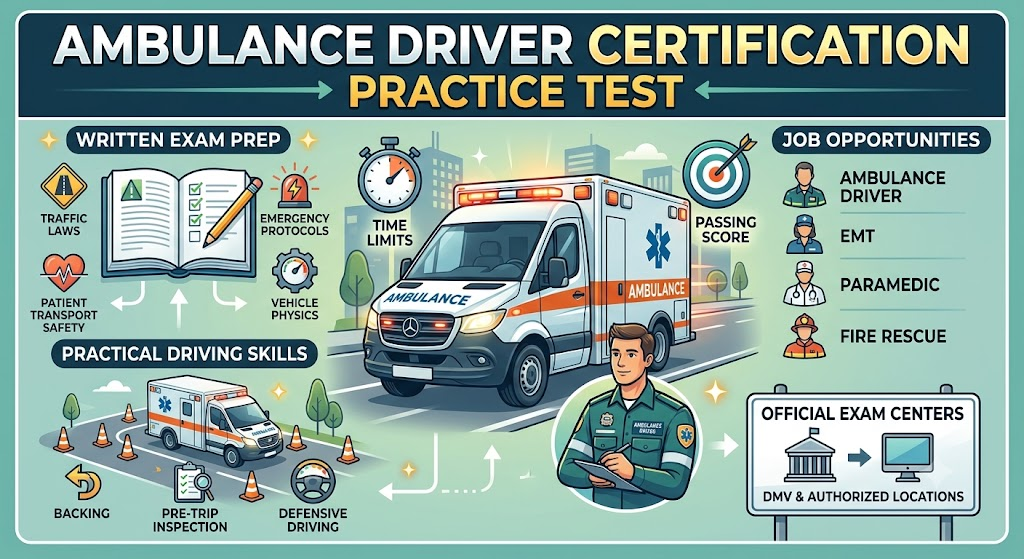
Additional Information
What the Course Entails and Exam Details
This comprehensive certification course and the subsequent examination cover essential topics and practical skills across multiple domains. Candidates will delve into the physics of emergency vehicle operations, including weight distribution, braking distances, and handling characteristics under different conditions. The course also emphasizes understanding relevant state and federal traffic laws, emergency vehicle privileges, navigation, and route planning. A significant focus is placed on safe patient transport protocols, defensive driving techniques, and the proper use of warning lights and sirens to clear traffic without causing collisions.
The practical component of the training and final examination involves proving competence in a real vehicle through various driving skills. This typically includes a pre-trip vehicle inspection, proper backing maneuvers, parallel parking, maneuvering in tight spaces, and demonstrating control in simulated traffic scenarios.
What to Expect in the Final Exam
The final step in achieving the Ambulance Driver Certification generally consists of two distinct parts: a written knowledge test and a practical driving skills test. The written examination is usually composed of multiple-choice questions administered at a physical testing location or occasionally through secure online portals. Candidates are tested on the rules of the road, emergency operating procedures, vehicle maintenance, and safe driving practices. A common number of questions range from 30 to 50, with a time limit (often around 60 to 90 minutes) and a mandatory passing score, typically 80% or higher.
The practical driving test requires the applicant to operate an ambulance under the supervision of an evaluator. This component assesses the candidate's ability to safely handle the vehicle, follow traffic regulations, use emergency equipment appropriately, and execute standard driving maneuvers. Both the written and practical tests must be successfully completed to obtain the final certification.
How to Study and Exam Centers
Preparation is key to succeeding on both portions of the Ambulance Driver Certification exam. Actionable study strategies include thoroughly reviewing the official ambulance driver's handbook or training manual provided by your state or organization. Consider enrolling in a classroom-based or online defensive driving and emergency vehicle operations course, which provides valuable theoretical knowledge and sometimes hands-on practice. One of the most effective methods to prepare for the written exam is by repeatedly taking online Ambulance Driver Certification Practice Tests. These simulate the actual testing format and help identify areas that need more focus.
For the practical test, seek supervised driving practice with an experienced ambulance operator. Focus on mastering smooth braking, accelerating, turning, and precise maneuvering, as well as the complete pre-trip inspection checklist.
The examination centers for both the written and practical components are typically state-administered locations, such as a Department of Motor Vehicles (DMV), Department of Public Safety (DPS), or state-authorized emergency medical services (EMS) training academies. Check with your local state agency for the precise locations and scheduling processes, which often require an appointment.
Job Opportunities from the Course
Obtaining an Ambulance Driver Certification unlocks specific career paths in emergency services and patient transport. Key job titles and career opportunities include:
Ambulance Driver
Emergency Medical Technician (EMT)
Paramedic
Firefighter/EMT or Firefighter/Paramedic
Event Medical Staff Driver
Non-Emergency Medical Transport (NEMT) Driver
Hospital-Based Critical Care Transport Driver
Frequently Asked Questions
Reviews
5.0
Based on 0 reviews
Leave a Review
No reviews yet. Be the first to review!