
Alterations of Neurological Functions Practice Test
$69.00
- Buy to unlock unlimited access to all Quiz questions.
- After purchase you can print a PDF of the whole quiz at any point. The PDF will contain the questions and the correct answers.
About this Exam
Welcome to your essential study guide for the Alterations of Neurological Functions Practice Test. This comprehensive resource is designed specifically for healthcare students and professionals—including nursing students (RN, LPN/LVN), nurse practitioners, physician assistants, and medical students—who are preparing for examinations that cover complex neurological pathophysiology and patient care. Mastering this material is crucial for accurately diagnosing, managing, and treating a wide spectrum of neurological disorders. This practice test serves as a critical tool to assess your knowledge, identify critical gaps, and build the confidence necessary to excel in your academic course or professional certification exam. It focuses on the applied pathophysiology, clinical manifestations, diagnostic pathways, and therapeutic interventions for various alterations in neurological function.
Ready to test your knowledge?
Buy Now to Access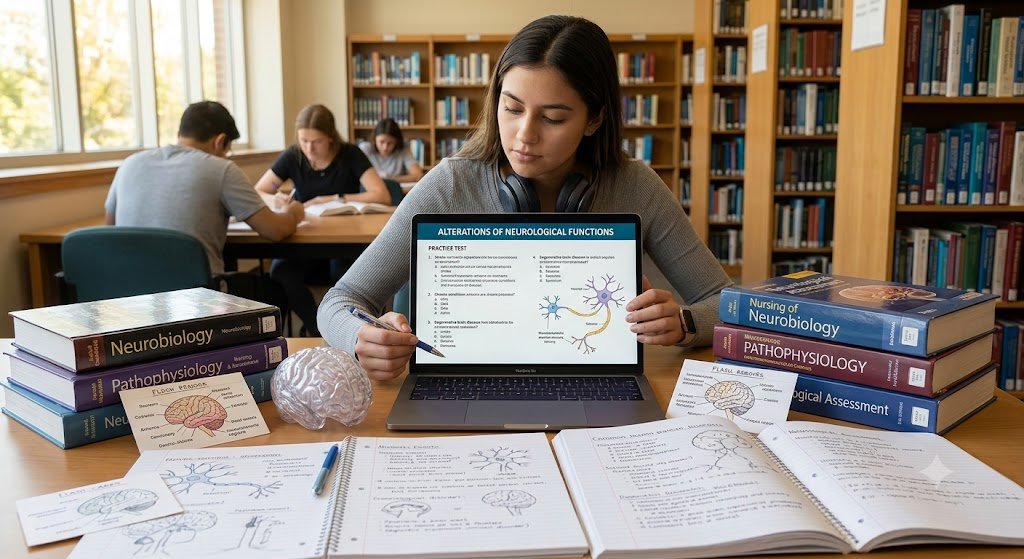
Additional Information
What the Course Entails and Exam Details
This examination is typically part of a larger curriculum in Advanced Pathophysiology, Medical-Surgical Nursing, or specific Neurology specialization modules. The core syllabus and skills covered within this practice test include a detailed examination of:
Neuroanatomy and Physiology Review: A foundational understanding of the central nervous system (CNS) and peripheral nervous system (PNS), including cellular structure, neurotransmission, brain regions, spinal cord tracts, and cranial nerves.
A cerebrovascular Accident (CVA/Stroke): Differentiating between ischemic and hemorrhagic strokes, understanding TIA, risk factors, clinical manifestations (FAST assessment), acute management, and long-term rehabilitation.
Traumatic Brain Injury (TBI): Classifications (concussion, contusion, diffuse axonal injury), pathophysiology of primary vs. secondary injury, and management of increased intracranial pressure (ICP).
Seizure Disorders and Epilepsy: Types of seizures (focal, generalized, status epilepticus), diagnostic criteria, pathophysiology, and pharmacological management.
Neurodegenerative Diseases: In-depth knowledge of Alzheimer’s disease, Parkinson’s disease, Huntington’s disease, and Amyotrophic Lateral Surgery (ALS).
Neuromuscular Disorders: Pathophysiology and management of Multiple Sclerosis (MS), Myasthenia Gravis, and Guillain-Barré Syndrome.
Infectious and Inflammatory Processes: Diagnosing and treating Meningitis, Encephalitis, and Brain Abscesses.
Spinal Cord Alterations: Understanding spinal cord injury classifications (complete vs. incomplete), neurogenic shock, and autonomic dysreflexia.
What to Expect in the Final Exam
While the exact format can vary by institution or certifying body, examinations covering alterations of neurological functions are famously rigorous and demand high-level critical thinking and clinical correlation. You can typically expect the following:
Exam Format: The predominant format is Multiple Choice Questions (MCQs), but many exams include complex scenario-based items (case studies), "select all that apply" questions, and matching or ordering sequences (e.g., ordering the steps of an assessment or prioritizing interventions).
Question Style: The questions focus less on simple recall and heavily on application and analysis. You will be expected to synthesize clinical data, interpret diagnostic tests (like CT/MRI results or CSF analysis), and determine the priority nursing or medical intervention for a given scenario.
Passing Score Requirements: Academic passing standards generally range from 70% to 80%, depending on the specific program (e.g., graduate nursing programs often have higher standards).
Time Limits: These exams are usually strictly timed, demanding that you manage your time effectively, often allocating roughly one minute per question or slightly more for complex case scenarios.
How to Study and Exam Centers
Preparation is paramount for success on this challenging topic. Adopt these proven strategies to optimize your study:
Utilize Active Recall and Spaced Repetition: Do not passively reread textbooks. Use digital flashcard systems (like Anki) or physical flashcards to master terminology, pathophysiology processes, and drug classes.
Engage with High-Quality Practice Questions: This practice test is your most vital tool. Analyze not just why the correct answer is right, but why every other option is incorrect. This builds critical reasoning skills essential for medical and nursing exams.
Master Pathophysiology Flowcharts: Create or study flowcharts that illustrate the sequence of events in conditions like increased ICP, stroke, or neurogenic shock. Visualizing the 'why' helps you retain the clinical 'what'.
Focus on Clinical Correlation: Always ask, "How will this pathology present in the patient?" and "What is my priority action as a clinician?" Link laboratory and diagnostic findings to the corresponding disease processes.
Simulate Exam Conditions: Take practice tests under timed conditions in a quiet environment to build your stamina and reduce anxiety.
Exam Centers and Administration:
This practice test is an educational resource generally accessible online through a learning management system or specialized test-preparation portal. For your official course exam or certification, you will typically take it:
At Your Educational Institution: Within a proctored classroom setting or testing center at your college or university.
Through a National Testing Service: Official certifications (like the CNRN, SCRN, or NCLEX) are taken at secure professional testing centers, such as Pearson VUE, which have locations globally.
Via Remote Proctoring: Many institutions now offer secure online exams that require a webcam and locked-down browser technology.
Job Opportunities from the Course
Mastering alterations in neurological functions is not just about passing an exam; it is a critical skill set that unlocks and enhances numerous specialized career paths within healthcare. Proficiency in this area is required for many roles, including:
Registered Nurse (RN) - Medical/Surgical Unit
Registered Nurse (RN) - Intensive Care Unit (ICU)
Neurocritical Care Nurse
Registered Nurse (RN) - Stroke Unit (SCRN Certification)
Certified Neuroscience Registered Nurse (CNRN)
Nurse Practitioner (NP) - Adult-Gerontology Acute Care
Nurse Practitioner (NP) - Neurology Specialization
Physician Assistant (PA) - Neurosurgery or Neurology
Clinical Nurse Specialist (CNS) in Neuroscience
Neurological Rehabilitation Specialist (OT, PT, or Speech)
Medical Doctor (MD/DO) - Neurology or Neurosurgery Residency Pathway
Health Professions Educator/Professor
Frequently Asked Questions
Reviews
5.0
Based on 0 reviews
Leave a Review
No reviews yet. Be the first to review!